
UVic’s community garden has been growing in the same place for close to 15 years. But as an agreement with the university for use of the space comes to an end, garden supporters fear that so will their efforts.
A Memorandum of Understanding between the UVic Campus Community Garden and the university will finish in October 2011.The “understanding” is that, at that time, the garden will be evicted to make room for new developments.
“We’re trying to make ourselves relevant to the university, monetarily and academically,” said Ada Saab, site coordinator for the Campus Community Garden.
Even after 15 years, the garden is not seen as a cultivated space which fulfills a purpose, she said. Instead, the university still views it as free space, available for development. And the garden’s university support has diminished since they were first established in 1996, “back when sustainability was the new black,” she said.
Last year, the university put aside a large budget for infrastructure and maintenance. But Saab said most of that budget was spoken for — several buildings around campus are undergoing a retrofit and receiving seismic upgrades — and the garden received little to no money for their operations.
There also isn’t much free space on campus for new developments, she said, because the university wants to maintain the compact layout surrounding Ring Road
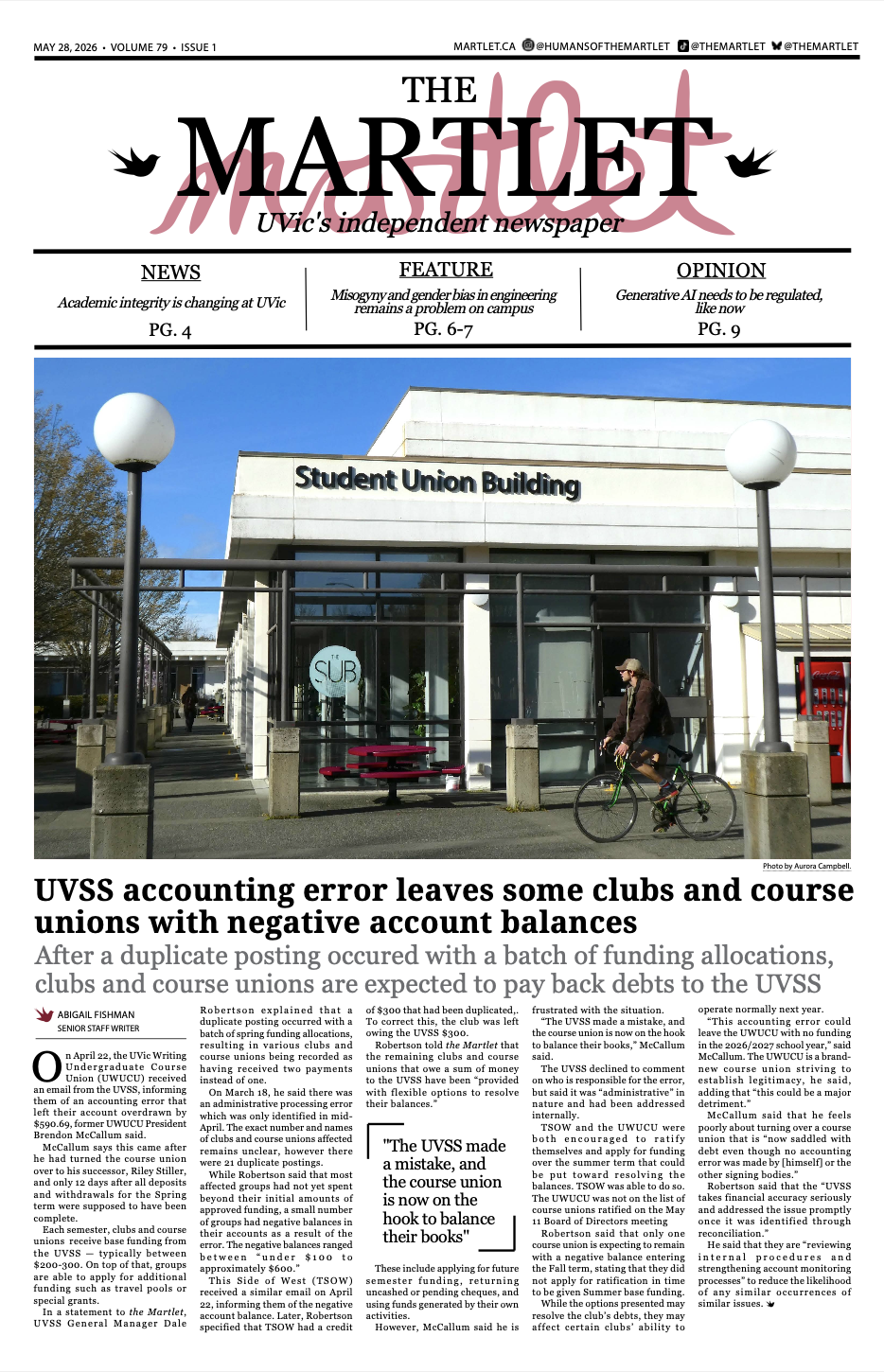
The garden is currently located along McKenzie Avenue, behind the Student Union Building (SUB) and between the Enterprise Data Centre and Technology Enterprise Facility.
When their current agreement with the university goes up, all isn’t lost for the garden. A new spot will be decided at the upcoming spring Campus Plan Committee meeting.
Neil Connelly, UVic’s director of Campus Planning & Sustainability, will be present at the meeting to offer a proposal that would include the garden in the development plan for the field behind Mystic Vale, or an alternative triangular area of land by the rugby fields.
Of these offers, the campus community garden people prefer the triangular area, because it’s much closer to their current location.
But moving would be costly no matter where they go, said Saab.
No water lines are in place on either of the proposed moving sites, meaning that new irrigation systems would have to be installed.
She said the gardens would also lose all their present facilities management support. Finally, Saab emphasized that not only would money need to be spent on new facilities, but all the resources, time, and effort put into the current site over the years would be lost.
“The money is in the soil,” she said. “You can’t just move that.”
The memorandum the university issued in 2006 notified the group of the 2010 change.
Saab says that a month-to-month lease would be impractical for the garden, and that a long-term period of occupancy would need to be established.
“You need to invest in at least an entire season, [but] a five-year period would be ideal,” she said.
When theuniversity and the garden talked in 2006, it was made clear the garden’s land was being considered for development, Connelly said.
“There was a bit of a plan already put in place when the Technology Enterprise Facility went in,” he said, adding that those running the garden were given certainty that after five years, they would have to move so that new projects could get underway.
Saab expressed concern that there is no mention of the garden in the current UVic Campus Plan. She is urging students and faculty to write letters of support in hopes that it will become a higher priority at the next university planning meeting.
The Campus Community Garden’s Annual General Meeting happens at 4:30 on Mar. 15, in the Student Union Building, room B025.
Cost of gardening
Ada Saab, garden site coordinator, says she couldn’t possibly put a number on how much money has been invested in the garden over time. But here are some numbers on the resources which went in. Individual batch numbers are how much Saab herself is investing in her plot this year.
ORGANIC MANURE: $50
SEEDS FROM WEST COAST SEEDS: $60
PLOT RENTAL: $30. The money is reinvested in supplies for the garden. Amenities
Saab says these things make the garden’s current location perfect.
FACILITIES MANAGMENT: the facilities management people are a big help, providing soil and leaves for fall bedding, and taking away refuse.
STREET LIGHTS: Enable gardeners who only have time in the e vening to keep a garden going.
PARKING: Allows gardeners to haul tools and supplies to the site.
PROXIMITY: The garden is very close to family housing, where many of its renters come from.
“The ability to walk to the garden has been extremely valuable to many of our renters — especially those with small children and strollers,” Saab said.


The garden has been my inspiration to focus my PhD studies on food security. What would really help in support of the garden would be increased student engagement with the garden academically. It is a living laboratory. The university support has been wonderful and we look forward to many years of growing food on campus.
The Martlet also reserves the right to use comments in the newspaper.