
The group aims to present a united front in Senate on a number of shared goals
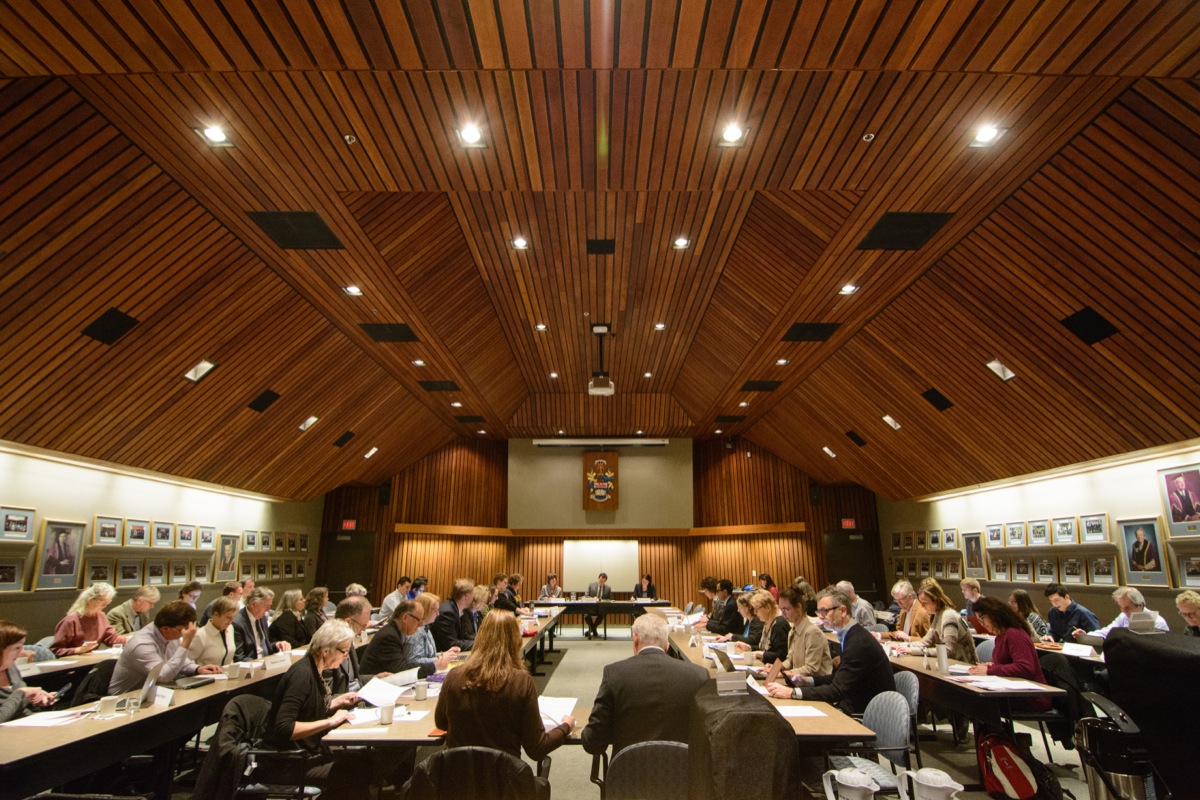
Photo by Hugo Wong.
Senate
The election results from this year’s Senate and Board of Governors races, which ran from Feb. 17-19, saw 10 members of the Student Leadership Alliance (SLA) — an alliance of student senators — get elected or acclaimed to the Senate.
In a statement to the Martlet, Evan Maher, a returning UVic senator, said ”I am very happy with the 10 seats secured by SLA-affiliated members and I am looking forward to the new year. This result provides a clear mandate to move forward on our core platform of academic transparency and student-driven policy.”
Maher has been pushing for changes to CAL accommodations, which he says are under attack, UVic’s at-risk behaviour policy (SS9125), and improvements to UVic Food Services.
“My experience on the Senate over the last two years has been eye-opening. I have personally experienced administrators obstructing proposals and motions I’ve brought forward.… Other than Mike Caryk and myself, I’ve only really seen three other student senators attend in person, and they rarely engage with the material or ask questions. We realized that as long as we were fragmented, the administration had the ability to push us around,” Maher said.
According to Maher, the SLA was formed to unify the senators. Maher said he has different political alignments than some of the alliance’s other members, but that they all agreed on a shared “Framework and Principles” document.
“We agreed that academic transparency, student safety, and the university’s ‘duty of care’ must come first,” he said.
“I want to emphasize that while we are a unified bloc, we are not an exclusive one. Each student is still fully welcome to vote and speak freely.”
Maher told the Martlet he is happy to work with the non-SLA affiliated senators on shared goals.
Nine candidates were acclaimed to the senate — a process that happens when the number of candidates is equal or less than the number of vacancies — including Maher, Jonah Arnold, Michael Caryk, Norman Kaminski, Ben Knight, Pascalle Sabine Ricard, Lily Luz Yeo, Mahmoud Chick Zaouali, and Kevin Zhang.
Some of these senators serve in elected positions in the UVic community already. Arnold is currently serving as the interim director of finance and operations for the UVSS, Caryk is serving as the interim director of campaigns and community relations, while Yeo is currently serving as a Director-at-Large (DaL).
The candidates that were elected to senate positions include Taylor McManus, Cohen Cheetham, Hannah DiGiuseppe, Bailey Moriarity, Tam Aljundi, and Felipe Semedo.
The 10 SLA- affiliated senators elected, according to Maher’s post, are Kaminski, Caryk, Maher, Knight, Ricard, Zaouali, Yeo, Arnold, Cheetham, and Semedo.
Senate elections are held in a way that ensures a diversity of faculty representation, ensuring at least one student from each faculty and three from the Faculty of Graduate Studies are elected. UVic says this “can mean the highest number of votes does not always translate to an elected position.”
After the nine candidates were acclaimed, four students were elected from the Faculty of Social Sciences and two from the Faculty of Science.
Griffin Foster — who served most of this year as the UVSS director of outreach and university relations, before formally resigning on Feb. 2 — was not elected to Senate, nor Artem Kuklev, who ran against Foster for the UVSS board in 2025, and who currently serves on Senate. Both Foster and Kuklev come from the Faculty of Social Sciences. Foster and Kuklev received 374 and 357 votes respectively.
In a statement to the Martlet, Foster said that he was disappointed he was not elected to Senate, but he plans to continue supporting the SLA.
“I am proud of the team that I have supported and intend to continue supporting,” he said. “I have every confidence that we will make meaningful strides in student representations, and that the elected senators will represent the students of UVic with devotion, integrity, and a spirit of collaboration.”
The Senate elections received 1 437 votes, out of 21 021 eligible voters, a turnout of 6.8 per cent. There were 103 abstain ballots.
Since only two nominations were received for students from the Faculty of Graduate Studies, there is a vacant seat. A second call for a graduate student senator was issued, and will close on Feb. 25.
Board of Governors
Gilbert Imoesi won the undergraduate representative position on the Board of Governors with 32.8 per cent of the vote. Maher came second, with 21.2 per cent. Sebastian Preston came third (18.7 per cent), McManus fourth (18 per cent), and Aljundi last (9.3 per cent).
There were 1 228 voters of an eligible 18 131. The voting percentage was also 6.8 per cent.
“I was a little disappointed in the board race, but [Imoesi] has said that he is interested in working with us. With [Ricard] also on the board, we hope to bring greater changes to food services, parking, and the at-risk behavior policy,” Maher told the Martlet.
Ricard won the graduate representative position, which saw a 7.2 per cent turnout — 209 votes out of an eligible 2 892 — with 57.9 per cent of the vote. Linnea Leist received 42.1 per cent of the vote.