
Heat waves are causing accessibility and workplace safety concerns in the Department of Biochemistry and Microbiology
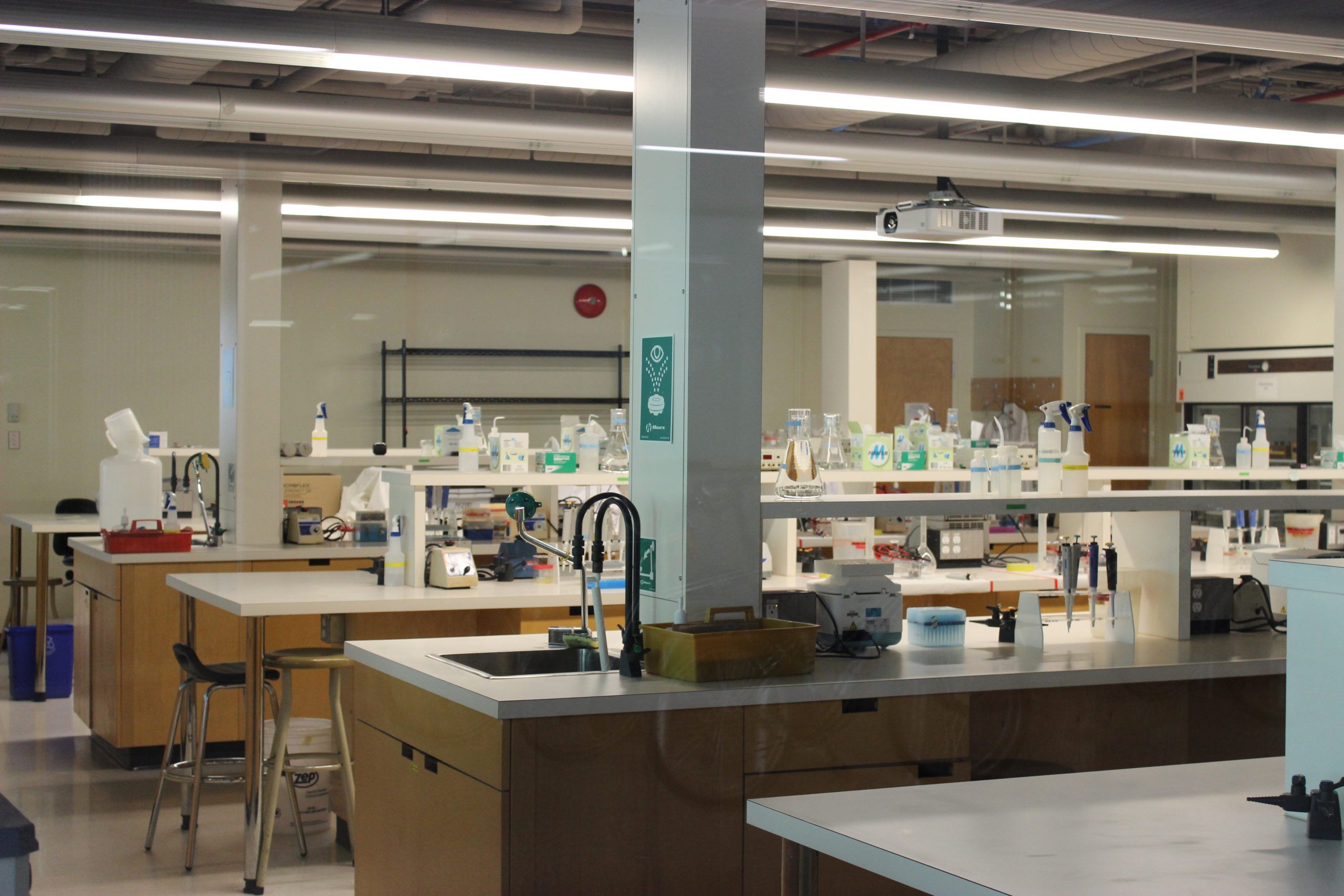
Photo by Ethan Barkley.
Summers are getting hotter. The Petch building isn’t air conditioned, and my cells are dying.
I’m a third-year PhD student in the Department of Biochemistry and Microbiology, and I use specialized insect cell cultures to express the proteins that I study. These cell cultures grow at 27°C; if temperatures rise above this threshold, my cells get sick and die, throwing me into stasis for several weeks while I order a new cell stock, wait for it to arrive, and coax it back into health.
The room where I grow my cells has no air conditioning, so during heat waves — which are happening more and more frequently in Victoria, and across the country — I resort to increasingly desperate measures to try to keep these cells, and by extension, my doctoral research alive.
Every year, the grad students and technicians in my lab suffer through a period of at least four weeks where the ambient indoor temperature makes it almost impossible for us to conduct research. My supervisor, Dr. John Burke — professor of biochemistry and microbiology at UVic — has been a principal investigator in the department for almost 12 years, and emphasized that “comparative universities throughout Canada are almost all climate-controlled.”
“To run a professional research environment requires a degree of climate control to actually carry out repeatable scientific experiments,” he said.
The installation of air conditioning throughout the Petch building would significantly improve our department’s capacity for scientific output. Summertime temperatures in the building have been causing problems for years, and the issue remains unresolved, despite the fact that conditions in Petch regularly exceed those stipulated in the University of Victoria’s Integrated Energy Master Plan, which states that “laboratory spaces shall be maintained at room temperature (23°C–25°C).”
When the Integrated Energy Master Plan was developed in 2011, passive cooling could maintain Petch within this temperature range. However, we have entered an era in which this is no longer possible without air conditioning. As temperatures continue to rise each year, this issue has escalated from failed experiments and wasted funds to a direct threat to workplace safety and accessibility.
Rachel Witt, a master’s student in the Microbiology program at UVic, described to me how the summer heat makes working in their lab almost unbearable. Due to a confluence of factors, including the wall of south-facing windows, equipment that throws off a substantial amount of heat, and hot water baths that continuously generate humidity, they’ve measured ambient temperatures in their lab over 32°C.
According to Witt, “that is a recipe for disaster in the summer. Especially [because] we are a containment level two lab, which means we have to be wearing a lot of PPE to do our work, including full length pants, [a] lab coat, and gloves, and all of that together makes for a really hot and kind of exhausting situation.”
Witt’s testimony underscores the extent of the problem — the heat in Petch is so extreme that the use of legally-mandated personal protective equipment (PPE) is impeding our ability to maintain safe working conditions. Canadian Occupational Health and Safety resources that calculate heat exposure risks for workers add the equivalent of 3°C to the ambient temperature when wearing lab-appropriate PPE. This means that, when they observed temperatures in their lab of 32°C, Witt was functionally working indoors at 35°C. The tools implemented to keep workers safe are now increasing their risk of heat stress exposure and heat-related illness.
In the case of Microbiology master’s student Veerle, these concerns extend beyond physical discomfort. “I have [an] autonomic nervous system disorder that causes me to have heat intolerance, so I get very close to passing out a lot when I am exposed to extreme heat,” Veerle told me. Like Rachel, Veerle works in a containment level two lab, meaning that it’s prohibited to open windows and doors to cool her workspace down.
To protect workers from heat stress, WorkSafeBC recommends rescheduling working hours to avoid the hottest part of the day, but even this strategy has reached the point of failure in Petch. Veerle said that, earlier in the week, she had been working alone in the lab in the evening to try to dodge the heat, but found that even at 10:00 p.m., it was so hot that she needed to lie down on the ground for a moment to prevent a fainting spell.
These workplace safety concerns are echoed by Burke. “I think it’s just important to emphasize the health and safety implications of having people working in over 30°C weather, and in protective equipment that’s required for biomedical research,” he said. “It would be almost impossible for anyone to do this type of research in the conditions that we’re doing [it in] without addressing this issue.”
Unbearable summer heat is not restricted to Petch’s second-floor research labs — the heat is also wreaking havoc in the undergraduate teaching labs on the main floor. Valerie Kerr, who has been a lab instructor with the department for 29 years, told me that she has observed the heat getting worse every year, particularly since 2018.
Valerie and other lab instructors keep dozens of ice packs for students to stuff into the pockets of their lab coats, but this isn’t always sufficient to prevent students from overheating.
“I have had a couple of students who have felt faint, and I usually let them leave for whatever time frame they need to cool down. And so far, that has been working,” Valerie said. “I do sometimes worry that we’re going to get a student who just can’t complete the lab.”
A statement issued by a UVic spokesperson recognizes that older buildings on campus are challenging to manage in extreme summer heat. “Buildings constructed prior to 2010 were not designed with cooling systems; adapting these buildings to be more climate resilient will require a significant capital investment.” While a handful of rooms in Petch have air conditioning to maintain temperature conditions for specific instrumentation, the statement acknowledges that the spaces without cooling systems can be uncomfortable during hot summer days. Additionally, the statement includes recommendations to manage the heat that simply aren’t feasible in a research lab; we can’t “wear lightweight and breathable clothing” when lab coats are required by law.
According to UVic, a campus-wide cooling and heating strategy for all buildings is in the works, which will prioritize investments in infrastructure retrofits with sustainable technology such as heat pumps, but no concrete plans or specific timelines for Petch were communicated in the statement.
The summer heat in Petch has reached a tipping point. High temperatures within our laboratories skew the results of scientific tests and analyses, affecting the replicability of experiments. The lack of environmental controls restricts our ability to properly maintain equipment and delicate instruments, which often have hard upper-limits operating temperatures. Unbearable working conditions limit who can participate in research, making it less accessible for those at a higher risk of heat-related health complications.
It adds an unnecessary burden to work that is already arduous — there are few experiments that don’t involve hours of preparation, implementation, tailoring, and clean-up. As a cherry on top, every failed experiment, prematurely-replaced piece of equipment, and heat-exhausted lab technician represents unnecessary spending of publicly funded grants.
Maintaining our integrity as an institution requires us to be realistic about the environmental factors impacting our work. Additionally, the university has a responsibility to prioritize the well-being of staff and students. The climate is changing, and UVic needs to adapt in order to maintain its reputation as a world-class leader in scientific research. Air conditioning in Petch isn’t just overdue. It’s essential.