
The university is preparing to introduce new doctorate programs aimed at working professionals in different industries
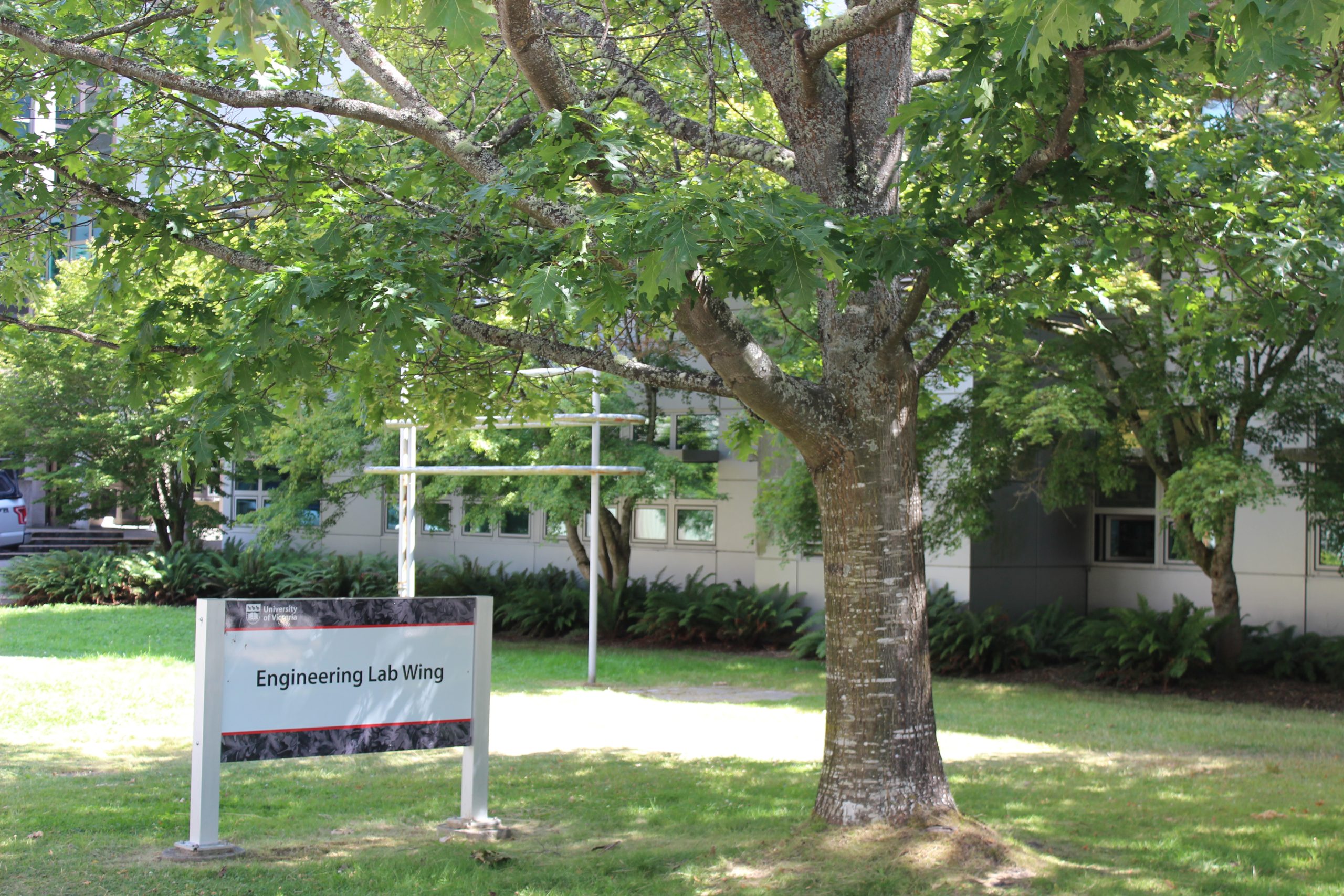
Photo by Ethan Barkley.
UVic is launching a new doctoral program aimed at working professionals in the engineering industry — the first of its kind in Canada.
The Doctor of Engineering (DEng), proposed by Dr. Mina Hoorfar, Dean of Engineering and Computer Science (ECS), was approved by the UVic Senate in November 2024, before being approved by the BC Ministry of Education. ECS aims to launch the DEng in September 2026.
“We were initially thinking we could do it earlier, but we also want to do it really right,” said Dr. Jens Weber, Associate Dean Professional Programs & Development, in an interview with the Martlet.
Programs like the DEng are geared towards professionals who have experience in their given field. While UVic does offer other PhD programs in engineering, there are some key differences, primarily in the program’s audience.
“The Doctor of Engineering program is a program that explicitly acknowledges that we’re training for a continued career in industry and professional practice,” said Weber. “We are setting these students up with the kind of courses that really are geared towards impactful innovation in the industrial world.”
“We’re not accepting students that are fresh out of a [master’s degree],” he added. “We’re actually requiring students to have seniority in the industry, which in this case is at least seven years.”
Weber anticipates the program will have a smaller cohort of around 10 to 15 students, and take approximately three years to complete. Students will undertake a kind of dissertation, known as a praxis, that is more flexible, and could include a patent, or computer software.
Although it was eventually approved, some senators expressed concerns about the DEng at the November 2024 Senate meeting. According to the meeting notes, one senator raised an issue that the “creation of a professional doctorate seemed to reduce the academic standards of the university.” Another senator raised the concern that an external industry partner could exercise undue influence on the direction of the student’s research.
However, several others supported the initiative, saying that it “would promote growth in the health and engineering sector as well as address the need for more hands-on, real-world experience.”
Although the DEng is the first of its kind in the country, professional doctorate programs are not new in Canada. Common degrees of this kind include the Doctor of Medicine (MD), Juris Doctor (JD), and Doctor of Education (EdD). Further, UVic currently has several professional programs at the masters level, including Business Administration (MBA), Education (MEd), Engineering (MEng), and Public Administration (MPA).
In an interview with the Martlet, Dr. Robin Hicks, Dean of Graduate Studies, emphasized the benefits of these professional programs.
“A professional doctorate is probably best thought of as equivalent to a PhD, but distinct,” he said. “One is not superior to the other — they offer different things and target different audiences in terms of students coming into the program. There are generally different job prospects as outcomes for students who graduate from a PhD versus a [professional] doctorate.”
During the same meeting where the DEng was approved by the Senate, the Dean of Business at the time, Dr. Anita Bhappu, said that the Gustavson School of Business is considering a Doctor of Business Administration, another professional doctoral program.
“The proposed Doctor of Business Administration (DBA) program would complement our existing PhD in Management and Organization,” a spokesperson from Gustavson said in a written statement to the Martlet. “Each contributes something different to the university community, businesses and society at large and they each meet a different student need.”
According to the statement, DBA candidates in other programs are often full-time professionals, and their dissertations aim to “bridge the gap between theory and practice by conducting applied research, which directly impacts a business problem or policy… [which] is ideal for professionals who are looking to advance their leadership in business, rather than developing a career in academia.”
The Gustavson spokesperson told the Martlet that they are still in the exploratory stages of the program, so there is no confirmed timeline for the DBA.
Unlike the DEng program, there are a few other DBA programs in Canada, including at the University of Calgary, Athabasca University, and Royal Roads University.
Dr. Hassan Wafai, program head of the Doctor of Business Administration at Royal Roads, said in a written statement that these professional doctorate programs are often created in response to changing trends in education, stating that only 15 to 20 per cent of PhD graduates in Canada secure university faculty positions after their degree.
“[The Royal Roads] DBA program has a unique hybrid design, meaning that the program combines the research focus and rigour of a traditional PhD with the practical nature of a professional doctorate,” he noted. “[It] is designed for working professionals who want to make a difference in their field of practice or industry.”
When asked if UVic was considering other professional doctorates, Hicks explained that it is up to the discretion of the faculty to implement these new programs. “This is not a mandate, this is an opportunity,” he said.
Hicks believes that programs like the DEng are “a good example of [UVic] broadening our horizons and frankly catching up to the rest of the world in terms of the diversity of degrees we offer.”
Weber, meanwhile, hopes that other Canadian universities will implement similar programs to foster collaboration with students and faculty.