

Emily Lowan, climate activist and former UVSS Director, calls for ‘new ideas and new energy’ in BC politics
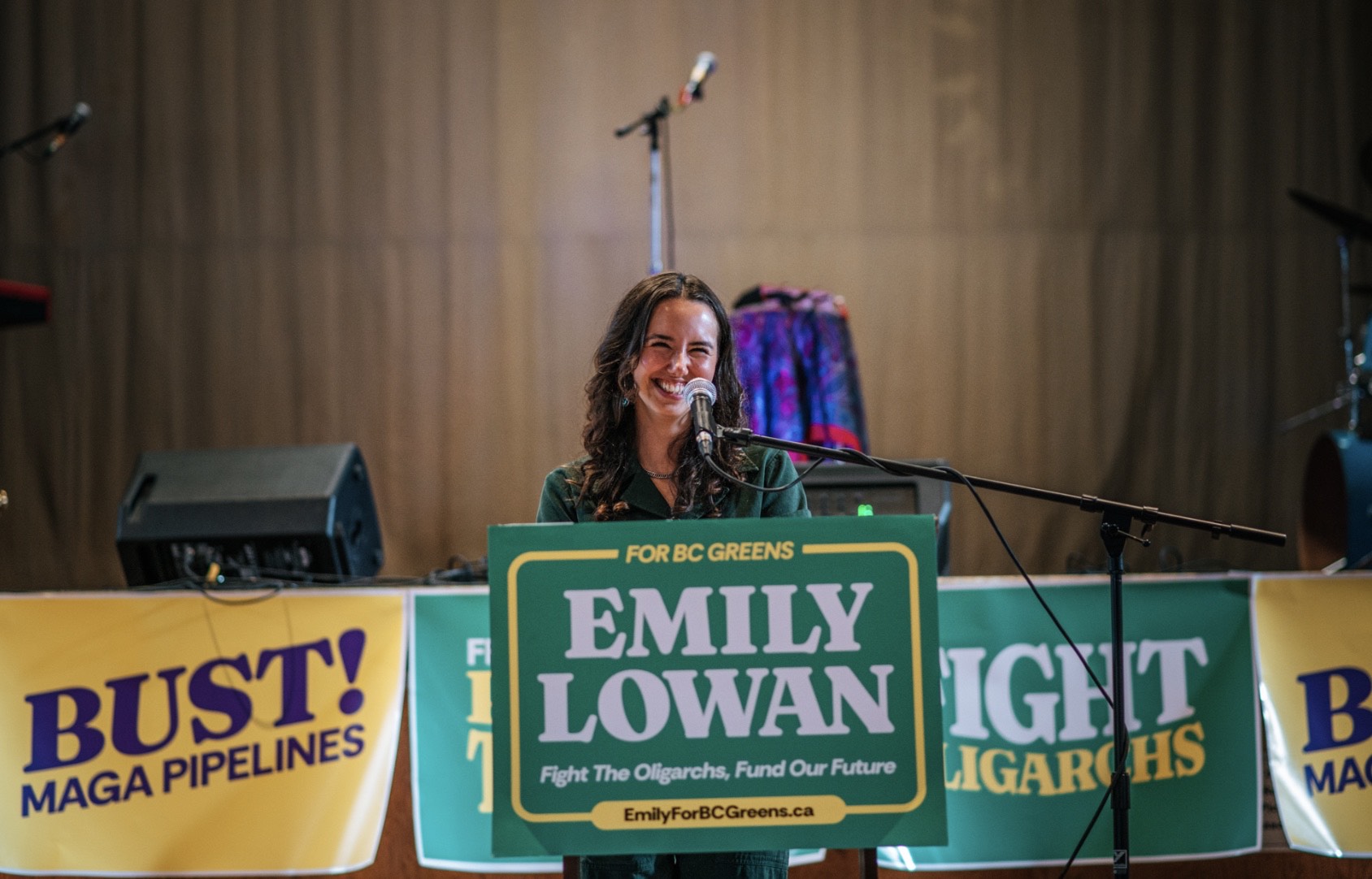
Photo courtesy of Emily Lowan.
Emily Lowan is a UVic graduate, with a degree in Political Science and Environmental Studies. She is a former UVSS Director of Campaigns and Community Relations, and a climate activist. Her background includes the Canadian Centre for Policy Alternatives, Divest UVic, and the Climate Action Network.
Now, she’s running to be the next leader of the BC Green Party, on a platform of affordability, climate action, and respect for Indigenous rights.
The BC Greens’ leadership race runs from Sept. 13 – 23, 2025. Because this is a party leadership election, only members of the BC Green party are eligible to vote. The deadline for party membership is Aug. 10, 2025.
Lowan’s campaign, “Fight the Oligarchs, Fund our Future,” emphasizes confrontation with large corporate interests — stopping the Prince Rupert Gas Transmission pipeline, banning fossil fuel expansion, and implementing vacancy control (a type of rent control, limiting how much rent can be raised for new tenants), as well as price caps on staple groceries.
She also wants to “tax B.C.’s richest corporations and the one per cent to fund 26 000 affordable housing units per year”, to make public transit free, and to provide mental health counselling as well as “good green jobs.”
The Martlet spoke with Lowan in an interview about her campaign and her vision for the future of B.C. politics.
This interview has been edited for clarity and concision.
What do you want voters to know about you?
I’m not a traditional political candidate. I’m a 24 year-old renter and organizer for climate and Indigenous solidarity. I’ve been doing movement-building and organizing work for about a decade. I’ve led successful campaigns, including fossil fuel divestment at UVic, done investigative research, and built broad coalitions across climate labour and Indigenous nations.
My experiences are largely outside party politics and government. But what I think the BC Greens right now need is actually a movement builder that can organize a resurgence — bringing young and disillusioned people into the party.
Your background is not traditional for a politician. How has it prepared you for party leadership?
I think the response that we’ve seen to my campaign has been pretty overwhelming. Our launch video got over 130 000 views across platforms. I think people are really desperate for a different kind of candidate that speaks directly to their interests, to working class interests, and the issues that they’re facing day in and day out.
I also think that our campaign slogan, “Fight the Oligarchs, Fund our Future” is really striking a chord. Fundamentally, I’m not trying to carve up the existing pie of voters. I’m trying to bring in thousands of young people, and disillusioned individuals across B.C., who haven’t previously been involved in a political party before.
How did you land on that slogan, and what does it mean to you?
What I’m saying is that we’ll never be able to fix what’s broken so long as a small handful of men take more and more of the pie every year. That’s why we’re building a people-powered movement to force our government to directly confront corporate interests, so we’re able to invest in a future that works for everyone.
I think this is really resonating. To back up a little bit further, the current government came to power eight years ago, when I was actually too young to vote, and since then, I’ve watched every major problem in B.C. get worse. Life expectancy is falling, while the cost of living spirals out of control. A third of British Columbians struggle to pay for groceries, and everyone I talk to is worried about the future and rising climate catastrophes.
Now, the government is broke, and they say that the only way they can afford schools and hospitals is if we subsidize a bunch of foreign billionaires to dig up and burn more fossil fuels. That is not true. I believe the province is going down the wrong path, and I can’t sit on the sidelines anymore.
I’m really feeling this momentum; like there’s a surge of people that feel the deep brokenness of our systems here in B.C., and they see how wealth is being hoarded at the top. So, I think there’s a large appetite for new ideas and new energy in B.C. politics.
Where have the existing parties here in B.C. have gone wrong on Indigenous rights, and what would you do differently?
How do I count the ways? Looking at it in chronological order, the BC NDP steamrolled Indigenous rights with bills 14 and 15. There was a massive backlash to the fast-tracking law that basically centralizes power and control in the Premier’s office. It’s a move that undermines Treaty Rights and Indigenous Rights. There was obviously a major response from Indigenous leaders and communities against that move, and if the Greens had held the balance of power, we would have been able to press pause on that legislation passing. We could have demanded that they follow the advice of these Indigenous leaders and wait until the fall at the very least, to have an actual consultation period with Indigenous nations and leaders. It was an incredibly rushed piece of legislation, and if the Greens were holding the NDP accountable, we could have paused that process.
And then shortly after, the BC NDP approved the Prince Rupert Gas Transmission (PRGT) pipeline, which is backed by a number of equity firms that have close ties to Trump’s inner circle and is fiercely opposed by a number of nations along its route. This is another egregious example of the NDP government steamrolling Indigenous rights. And in this case, the Gitanyow Hereditary Chiefs were calling for their law to be respected, and for the Premier to issue a new a modern environmental assessment for the project, because, effectively, they found a loophole, and they allowed the project to maintain a ten year old certificate despite all the changes in science, UNDRIP, and Indigenous Rights over the last decade.
I could go on and on, but I think those are the two most egregious examples; bills 14 and 15, and the approval of the PRGT project. Obviously the bill 14 and 15 pieces have failed to a degree, but we can still work with First Nation leaders to prevent violations of Rights, and, for instance, demand that the B.C. energy regulator uphold and fully implement DRIPPA.
Earlier, you mentioned reaching new voters who feel disenchanted with the current political status quo. How will you reach these voters, and what is your message to them?
I think the message of my campaign is deeply resonating, and in our campaign, we’re trying to effectively double the base of the party — to reshape this party so it works for young, and working people. I think this is a once-in-a-generation opportunity for young people to come in at the ground floor and ensure that their voices are truly heard, and to have a party that actually moves in lockstep with social and climate movements.
This is what the NDP used to be. They used to be truly responsive to climate and social movements, and labour movements. Now, we see that power is centralized in the Premier’s office. It feels like they’re deeply out of touch. They’re tepid, and afraid to actually have a deep connection with what could be their base. I’m opening the door to young people, so we can change the conversation, to center us — to center working people and not corporate lobbyists.
I mentioned this goal of 5 000 new members to the Green Party. I think step one is to tell people the truth. It turns out people are ready to hear it. As I said, more than 150 000 people have watched my first couple of videos, and I’m focused on growing the number of people who vote, not fighting over a shrinking pie. My campaign is about bringing in people who’ve never seen their priorities reflected in B.C. politics. That’s how we win, and that’s how we actually strengthen our democracy. Step two is to then show people that democracy can actually be empowering and fun. We’re doing that with in-person rallies, and a whole lot of conversations with our friends, neighbors, and fellow organizers.
The third phase is to actually sign up to be a member of the BC Greens. It’s completely free for anyone under the age of 30. This is an opportunity to vote for the person you want, and to hold the government’s feet to the fire. I’m really hopeful that young people see this as an opportunity — as big of an opportunity as I see it. Basically, this entire government functions with a one-vote majority. That means if the NDP loses one MLA, or the Greens win one more, every law and every budget will need Green support to pass. That gives grassroots people more leverage than we think.
Do you have anything you’d like to add before we end?
There are some more platform points that I’m excited about. Effectively, the focus of this campaign is about taxing B.C.’s richest corporations and one per cent, and using that revenue to fund our affordability agenda, which includes 26 000 new units of actually affordable green housing every year. It includes free transit, rebuilding the public health care system, and tens of thousands of good green jobs.
I’m hopeful that this will resonate with young people like it does with me. There’s a number of other measures and policy points that are outlined on the ‘issues’ section of our website. It includes implementing price caps on staple groceries to bring down our monthly costs and re-implementing vacancy controls across the province, to prevent landlords from significantly increasing rents after tenants move out, as well as stopping the MAGA-backed PRGT pipeline, which is an incredibly salient issue for climate and Indigenous Rights organizers. I’ll just add that the PRGT project will cost the public billions, create minimal permanent jobs, and send the profits to U.S. oligarchs and Donald Trump’s inner circle of donors.
Lowan’s platform, including a list of more detailed policy proposals, are available on her campaign website. You can learn more about Lowan, and the other contestants running for leadership on the BC Greens website.