

Dr. Sophie Norris’ research team has predicted the speed of glacial erosions for most glaciers on Earth
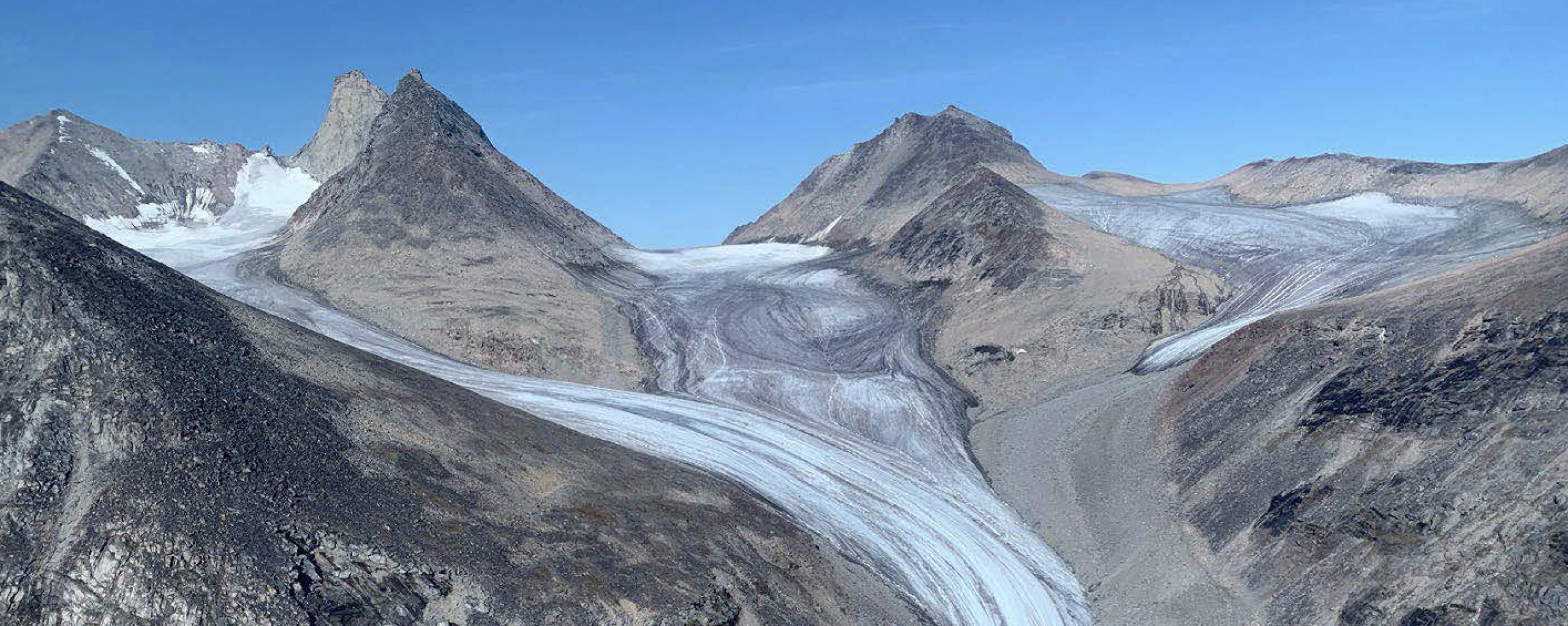
Photo by John Gosse.
Dr. Sophie Norris, an assistant professor in the Department of Geography at UVic, recently published major new research on glacial erosion in Nature Geoscience.
“The focus of our study was to figure out what was controlling the rate and what different processes were affecting how quickly glaciers erode,” said Norris in an interview with the Martlet.
Norris’ research was undertaken in partnership with, and financially supported by, Canada’s Nuclear Waste Management Organization (NWMO). The study included researchers from Canada, the U.S. and parts of Europe.
Led by Norris, the research began at Dalhousie University in 2021, where Norris was a post-doctoral fellow, and moved to UVic when she accepted a faculty position in 2022.
“What our study did was to think a little bit more broadly about all the different things that could affect glacial erosion,” said Norris.
According to Norris, people have often assumed that glacial erosion is heavily controlled by how quickly a glacier moves.
This study looks at how other factors — such as precipitation, temperature of glacial ice, and the type of bedrock underneath the glacier — can also determine when a glacier erodes.
Taking these other factors into consideration, Norris and her colleagues were able to predict the speed of glacial erosion for 180 000 of Earth’s glaciers.
The research team used a machine-learning approach to statistically analyze and predict glacial erosion rates. Norris told the Martlet that predicting glacial erosion has practical applications, besides gaining a greater understanding of our natural world.
“Understanding glacial erosion is incredibly important in Canada for safe burial of nuclear fuel,” said Norris. “This was one of the drivers behind why we looked at this.”
The complex factors that cause erosion is important information for landscape management, long-term nuclear waste storage, and monitoring the movement of sediment and nutrients around the world. Though there has been prior research on glacial erosion, this most recent study conducted by Norris’ team is by far the most extensive one.
“We produced a global synthesis,” Norris told the Martlet. “We did our very best to make sure that contemporary glacial erosion rates from published literature were included where they were available and where we had enough information to include them.”
One of the many challenges that Norris and her team faced while conducting this research was getting glacial erosion rates from previously published literature. “Although we have 180 000 glaciers on Earth, very few of those have actually got direct measurements,” said Norris.
By using the machine-learning approach, the team was able to produce equations estimating 99 per cent of glacial erosion to be between 0.02 and 2.68 millimetres per year.
“When we compound that by many decades, glacial erosion is a really important process affecting lots of things across our landscape,” said Norris.
One of the most surprising things for Norris during her research was identifying the amount of different factors that affect glacial erosion.
“For the first time, we were able to see a quantitative link between things like glacial erosion and geothermal activity … seeing that all of these things affected glacial erosion was really interesting,” said Norris.
At UVic, Norris runs the Geomorphology and Chronology Research (GCR) lab, where quantifying the rate of change of landscape processes is investigated. The research conducted in this lab isn’t limited to Victoria, but extends all across Vancouver Island and is even province-wide.
With this study now published, Norris’ day-to-day includes a lot of field work and working with students across the province, as well as working in UVic’s geochemistry lab.