

Andúril-2, the team’s latest design, is their fastest and highest-flying rocket yet
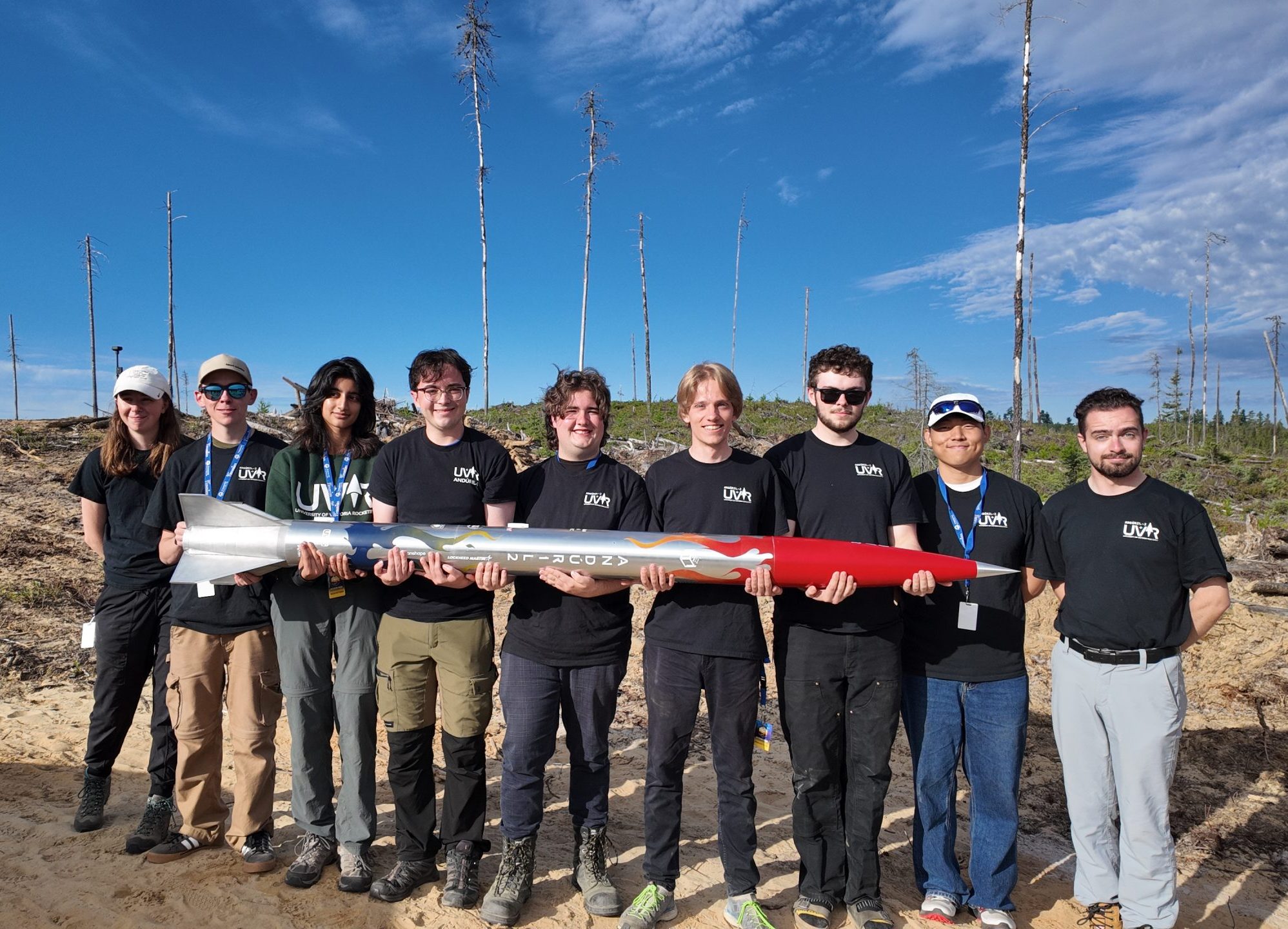
Photo by Saiprasad Dhodi.
On Aug. 19, 2025, the UVic Rocketry Team took on Launch Canada — the country’s largest student rocketry challenge — in Timmins, Ontario. This wasn’t UVic Rocketry’s first time at Launch Canada — they’ve participated in the competition every year since 2022.
In that time, the team has come a long way, beginning with their launch of the rocket Xenia-1, which achieved a peak height, or apogee, of 10 293.9 feet, and secured the team second place in the Basic category.
In 2024, UVic Rocketry launched their first successful supersonic rocket with the Andúril-1, which achieved an apogee of 24 118 feet, just shy of their predicted apogee of 27 686 feet.
However, Andúril-1 was not the team’s first attempt at a supersonic rocket. They first attempted to build one with the Hyak-1, which the team prepared for the Spaceport America Cup competition in 2018.
Unfortunately, the Hyak-1 experienced issues during lift off, which caused it to rapidly disassemble, never achieving flight. The team attributed this to issues with the rocket’s fins.
At the 2019 Spaceport America Cup, UVic Rocketry again attempted a supersonic rocket with the Hyak-2. The team improved the designs of the fins, as a response to Hyak-1’s failure, but the team’s hard work and ingenuity did not result in the supersonic rocket they were hoping for. The Hyak-2 also experienced an unplanned disassembly during lift off and never achieved flight. At the time of writing, the cause is unknown.
Andúril-2, the successor to their only supersonic rocket to achieve flight, has been in the works for the past year, following the successful launch of Andúril-1 at Launch Canada last year, and is the culmination of years of improvement, ingenuity, and hard work.
Most of the components of Andúril-2 were machined by the UVic Rocketry team themselves, at the UVic machine shop. Landon Day and Julien Edwardson, two senior members of the team, estimated that 90 per cent of the rocket’s mechanical components were machined in house, excluding bolts, fasteners, and some of the electronic components.
Andúril-2 passed its inspection to participate at Launch Canada on Aug. 17, 2025, and launched two days later. Prior to launch, the team had high hopes for Andúril-2 — expecting an apogee of 31 000 ft and supersonic speeds.
They were successful — exceeding even their own predictions. Andúril-2 reached a speed of Mach 2.2, going approximately 2 700 kilometers per hour, and achieving an apogee of 32 694 feet. Its flight, however, was not without its hiccups. Andúril-2’s sensors did not properly detect when it had reached apogee, resulting in the parachute not deploying at the correct time and a descent that was too harsh for the rocket’s abilities, causing the nosecone to separate from the rest of the rocket.
The team was able to recover the nosecone, which contained the rocket’s GPS system, however, but much of the rocket is still unrecovered. Thanks to the gyroscope data contained in the nosecone, UVic Rocketry was able to narrow down the failure causes of the flight, which Edwardson said they believe to stem from an issue with the altimeter sensors — sensors which detect the rocket’s altitude.
Still, despite its hiccups, Andúril-2 marks a momentous occasion for UVic Rocketry, becoming both their highest-flying and fastest rocket yet.
UVic Rocketry is still deciding what their next goalpost is, following the incredible performance of Andúril-2, but one thing is clear — they have no intention of slowing their roll. “Our team is growing and we’re very proud of how [what] we’ve accomplished this last year,” Day said.
“It’s the stacking of all of those lessons that you learn over the years that lead your design to become better and better and better,” said Edwardson.