
Commuter students face long waits, crowded lots, and daily frustration while trying to get to class on time
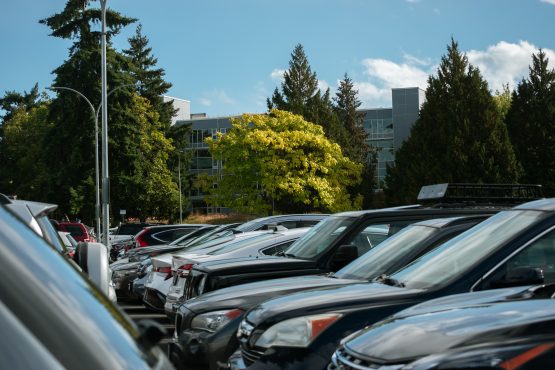
Photo by Julia McClintock.
Every morning at UVic, students circle the Ring Road in frustration, desperately searching for a parking spot before class begins. Some arrive 30 minutes early, only to find every space taken, while others give up, showing up late or skipping class altogether. For many students, commuting by car isn’t a choice, but a necessity. Housing shortages in Greater Victoria mean that many students have to live far from campus, leaving them with commutes via transit or bike upwards of an hour, making driving the most feasible option. UVic’s parking infrastructure, however, is not keeping up with the needs of these students.
Currently, UVic offers roughly 4 700 on-campus parking spaces, and sells around 3 000 monthly permits. Students pay $79 a month for general parking, $52 for discounted “value” permits at outer lots like Lam Circle or the Ian Stewart Complex, or $45 for motorcycle permits. Despite these options, peak times and full lots routinely leave students at a loss.
Student forums reflect this frustration, with many social media posts complaining about the situation. One Reddit user on the UVic subreddit posted, saying that “Every morning, especially at the beginning of the semester, it’s a nightmare finding parking,” and requested tips to avoid this.
The comments in response ranged from suggesting arriving before 8 a.m. to claiming that parking is “hopeless,” and it’s more convenient to take the bus.
UVic emphasizes sustainability, encouraging students to walk, bike, carpool, or take transit via the U-Pass, which is paid for with tuition and provides unlimited access to Victoria transit for all students. While support for sustainable transportation is important, it shouldn’t come at the cost of addressing the immediate reality for commuting students. Transit can be unreliable or indirect, and cycling can be difficult in poor weather or for long distances. For those who must drive, the current system leaves them stressed, frustrated — and often late.
UVic acknowledges that students experience delays when searching for parking, and cites an average occupancy of 80 per cent across all lots. Yet averages mask the daily reality — core surface lots often fill completely during morning hours, leaving students to navigate outer lots in hope of a spot, or risk missing class.
The last significant parking expansion was in 2015, when the university added 334 spaces to the Centre for Athletics, Recreation and Special Abilities (CARSA) parkade. Since then, there has been no substantial increase in student parking, even as campus development has grown. UVic’s Campus Plan prioritizes sustainable transportation over expanding parking capacity, citing high construction costs and the need to preserve land for academic use.
While sustainability is crucial, ignoring the practical needs of commuting students undermines another of the university’s commitments — student success.
It’s time for UVic to take concrete action. Possible solutions, that wouldn’t require destroying natural spaces, include constructing multi-level or vertical parkades, expanding value-permit options closer to popular campus buildings, or implementing real-time parking updates to help students find open spaces quickly. A hybrid approach that prioritizes both sustainable transit and adequate parking ensures students can arrive on time, and without unnecessary stress.
Parking may seem mundane, but it directly affects attendance, learning, and student well-being. Students shouldn’t have to choose between arriving late or trekking from a distant lot just to attend class. If UVic wants to uphold its educational mission, it must recognize that commuting students make up a large part of the campus community and provide realistic, accessible parking solutions for them. Addressing this issue is not just a matter of convenience, it’s a matter of fairness, equity, and supporting the success of all students.
UVic has made strides in promoting sustainability, but it cannot do so at the expense of students’ ability to engage with campus life. By investing in smarter, more accessible parking options, the university can improve student life significantly. Students deserve a campus where they can spend their time learning, not finding a parking spot.