


‘The Salty Scent of Home’ is an ambitious opening to the 2025-2026 theatre season, but the acting somewhat drags it down
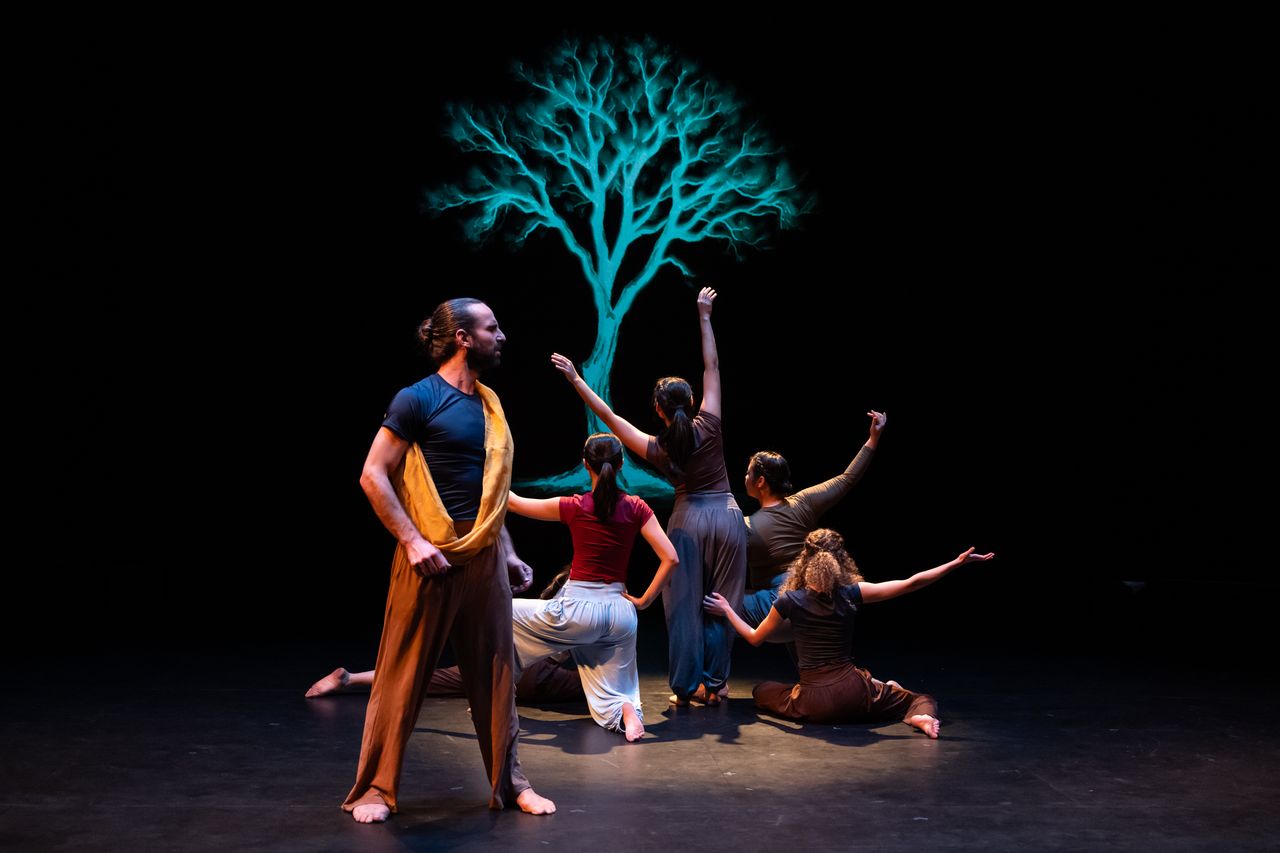
Photo courtesy of the Phoenix Theatre.
The Phoenix Theatre’s 2025-2026 season began with The Salty Scent of Home, a piece of ‘Celebratory Theatre’ that tells five interwoven narratives, following new immigrants to Canada.
A collaboration with the Departments of Theatre, Psychology, Curriculum & Instruction, Educational Psychology, and Leadership Studies at UVic, as well as the Inter-Cultural Association of Greater Victoria and the Vancouver Island Counselling Centre for Immigrants and Refugees, The Salty Scent of Home hopes to test the power of theatre to create social cohesion and a feeling of belonging for new immigrants.
The Salty Scent of Home’s multiple stories are told mainly through interpretive dance. There is dialogue, but dances are the primary vehicle through which the emotional states of each character are conveyed. With some clever blocking, the ensemble of seven can transform into a family, a mental or physical blockade, a labyrinth of bureaucracy or a garden. While it’s not the most complex choreography, it’s effective in setting a scene — and the staging does a lot to convey a larger setting.
The play follows five different immigrants, each coming to Canada for a variety of different reasons. Each scene is broadly taken from real stories from real people and adapted for the stage. The show’s focus is on dance, where abstract emotions are made physical. The stories, save for two, are mostly disconnected, so the audience has to relate to each individual experience separately, as each new immigrant grapples with the hardships of settling into a new environment.
Probably the strongest scenes come from the comedic story of a man lost in a twisting bureaucracy that accidentally moves him to B.C. instead of Québec, and another consistently dramatic and sincere story, following a woman’s journey from Afghanistan to Canada.
However, The Salty Scent of Home has a major stumbling block: the acting is flat. While the actors enunciate and project properly, they mostly do not emote, leaving the play feeling, for the most part, very one note. Speaking personally, I could only see the actors, and not the characters they were portraying. It detracted from the experience, where authentic vulnerability is the focus of the show. These performances are based on real stories, from real people, and for a moment, I couldn’t see those people, only the actors.
This contrasts last year’s im:print 2024, where im:print’s performers were depicting their personal stories through dance, music, and monologues — leaving no distance between performer and performance.
This isn’t to say that personal connection between the actor and the character is necessary for an empathetic performance. Last year’s Eyes of the Beast had actors reciting monologues that were based on people’s experiences with climate disasters. But the acting on display was more dynamic. I believed that those weren’t actors, but people who had lived through the experiences they were speaking of. The acting style chosen for The Salty Scent of Home only emphasized the gap between actor and character. Perhaps this was a stylistic choice, given the focus and attention on dance rather than dialogue, but I can’t say it was effective. Rather, it drew attention to itself.
Overall, it’s hard not to admire The Salty Scent of Home’s ambitions in conveying the immigrant experience. These are stories based on real people’s experiences. But in terms of conveying these powerful stories and experiences through the medium of the stage, the acting presented a serious stumbling block.
The Salty Scent of Home is playing at the Phoenix Theatre until Oct. 18. Tickets can be purchased at the Phoenix Theatre’s website.