

First meeting of the 2025–2026 academic year sees lengthy debate on accommodations
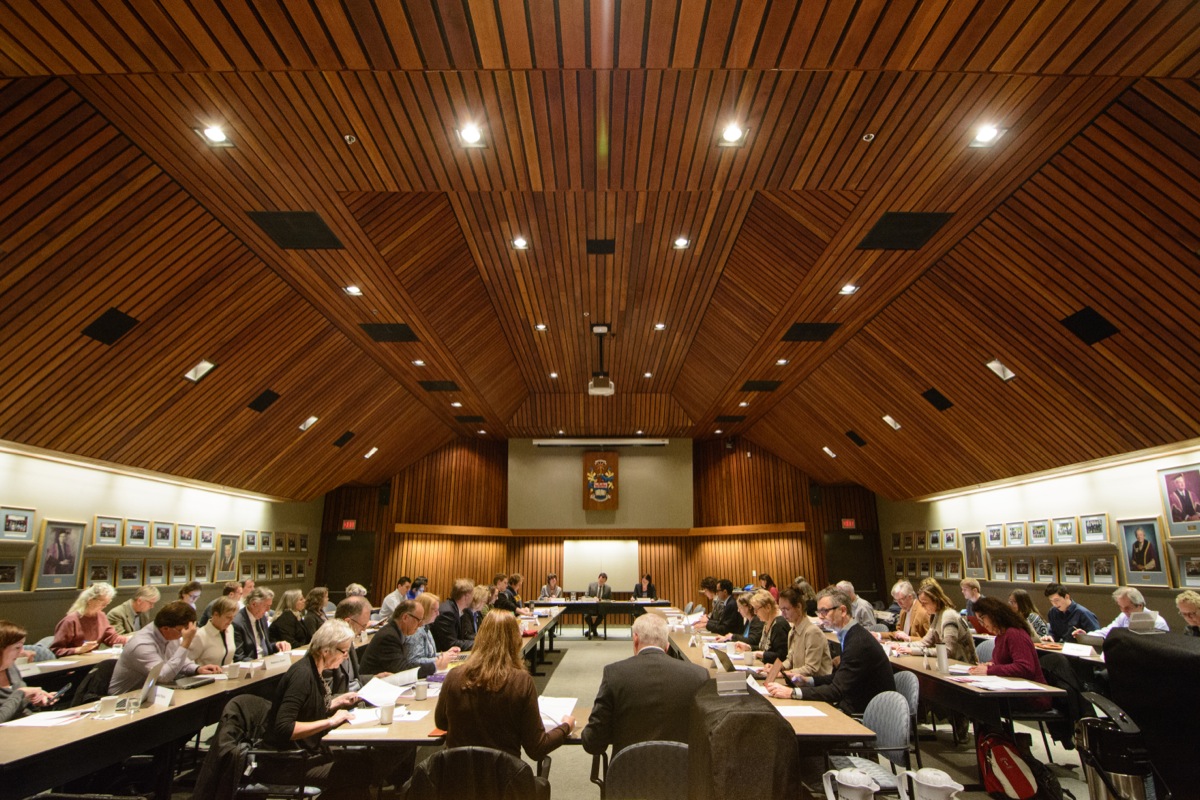
Photo by Hugo Wong.
In a two hour-long meeting on Oct. 3, UVic’s Senate met for the first session of the 2025–2026 academic year. The Senate heard a number of reports and voted on a few minor motions, but the bulk of the meeting was spent on the annual Academic Accommodations Policy report, which saw fiery engagement from several faculty and student senators.
The meeting was run by Dr. Annalee Lepp, Senate Vice-Chair and Dean of Humanities, in place of UVic’s acting president, Qwul’sih’yah’maht, Dr. Robina Thomas. Lepp acknowledged the presence of 20 new senators.
The full meeting agenda, including all reports, can be found here.
Financial Report
Senate received the 2024–2025 financial report, which breaks down the university’s financial situation and notes revenues, endowments, expenses, and other financial information. According to the report, UVic received $808.3 million in total revenue in 2025, with $761.7 million in 2024. The report breaks down sources of revenue, including student fees, government grants and contracts, non-government grants and contracts, and other sources like sales and business income.
The report also notes $2.2 billion in total assets.
Senate Committee on Academic Standards
The Academic Standards committee gave its report and brought forward a number of motions, including a motion for the Senate to approve a revision to the time limit for degree completion for the Honours program in the Faculty of Science.
Under the previous time limit, students wishing to take longer than four years to complete their degree would have needed to seek approval from department chairs. This revision removes the imposed time limit, but specifies that “students who have not completed their degree programs within five calendar years of first registration will be required to satisfy any revisions that may have been made to the program requirements since they first registered.”
The proposal states that this revision brings the Faculty of Science policy in line with that of the Faculty of Humanities.
The committee also brought forward a motion for Senate to approve changes to the English language proficiency requirement on the academic calendar, which aim to “provide more options for applicants to demonstrate English language competency,” “align UVic’s current requirements with other comparable Canadian post-secondary institutions,” and “support the potential success of our incoming students.
The revisions to the requirement can be found in the meeting agenda. Both motions carried.
Senate Committee on Planning
The committee introduced a motion for the Senate to approve the discontinuation of a Non-credit Professional Specialization Certificate in Population Health Data Analysis.
According to the proposal, this was a four-course non-credit certificate developed and originally offered in partnership with Population Data (PopData), the Department of Geography, and the Division of Continuing Studies (DCS). However, the committee says the certificate “does not readily align with emerging micro-credential programs” that are more easily accessible to intended audiences.
One senator asked about enrolments in this certificate, to which a spokesperson for the committee responded that there were 25 registrations across the four courses. Following this discussion, the motion was carried.
Academic Accommodations Report
Much of the session was spent hearing this report, given by UVic’s VP Academic and Provost, Dr. Elizabeth Croft. Academic accommodations continue to be a divisive issue between faculty, students, and UVic administration. Many student and faculty senators shared their concerns about the approach the university is currently taking towards them.
An ad-hoc Senate committee to explore accessible education and accommodations was proposed, but many senators took issue with the prospect of these discussions occurring through the framework of a senate committee, with some feeling this approach would limit the possible solutions that could be explored.
Another senator said the proposed 18 months the committee would take to find solutions would be wasted, given that the solutions are “already known” and that students and faculty cannot wait that long for the problems to be resolved.
Other Business
The Senate received a report from the Presidential Reappointment Committee, and also voted to approve the graduating regalia design for the Professional Doctorate, which would be “an inside blue backing with a narrow band of gold velvet and a front outside assigned regalia colour to align with the line faculty’s undergraduate and master degree.”
Other matters brought before Senate included the approval of Academic Important Dates for January 2027 through April 2027, the 2024/25 Report on the Status of External Reviews of Academic Units, annual reports from the Senate Committees on Curriculum and Continuing Studies, the approval (and recommendation to the Board of Governors for its approval) of a list of new and revised awards, and Senate approval of appointments to the Senate standing committees for their respective terms.
The final motion before the meeting adjourned was the reappointment of Dr. Annalee Lepp to a second term as Senate Vice-Chair. Lepp was nominated by another senator with no other nominations put forward.
Further details on all of these items can be found in the agenda.