

Vigil held shortly after the two-year mark of the Oct. 7 attacks, weeks after U.N. commission finds Israel has committed genocide
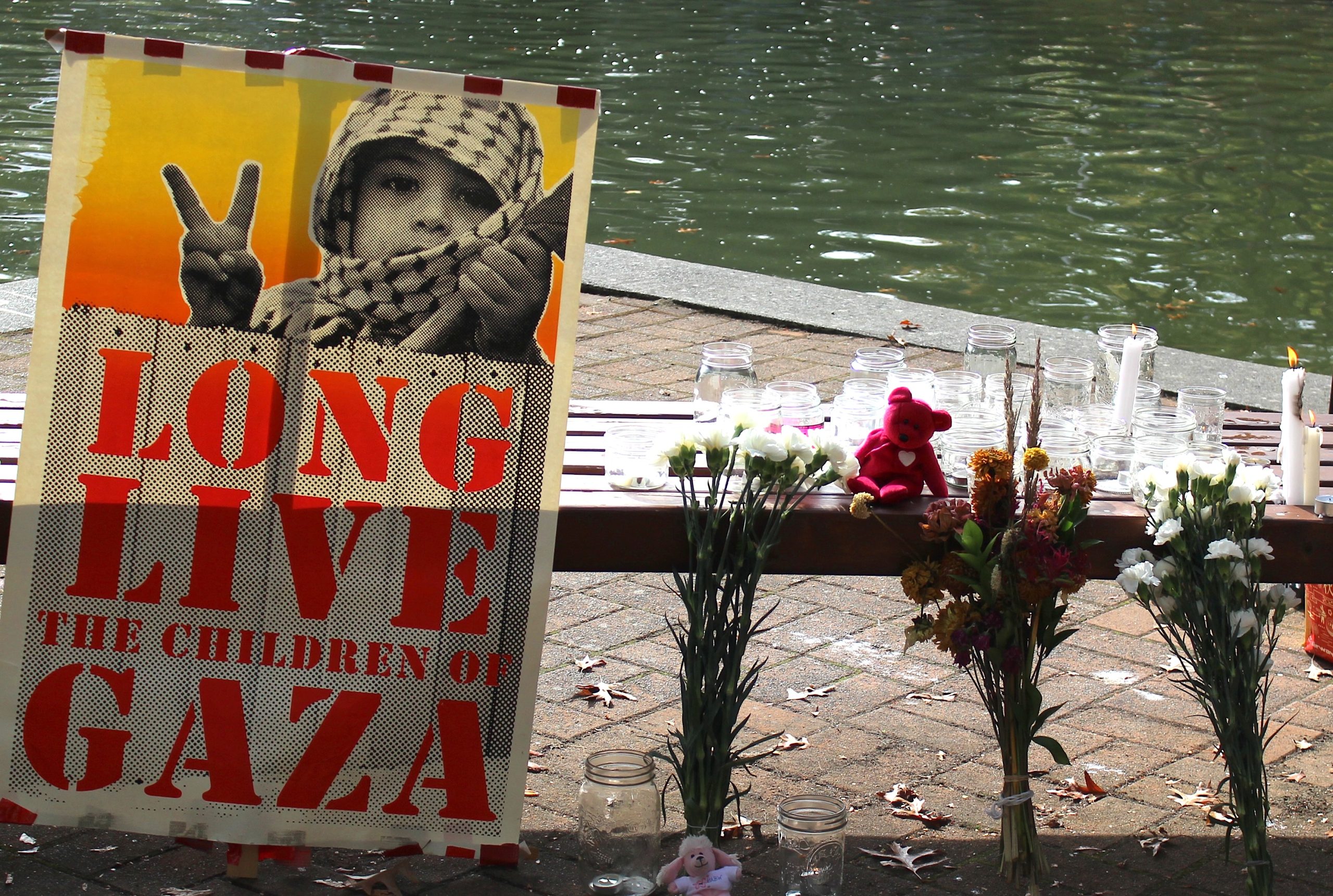
Photo by Declan Snowden.
Students gathered around Petch fountain on Oct. 9 in a display of solidarity and grief for the two year anniversary of what a U.N. commission has officially declared a genocide in Gaza.
Since the attacks on Oct. 7, 2023 by Hamas, which left 1 195 Israelis dead and around 240 taken hostage, Israeli military operations in Gaza and beyond have killed more than 67 000 Palestinians and injured more than 167 000, with many people still unaccounted for, and over two million survivors are enduring an ongoing humanitarian crisis.
To recognize and mourn the devastation, students gathered together to reflect and grieve with other members of the UVic community. The event was hosted and promoted by a mix of student groups and other local organizations, including Divest UVic, the Tzedek Collective, Dykes Nation, Labour 4 Palestine Victoria, and Food not Bombs.
“I am just grieving,” said one of the speakers at the vigil. “But most of all I am grieving for the Gazans that are under these awful, unlivable conditions, and nobody says a word.… There is no way to express this grief and this rage and everything we are forced to feel every time we open social media.”
Others at the vigil spoke about “what it’s felt like to have been so publicly witness to the genocide,” and struggling with the feeling that “it’s so hard to do anything about,” said a UVic faculty member who was present and asked to remain anonymous. “There was a lot of sharing: shared grief, shared helplessness. [It was] a space for a lot of that.”
Attendees shared personal and familial experiences, sang songs, read and wrote the names of children and journalists martyred by the violence, and some even created chalk art in the name of the victims.
Visible Campus Security (CSEC) officers remained present throughout the vigil. Students were asked to leave by CSEC, due to the UVic-affiliated groups not having booked the space in advance, although attendees said no one was forced to leave. The hour-long vigil concluded after organizers relayed CSEC’s message to leave, but many individuals remained afterwards.
One individual involved with the event said they were warned by CSEC that Saanich Police would come if they did not disperse, however, the vigil concluded without a police presence.
“It felt surveilled, for sure,” said the faculty member. “[Campus Security] was definitely there watching the whole time. Maybe that contributed to why some people didn’t feel as comfortable saying anything.”
In a statement about the vigil, a UVic spokesperson said that the university “values the free and lawful expression of ideas and our community’s right to demonstrate safely.”
UVic “[believes] in our community’s right to demonstrate on all sides of the complex conflict in Gaza and will not limit debate or prohibit the reasonable exercise of freedom of expression,” they said.
The spokesperson also said that event organizers must use UVic’s space booking process “so the university can put measures in place to support safety and positive dialogue.”
They added that “local police are uniquely trained to support peaceful demonstrations” and that CSEC regularly works with police on event planning.
The vigil is a continuation of two years of student-led activism, expressing solidarity with Palestinians and frustration with UVic administration. Multiple walk-outs, public marches and disruptions, and even an encampment have taken place on campus since October 2023.
Despite student protests, UVic has yet to take any public actions surrounding demands to boycott and divest from corporations that directly, and indirectly, contribute to Israeli military operations, although they no longer have investments in the Bank of Nova Scotia as of March 2023.
However, many of these discussions about divestment took place under UVic’s previous president, Dr. Kevin Hall, leaving many to wonder if his successor Qwul’sih’yah’maht, Dr. Robina Thomas, will bring a different approach.
“The bare minimum would be acknowledging the genocide.… I want UVic to live up to some of its stated principles,” the faculty member told the Martlet. “UVic makes a big deal of being a university that respects Indigeneity and Indigenous peoples, and remaining silent on the genocide of an Indigenous peoples feels completely antithetical to that.”
While the vigil held on UVic’s campus only roused about thirty or so attendees, there were nationwide vigils on Oct. 7 led by university students. In Montreal, thousands of students took to the streets in a rousing show of solidarity, and at UBC over a hundred community members and students came together to mourn.
As of Oct. 9, a ceasefire deal has been struck between Israel and Hamas, although the longevity of the deal and lasting peace remain uncertain, as previous ceasefire deals had fallen through.
However, even with the recent ceasefire deal, action for Palestine on campus is not likely to end. In an Instagram post, the vigil’s organizers called the event a continuation of “the same Palestinian solidarity student-organizing that has happened on campus over the past few years” and they assure that this solidarity will carry on.