
The theatre’s latest production is simple but effective
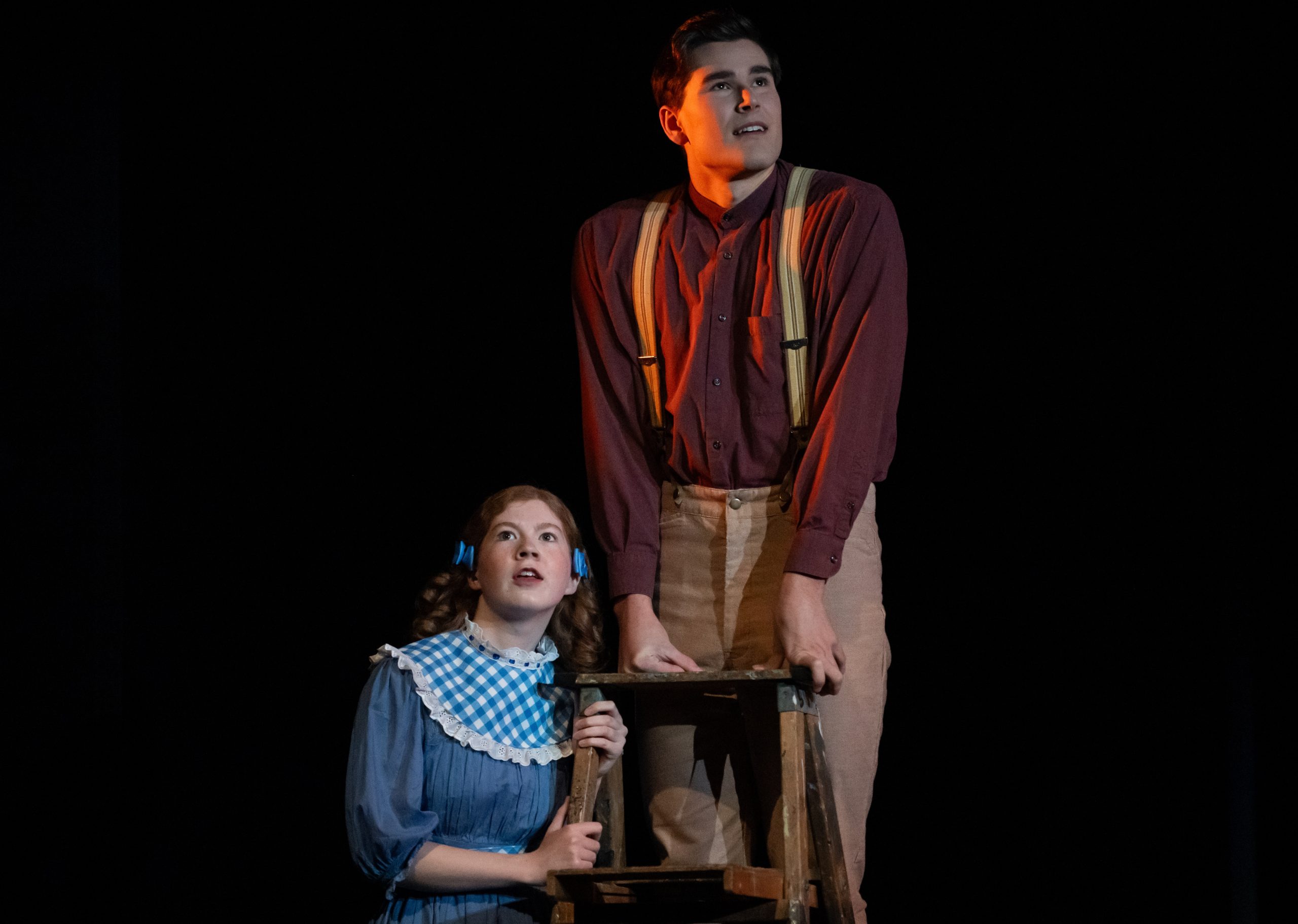
Photo courtesy of Phoenix Theatre.
“What remains of Babylon?” asks Our Town’s Narrator/Stage Manager, played by Kieran Nowazek. Other than the records of kings, and the occasional tax record etched into stone, what do we know about the daily lives of those who lived there? This is the thesis statement of Our Town, the Narrator explains –– a record of daily life in the early 1900s, in the fictional town of Grover’s Corners, New Hampshire.
The Phoenix Theatre’s production of Thornton Wilder’s seminal classic, Our Town, is simple, much like its plot. This isn’t a detriment to the production, the performances, or the script. Inherently, this is a play about portraying a specific moment in time, highlighting what makes the banal daily routines worth remembering.
What has made Our Town a classic is its charm. Nothing monumental happens in the play. We are given a window into the lives of the town’s residents through the lens of two neighbours, Emily Webb (Azura Idu) and George Gibbs (Patrick Jaworek), as they go from schoolyard crushes to a married couple. Despite the everyday nature of the story, it remains compelling. This is highlighted by the thesis statement delivered by Nowazek at the beginning, which gives some much-needed context as we follow these character’s simple lives. It also helps that two kids falling in love is inherently cute.
Adding to the production’s charm is Nowazek’s presence as the Narrator/Stage Manager, described as such because the Narrator is an active participant in the show. The Narrator is the one who introduces the scenes, thanks the characters (not the actors) for their performances, delivers their own monologues on the nature of life, and maps out the scenery of the town. It’s a casual breaking of the fourth wall — the metaphorical wall between actor and audience. Nowazek is fantastic at juggling that job, and making it appear as natural as possible.
On the production side, Our Town demands a minimal set. In fact, the actors are required to mime props and scenery, with only a table to represent a house, or a ladder used for a second storey. But the focus is, again, on the actors and the script, rather than an elaborate set. The sparse stage design adds to the simple charm of the story.
One especially effective scene has Emily and George watching the full moon from their bedroom windows, while George’s parents admire it from outside. What gives the scene weight is the effectively realized atmosphere of a quiet moment shared with someone else. The play allows the audience to sit in this moment, and feel the significance accorded to it by presenting this moment on stage.
Our Town does suffer a little in its final act, due some of the performances. At risk of spoiling the play, the story’s three acts — Daily Life, Love and Marriage, and Death and Eternity — correspond to their titles thematically. As one character grapples with their death, and their new existence as a ghost, the actor’s performance of said character feels flat when compared to the weighty themes of eternity being explored in the scene, and the discovery that reliving one’s memories is more painful than initially thought.
The final scene, however, recovers from this lapse somewhat, allowing a moment for the atmosphere of the graveyard and grief to settle — as the audience did spend an entire play getting to know these characters, and their loss is felt.
Our Town is a quiet and simple story about daily life, and that simplicity has given the play its continued resonance with audiences since its first production in 1938. In the words of a friend’s mother, ‘It’s a real chestnut.’
It runs at the Phoenix Theatre runs until Nov. 22. Tickets can be purchased at the Phoenix Theatre website.