

A Climate Disaster Project feature series.
The stories in this series were shared as part of the Climate Disaster Project (CDP), an international collaboration of post-secondary and media partners coordinated through UVic’s writing department. Students in CDP classes learn trauma-informed techniques from interviewing and working with survivors of disasters from wildfires to floods to extreme heat. They then take that work in the community. And, this year, those students submitted testimonies that were published in The Guardian to coincide with COP30. These stories cover wildfires in Brazil’s wetlands, flooding in India, and glacier melt in the Peruvian Andes. But before the students embarked on that work, they interviewed each other, sharing their own experiences with climate change and what they think can be done about it. These are some of their stories.
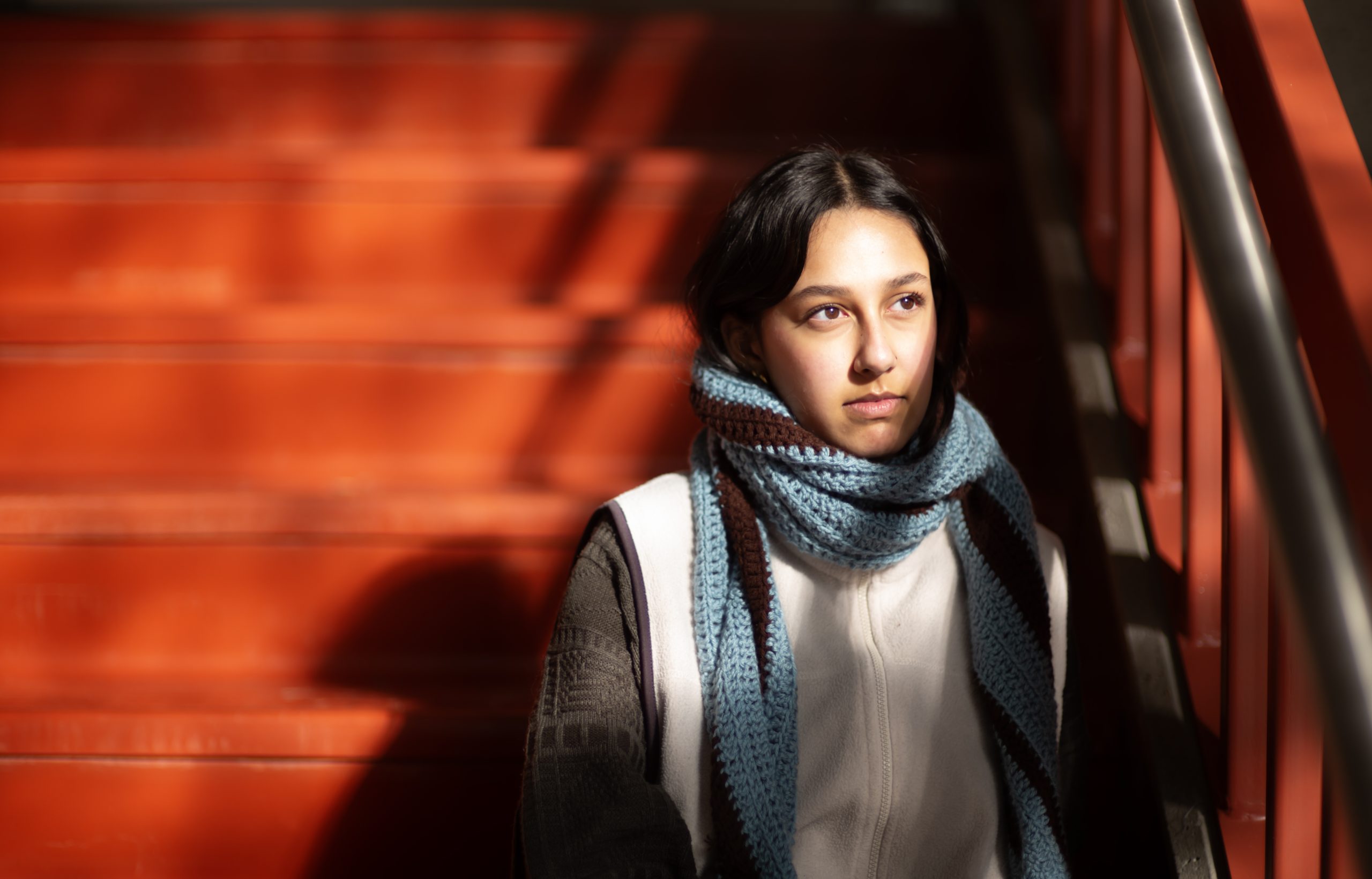
Raamin Hamid. Photo by Guochen Wang.
Lahore, Pakistan, Lahore/Pakistan Floods, 2014
Raamin is an undergraduate student at the University of Victoria studying political science. When she isn’t in her classes, she loves to read a good book (preferably bell hooks), crochet, or catch up with friends over an oat latte. Raamin grew up in Pakistan’s capital, Islamabad, where her politician-mother was a controversial figure for challenging traditional values. This made Raamin a target for bullying at school. Yet Raamin remained strong willed. As a child, she says, “I really liked telling people when I thought they were wrong.” Raamin also really liked to dance and perform for her family and their neighbours. At the age of eight, her family moved back to Lahore, the city where Raamin was born and the rest of her family still lived. When the community flooded in 2014, nine-year-old Raamin was confused about what was going on, and worried for her neighbours.
I was in Gulberg, a municipality of Lahore. You would come off the main street and go into this circle of houses. My house was at the back. It was a white house, with plain white walls. We were renting the top floor. It was nice. There was a playground in the middle of this cul-de-sac, and shops closer to the street.
I was going to school. I was only eight, getting used to this new environment, trying to make friends. I remember my mom used to watch the news because she was a politician. She’s the woman who passed the right for women to divorce, child labour laws, and blasphemy laws. There was this report that there’s going to be really heavy rainfall. No one was expecting there to be a flood. My mom was a little apprehensive. This isn’t the first time she had lived through floods. But this was the first time I had.
I remember the first day. The rain was really heavy. It was really early in the morning when I came out of my room, went to close the window. I remember that new morning light, the glow. Cloudy, but the sun is shining behind the clouds. I could see the playground. It had fences, maybe four to five feet tall. The whole thing was pooled with water. There was gross, murky, brown water all around the streets. It just rose out of the sewers.
Mom was like, “We’re not going to go out for a few days.” I was like, “Okay, no problem. No school, no worries.” I didn’t really think about it. I was just like, “Okay, I’m just going to go to my room and sleep.” The people in my house couldn’t go anywhere. People couldn’t come to visit. My brother was only five. He was just like, “Why can’t we go out?” “What is going on?” It was isolating.
I don’t know if it was the second day or the third day, but my dad had to go to the bank. They did something with the sewage system, and the water started going down a little bit. You can’t drive a car in four feet of water, so he was like, “I’m going to walk.” I’m like, “What?” I felt like I was living in this dystopian world, where this guy has to walk through water to get to the bank. Then my mom was like, “Let him go. This happens all the time.” But I think she was worried about people in the red-light district or very poor places she worked with. I remember her being worried about what they’re going to do or where they’re going to live.
I was definitely touched by how she was wanting to help these people. Maybe this is selfish to say, but a tiny bit of me was like, “But I’m right here. Why aren’t you helping me?” Not that I really needed help. I was trying to wrap my head around what this was that was unfolding in front of me, outside my balcony. I knew it was a flood, but how? Why is there so much water? Where’s it going to go? I wanted for my mom to be like, “This is what’s happening.”
The fourth or fifth day, the water was about two feet. I don’t know what happened, but mom was just like, “We have to go see Auntie Sonia.” I remember going into the car. The water was higher where they were because they were living in a low point in the street. Her house is the most gorgeous ever. It’s all turquoise, stained glass. Her security guard came and mom was like, “Can you open the gate so we can go in?” He was just like, “No, Sonia doesn’t want anybody to come.” I don’t know why, but that is ingrained in my memory. Us going to her house, and me being like, “Oh, the water’s higher here.” Then I guess I was a little bit worried, like, “Why are we here? Why are we out on the road, mom?”
When the water went down, everything was damp. You could smell the remnants of the water. The shops were no longer there because they’re not actual buildings; they’re just stalls. All their stuff went under. There were other people who were under the poverty line, who didn’t know how to come back from it, who lost everything. It’s so devastating. I was thinking about this when I was eight: the privilege of being in a house that was on the top floor. Nothing got damaged.
I think that flood is a pivotal point for me in my story of learning about climate change: what it is and how it can affect people. In a country that has such low economic and social awareness, I didn’t really know the words “climate change” when the flood happened. Climate change isn’t really talked about in Pakistan. There is a lack of knowledge about climate change, what a climate disaster looks like, what you need to do after, and how it can evoke trauma.
I don’t really feel okay with what happened. I feel helpless. Obviously, none of us can control climate disasters. It just, I think, hurt a lot of people. Not me. Well, I guess it has hurt me. I’m someone who tries to put a positive twist on anything. This is a difficult thing to put a positive twist on because I struggle with the idea of people not wanting to do something about it.
At the heart of it, I want people to know that less privileged countries go through much more than Canada in a flood. Everyone has their individual lived experiences, but I’m talking about socially and economically. When you have issues of poverty, race, sexuality, and gender intersecting together in this one country that is already misrepresented, it’s harder to combat climate change.
We don’t live in a society where empathy is seen as a core attribute. I think that that needs to change. If we educate people on climate change and empathy, then we can help the people who are in situations that aren’t in their favour.