

Reusables are great, so long as you actually reuse them
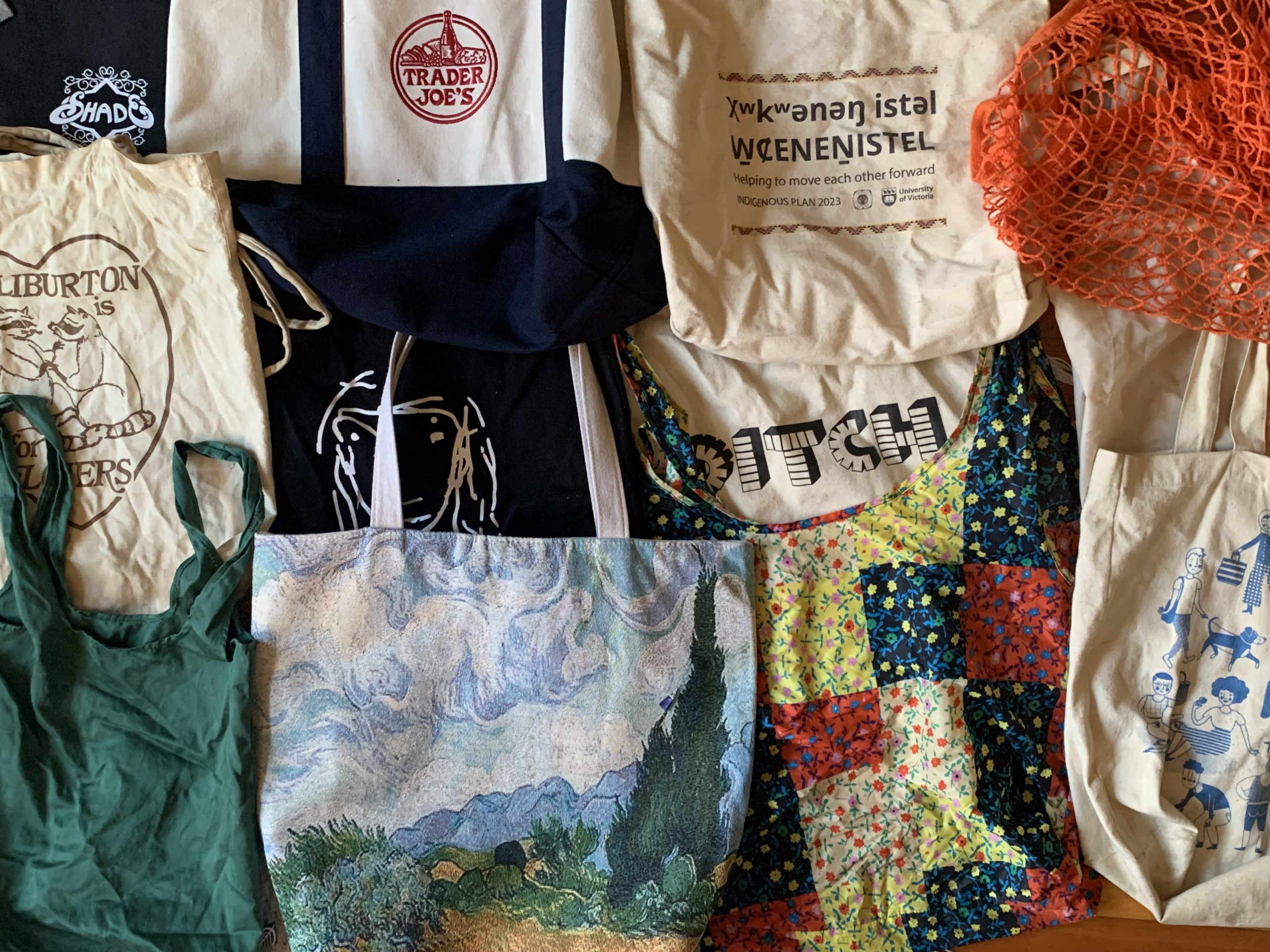
Photo by Rae Dawson.
In 2018, my grandmother gifted everyone in my family reusable tote bags for the holidays. When I moved to the West Coast the next year, my tote bag became a staple item to have on hand, as the City of Victoria had passed the “Checkout Bag Regulation Bylaw” in 2018 — meaning a ban on single-use plastic checkout bags. I still have the same bag to this day, and it has served me in countless grocery trips, errands, and commutes. However, since receiving my first tote — and arguably the only one I use most frequently — I have acquired enough tote bags to cover the floor of my bedroom.
Victoria’s ban of single-use plastic bags kicked up controversy when first introduced, leading the municipal bylaw all the way to B.C. Supreme Court. After many legal challenges, the bylaw was finally fully put into action in early 2021. Lisa Helps, Victoria’s mayor at the time, stated, “Reducing the distribution of single-use plastic items in Victoria is helping to keep plastic waste out of our landfill, save tax dollars, and protect the environment.”
There is no doubt that reducing plastic bag waste is a boon for the environment. By the end of 2025, over 4.2 trillion plastic bags will have been produced worldwide, 15 billion of which will be consumed in Canada. It takes about 1 000 years for a plastic bag to degrade in the landfill, and even then, it photo-degrades into many small and harmful micro-plastics that leak into the surrounding environment. According to a 2019 report by Ocean Conservancy, plastic bags, grocery and other, were the seventh and eighth most collected items during their International Coastal Cleanup. The report totaled just over 1.9 million plastic bags found along the coast. Less than 10 per cent of plastic in Canada is recycled.
A reusable tote bag has been offered as the solution to the problem of single-use plastic bags in Victoria. But how sustainable is this industry really?
According to a 2018 study done in Denmark, a conventional cotton tote bag needs to be reused 7 100 times to offset the environmental impacts of making it, or 20 000 times if the cotton is organic. This is due to factors like the high water content needed to make cotton textiles, only about 15 per cent of cotton produced being reused instead of put in a landfill, and the non-recyclable nature of many cotton tote bags due to the paint used for their graphics.
To offset the environmental cost of the average cotton tote, each bag would need to be used once a day for over 19 years. If everyone was buying one or two tote bags to reuse and only replacing them every 20 years, this wouldn’t be an issue. However, the monstrous collection of tote bags in my own closet and many of my friends’ proves that material alone is not the issue when it comes to our climate woes — overconsumption is much more costly.
Many of my tote bags I did not intentionally acquire, most were given to me as gifts or promotional give-aways. Despite not spending a penny on most of my totes, I still am consuming them at a rate much higher than I can use them, let alone offset their environmental impact.
Most of us were taught the three R’s in kindergarten: reduce, reuse, recycle. However, what most of us don’t know is that the three R’s are arranged in a hierarchy, with reduce being the most important. Prevention and minimization of waste is a surefire way to combat climate change, but that starts with our ability to say no to our drive to consume.
While it is true that 80 per cent of global CO2 emissions are the responsibility of just 57 companies, these companies rely on our drive to consume at an unprecedented rate to continuously turn a profit. The importance of individual purchasing power and consumer ethics is proven by the historic success of boycotts.
One of the most recent examples of successful boycotts is Starbucks, who has been the focus of boycotts for reasons ranging from raised prices, union-busting, and suing their unionized workers for tweeting in support of Palestine. This resulted in the company losing $11 billion dollars in 2023, and is still struggling to recover as they have had to close 12 retail stores across B.C. this year due to them “falling short of financial performance targets.”
What may seem like an arbitrary purchasing choice can send a significant message to companies who profit from the culture of overconsumption. Reduce; shift your mindset from “Do I want it?” to “Do I need it?” Reuse; consider if you already have something that fulfills what you’re considering purchasing. Recycle: repair your old items, or craft something out of things you already have.
Your purchasing ethics matter more than ever. The only thing we can control is ourselves, and it’s time to take responsibility for that for all of our sakes.