


As ICE grows into one of the most aggressive and controversial law enforcement agencies in the U.S., Canadian companies and public funds are quietly supporting the infrastructure that makes it possible
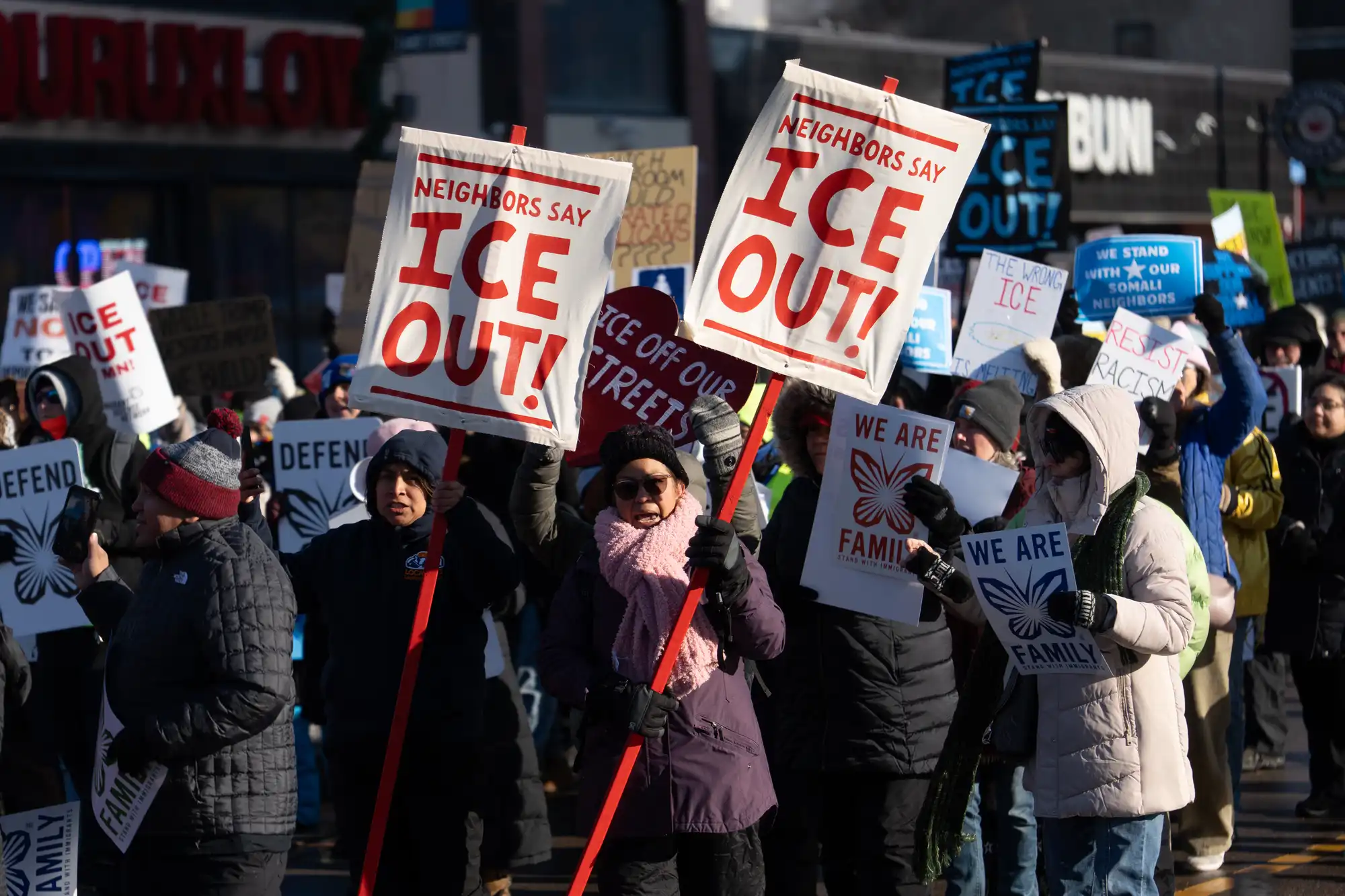
Photo via mrpnews.org.
Immigration and Customs Enforcement (ICE) is no longer a peripheral agency in the U.S. Over the last year it has become one of the most heavily funded and expansive arms of U.S. “law enforcement,” tasked with carrying out immigration-related arrests, detentions, and removals on a massive scale.
Its growing presence has brought public scrutiny over fatal shootings, detention conditions, aggressive raid tactics, and the practice of officers wearing masks to conceal their identities. That scrutiny should not stop at the border.
ICE already maintains a quiet but real presence in Canada. The U.S. government lists ICE offices in Toronto, Vancouver, Calgary, Montreal, and Ottawa. An ICE spokesperson has confirmed in a statement to the CBC that its criminal investigative branch, Homeland Security Investigations (HSI) operates out of the U.S. embassy and consulates in those cities.
While ICE agents cannot arrest people in Canada, carry weapons, or execute search warrants, HSI conducts cross-border criminal investigations including work related to drug trafficking, human smuggling, financial crime, and terrorism. With this information recently brought to light, the public has taken to social media to call for ICE operations in Canada to be shut down.
As ICE expands its operations, Canadian organizations are increasingly implicated in supporting the infrastructure that allows those operations to function. Through real estate transactions, government-subsidized technology, security contracts, and equipment manufacturing, Canadian involvement is fuelling ICE. This should prompt serious public concern.
In B.C., that concern surfaced last month, when it emerged that an industrial building in Virginia developed and owned by the Jim Pattison Group, a Vancouver-based company, was set to be sold to the U.S. Department of Homeland Security (DHS) for use as an ICE processing facility. The company said it was unaware of the intended purpose when it accepted the offer, and after public backlash — including calls for a boycott of Pattison-owned companies from BC Green Party leader, Emily Lowan — the company announced the sale would not proceed.
This incident drew significant public backlash because it was highly visible, but similar arrangements are occurring elsewhere in Canada, with little attention and much less scrutiny.
The Canadian federal government has committed $1 million in public funding to support the commercialization of AI-enabled surveillance tools developed by JSI Telecom, an Ottawa-based firm that has conducted millions of dollars’ worth of business with ICE over the last two decades.
Roshel, a Brampton-based defence contractor, has supplied armoured vehicles to ICE under a $10 million rush order. A U.S. subsidiary of Montreal-based GardaWorld has been cleared to bid on up to $138 million USD in ICE contracts, including work tied to the Florida detention centre dubbed “Alligator Alcatraz” that has drawn significant public criticism. Hootsuite, a Vancouver-based tech firm, saw backlash over a contract with the DHS, which oversees ICE. Hootsuite CEO Irina Novoselsky said the contract with DHS does not include tracking or surveillance, but did not commit to ending the contract despite public backlash.
Individually these arrangements can be framed as routine business decisions or standard cross-border cooperations. But collectively, they raise a broader question about responsibility and alignment. ICE is not merely another foreign client. It is an agency whose methods and outcomes have made it one of the most contested institutions in the U.S.
Canadian involvement matters because it does more than generate revenue; it confers legitimacy. When Canadian organizations provide property, technology, vehicles, staffing, or publicly subsidized tools, they help normalize ICE’s expansion and continued operation at a moment when its tactics are becoming more aggressive, and its agents are acting with impunity.
Canadian organizations do not bear responsibility for ICE’s existence or actions, of course, but they bear responsibility for the choice of doing business with the agency. Decisions to sell property, provide surveillance tools, manufacture equipment, or staff detention facilities are not morally neutral, particularly when the consequences of those services are well documented.
The reversal of the Pattison Group’s proposed sale shows that Canadian actors are capable of drawing lines when public scrutiny demands it. ICE operations may be beyond Canada’s control, but Canadian participation in said operations is not.
If Canadians are serious about the values it claims to uphold, then those values cannot stop at the border. ICE has moved beyond enforcing immigration law; it has become a tool of intimidation and violence under the Trump administration. Canadian participation in sustaining this is a choice, not a necessity, and it is a choice that demands public attention before this terror is normalized.