
This summer, CCG hosted sociology grad student Ethan Fortin to conduct survey of insect populations in select campus areas.
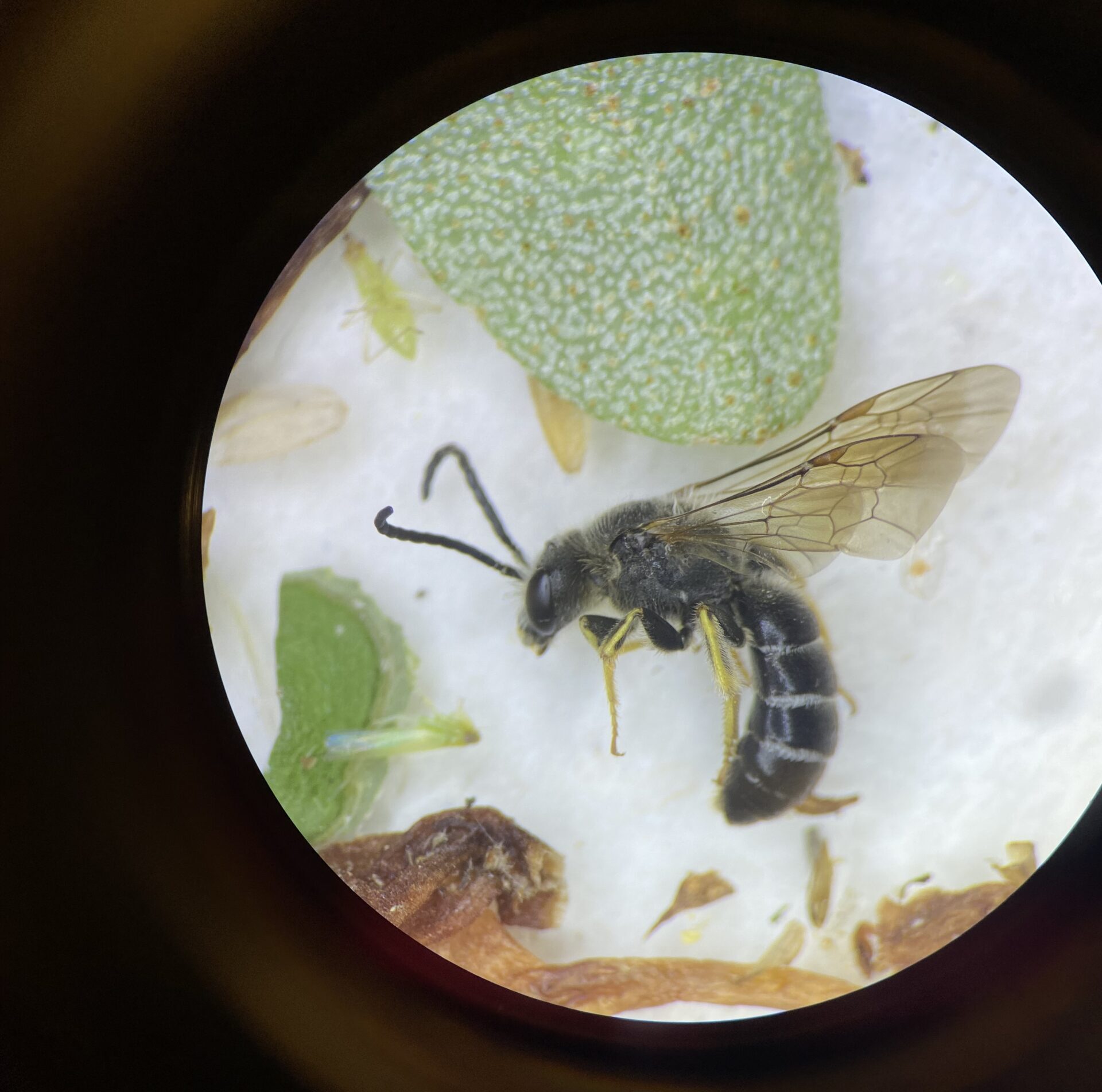
Photo courtesy of Ethan Fortin.
Over a six week period this summer, the Campus Community Garden (CCG) began a student-led research project with the encouragement of the Sustainability Scholars Program. The project enlisted one paid graduate intern to conduct research aligned with their expertise, in collaboration with the CCG.
Juls Macdonell, the assistant coordinator at the CCG, said that this initiative marked the first research project in the CCG’s history.
This year, Ethan Fortin, a second-year graduate student in Sociology, conducted a biodiversity survey of insects in designated plots in the CCG, Finnerty Garden, and the quad. He earned his undergraduate degree in Biology at the University of Alberta, with a focus on entomology, the study of insects.
“I was looking specifically at ants, bees, and wasps,” Fortin said about the research project. “[Wasps are] a really good group for seeing wider ecosystem effects. There’s lots of pollinators, there’s lots of predators, lots of parasites all within that group, and if there’s a lot of them, it’s a really good indication that there’s a lot of biodiversity.”
According to Macdonell, CCG originally imagined a survey on both bugs and birds, but because Fortin’s resume was so tailored to wasps, it ended up being a survey of local insects. Other than a check-in every two weeks, Fortin was mostly left on his own until the end of the internship, when Macdonell helped Fortin frame the report for UVic’s Administration.
Macdonell said that the goals of the research project were not to force specific demands onto the university, but to support their goals and give them the opportunity to extend their research.
Fortin’s research focus was on pollinators and parasitoids, “which is a lot of the wasps,” he said. “Many of them are less than a millimetre long — they’re tiny. Parasitic wasps are my favourite group of bugs; they’re very cool.”
Fortin explained that a lot of parasitoids are specialists, meaning one species will parasitize, or live on, another species of insects. For example, certain families of parasitoids parasitize only scarab beetles (Scoliidae wasps) or only monarch butterflies (Pteromalus cassotis).
“The group acts as a really good stand-in for the wider ecosystem, because if there’s something parasitizing scarab beetles, then you know there are scarab beetles, and so you don’t need to sample for every kind of bug if you can sample for this group of parasites,” he said. “The more diverse that group is, the more diverse the wider ecosystem must be.”
According to Fortin’s research, the native plant garden plots had statistically higher biodiversity of insects than Finnerty Garden or the quad did. What surprised both Fortin and Macdonell was that the biodiversity of Finnerty Garden and the quad plots were relatively the same.
“It really does go to show that non-native plants are not useful in terms of biodiversity. They’re not nearly as effective as native plants,” said Fortin. “You might see some pollinators, you might see some charismatic big bugs like honeybees [and] bumblebees show up for the big huge ornamental flowers, but you’re just not getting all these little species.”
“When they’re so highly managed too, it doesn’t create the same kind of habitat in the undergrowth, or the leaf litter in the messiness of what native plant gardens can sometimes be. That messiness is good; that’s part of what allows for so many different habitats.”
If you have visited Finnerty Garden, you may have noticed that several plants are surrounded by wood shavings. “It’s all kept very clean,” said Fortin. “There’s a certain aesthetic preference for cleanly cut lines and clean ground that has no leaf litter, grasses. It really really limits what bugs, what animals are able to use it. There’s not nearly as many resources or habitats.”
Macdonell plans to present the final report to UVic, and post it on the CCG website as a public-facing resource in their resource tab.
“If we get the chance to do another Sustainability Scholars grant next year…. Now that I’ve seen what research students, what grads students have, which [are] very specialized skillsets, I would want to do something similar … so someone could come in with a skillset like that and do what they do best.”