

During debate over the contentious development, council encountered confusion over provincial regulation and municipal independence before ultimately rejecting a high density project near UVic
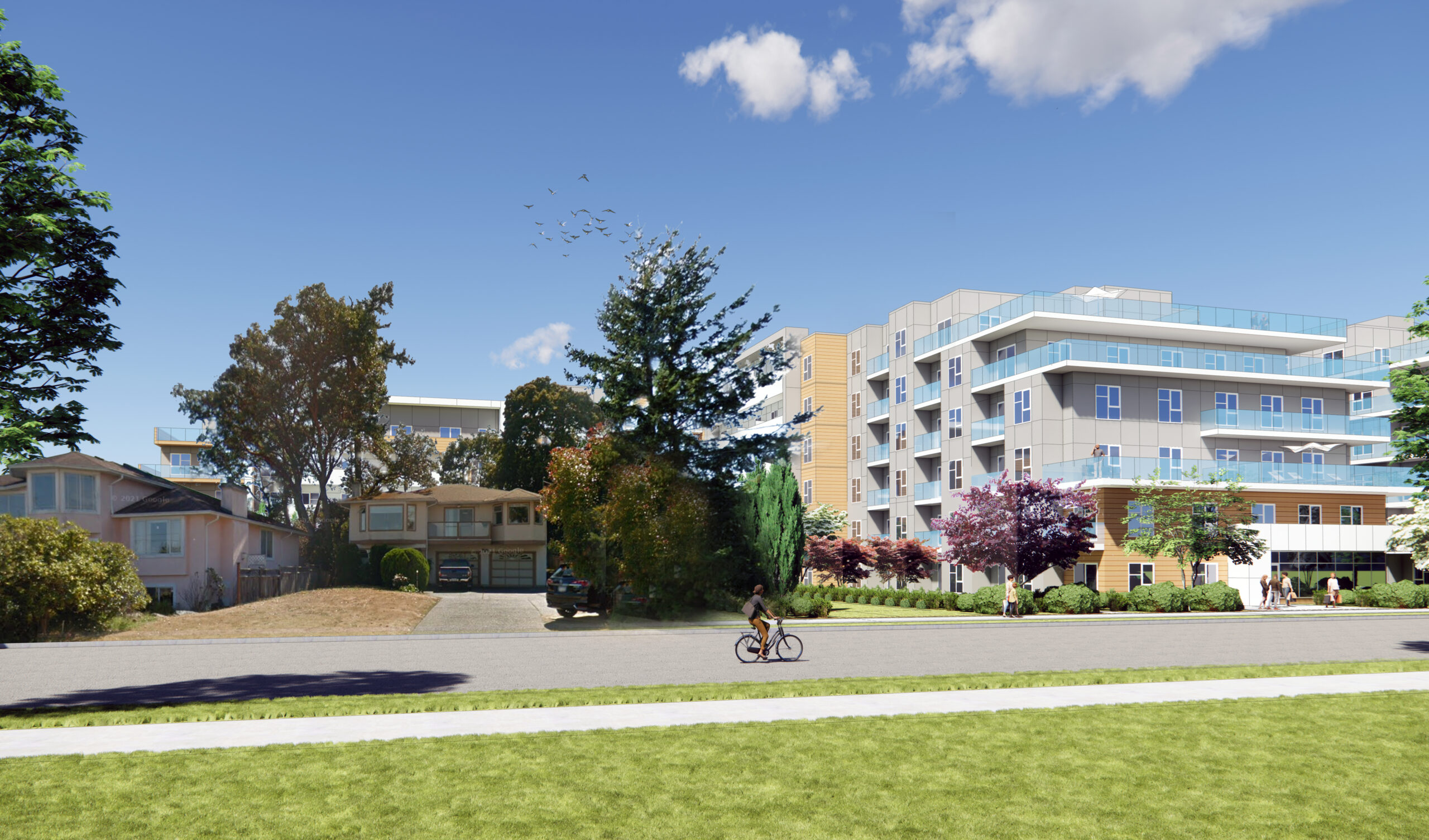
Rendering via Lovick Scott Architects.
On Aug. 17, Saanich council voted 6-2 against a newly proposed development at Edgelow Street and Finnerty Road. The development would have brought 349 new units to Gordon Head, near the university, including 92 two-bedroom units, which have a 2.9 per cent vacancy rate in Saanich, and 27 three-bedroom units, which have a 0 per cent vacancy rate.
The proposal was ultimately rejected by councillors Colin Plant, Karen Harper, Judy Brownoff, Susan Brice, Nathalie Chambers, and Mena Westhaver.
Councillors Teale Phelps Bondaroff and Zac de Vries voted against rejecting the development.
The proposal would have seen the development of seven properties, two of which currently reside in a “Transit-oriented area” (TOA). TOAs are areas where the province requires municipalities to approve higher-density developments, provided the projects meet certain criteria — such as being within 400 metres of a bus exchange.
Although the proposed property meets these requirements, there’s a catch: because five of the properties in the proposed development lie outside the TOA, council had the ability to reject the development.
To prevent councils from potentially rejecting developments that fall in a grey area, the properties must undergo what’s known as “consolidation,” where the property lines are legally erased between the lots. This would require the developer — Invictus Commercial Investment Corp. — to acquire all the properties.
Since Invictus did not purchase all the properties, they had not been consolidated. Invictus President Doug Foord told council via email that banks won’t allow financing for properties being purchased above market value without the development rights already in place. Therefore, purchasing and consolidating before application is impractical.
Councillor Plant raised a point of order prior to the first reading on the proposal (for discussion to even begin on the development, first reading must be done, and council must move for a second reading, where discussion will occur) saying there is no need to do any readings if council’s intention was to reject.
Saanich Mayor Dean Murdock saw Councillor Phelps Bondaroff move to do the first reading before Plant interjected with his point of order, so council voted to do a first reading. However, a majority of councillors (Brownoff, Westhaver, Brice, and Plant) opposed the reading. Plant then moved to reject the application.
Plant said he wants to “acknowledge this is rental housing that we need in Saanich,” but that he was “struggling with the amount of density that is being envisioned here,” and that there were no community amenities.
Conversely, Phelps Bondaroff opposed rejecting the application, reminding staff and council that the province’s housing targets only account for roughly 75 per cent of the district’s actual need, and that the district is far from meeting its actual housing needs.
“We have to weigh the housing needs of our community and the needs of our broader community. What I see in front of us is 349 units that are between a primary growth area and between a TOA. [And] one of the questions I get a lot from concerned citizens is … ‘how do we solve traffic problems on McKenzie?’” Phelps Bondaroff said.
“We could provide people with transportation options. We can also house people close to the things they need to get to.”
Phelps Bondaroff suggested that high density projects such as this could reduce traffic by reducing the need for students to commute from distant communities.
Foord said that the district suggested more internal amenities for the project, including a rooftop social space, but that he was against the idea since the development would have a large student rentership, and he didn’t want parties occurring there, disturbing neighbours and the broader community.
Harper, who is currently running for mayor of the district, moved to have staff develop a policy on how the district will handle TOAs and lot consolidations going forward. The motion passed unanimously.
In an interview with the Martlet, Harper said she voted to reject the proposal over confusing and unclear policy on developments partially in TOAs, but that she was not against density.
Harper supported rezoning for a similar six-story apartment near UVic earlier in the meeting, and said that she liked parts of the rejected development, including the variety of units and its proximity to UVic and other amenities.
Harper said she also had concerns over the community’s reaction to the proposal. “It was very clear that most of the community was still very concerned by it,” she said.
Phelps Bondaroff and de Vries, who is currently running for mayor in the upcoming local B.C. general elections, were the only councillors to vote against rejecting the development.
In an interview with the Martlet, de Vries said that “council focused almost entirely on the technicality of whether or not this was in the transit-oriented area.” He said that the application was worth “considering on its merits, looking at … our community needs.”
“This was a project that had student-friendly as well as family-suitable and oriented units close to both the university, but also close to schools, and I think it’s really important to provide a range of housing options near schools, so that people of all incomes can live closer to the schools which their kids attend.”
Foord told the Martlet that he hopes to bring the proposal back in a few months with the new council and that they will hopefully be more receptive to the project.
“[UVic has] 22 000 [student] enrollment, 5 000 faculty, and I think it’s 2 300 beds plus 151 family units. So clearly inadequate housing…. There’s very little in Gordon Head, and there’s nothing in Oak Bay. So everybody has to commute; everybody that’s commuting is causing pollution [and]… stress on transportation systems,” Foord said, suggesting that density near campus could reduce traffic, commuting, and pollution.