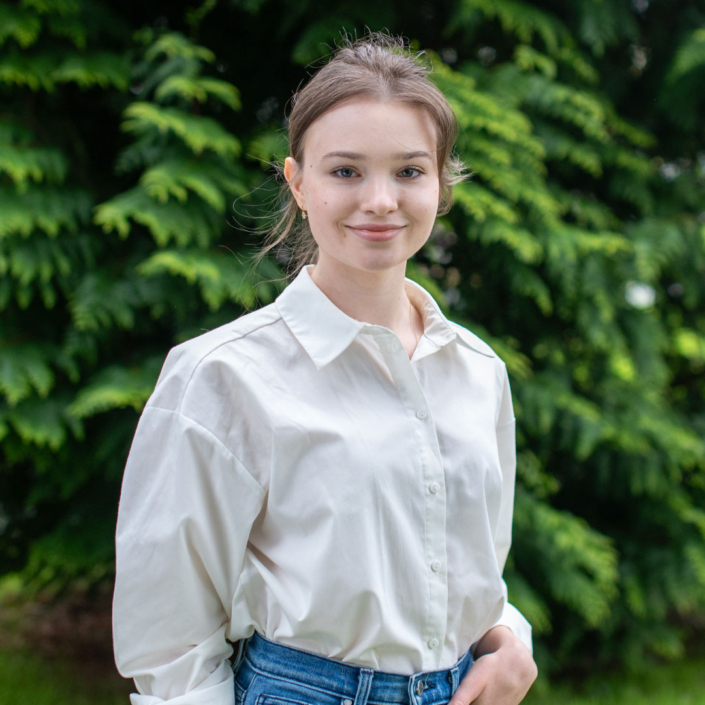

Student journalist Cereese Qusba spent almost two years investigating allegations of rape at Cornell’s Chi Phi fraternity house.
Graphic by Sabina Mendoza.
This article discusses sexualized and gender-based violence.
The story of the Cornell 57 is leading to vital, long-overdue conversations about the epidemic of sexualized violence on university campuses. It has also highlighted the enduring value of campus newspapers, and the potential we have as student journalists to seek justice, affect positive change, and hold even the most storied and powerful institutions to account when no one else will.
In October 2024, seven men affiliated with the Chi Phi fraternity allegedly drugged and sexually assaulted a Cornell student, identified as Jane Doe, in one of the university’s fraternity houses. The men identified in the lawsuit are Matthew Ingalls, Johnathan Newell, Winston Lee, Gillio Lopes, Diego Sarabia, Scott Norris and Scott Kretzschmar.
These seven men stand accused of gang-rape, but screenshots made public after the story broke show one member of the group chat “Chi Phi Actives” advertising Doe’s presence in the fraternity house to a group chat of more than 50 other Chi Phi members.
The story drew international attention after Doe filed a lawsuit against the Ivy League university in the middle of September of this year, stating that the university and other organizations had failed to protect her.
The civil complaint also names the seven men, several Greek Life organizations including the university’s Chi Phi chapter and her own sorority, Tri Delta, as defendants.
On Sept. 21, Cornell University’s independent student-run newspaper, the Cornell Daily Sun, published an editorial, castigating the university for its lack of transparency and regulation in relation to Doe’s sexual assault case, and perhaps most significantly, naming the defendants.
Before that, a student journalist, Cereese Qusba — then a senior editor at the Sun, spent 23 months building a relationship with Doe and her attorney, and interviewing Cornell administrators.
When a new editor-in-chief, Sophia Dasser, assumed control of the paper in 2026, Qusba — who was studying abroad in Australia — called her and told her she wanted the story she was working on about the alleged assaults to be a focus of the Sun.
Facing a no-confidence motion in his leadership this month, Cornell President Michael Kotlikoff admitted he never followed up on the 2024 report to learn what happened to her, or if any of the accused were punished.
Think about that. One student at Cornell, on top of her classes and writing for the Sun, spent nearly two years listening to Doe and working tirelessly to bring the story to light, when the university’s own president apparently couldn’t muster the curiosity.
As campus outlets, we lack the resources, staffing, and reach of larger news organizations. But that doesn’t mean we are toothless. The Cornell Daily Sun, established in 1880 — one of the oldest student newspapers in the United States — is itself a storied institution. According to the Sun, it receives over 16 000 readers per day.
Cornell University failed in multiple ways. It failed to provide a safe space in the first place; it failed to put measures in place that would mitigate or prevent violent behaviour like what the Chi Phi members are accused of. It also failed Doe in its response — allegedly allowing the accused perpetrators to write essays as a disciplinary action.
Tompkins County District Attorney (DA) Matthew Van Houten told CBS News he never received a transcript of a conversation between Jane Doe and Cornell University’s campus police before his office decided against bringing charges in 2024, while Cornell University said its police department provided the DA with the results of their investigation.
The purpose of journalism is to act in the interest of the public. As journalists, we aim to detect and expose crime or misdemeanor, protect public health and safety, prevent the public from being misled by a statement, organization, or an individual, and communicate matters of public interest.
When we become journalists, we learn that we are supposed to be the pillars of democracy. We are supposed to call out institutions, and those in power, when they fail to serve us. Dasser, Qusba, and the rest of their team at the Sun have done exactly that — followed their journalistic duties to uphold values that ensure safety on their university campus, and hold their institutions to account when they fail to meet that standard.
And even against what seem like impossible odds, the work of student journalists can lead to change. The editors of the Sun are certainly not to credit for Doe’s decision to pursue civil litigation, knowing that survivors of sexualized violence still face overwhelming stigma, victim blaming, and online harassment grounded in the most vile misogyny; Doe’s family home was recently the target of a swatting attack — a harassment technique involving making a false police report to draw law enforcement to a location, which can often turn deadly.
That bravery is hers alone. However, Qusba may be credited for understanding this was a story that needed to come to light, and for her dogged reporting when few others were paying attention. The state of New York has since reopened investigation into the case, and Governor Kathy Hochul has appointed state Attorney General Letitia James to head up the case as a special prosecutor.
We must recognize the bravery of Jane Doe, who was put in a position she never should have been in — seeking justice for herself after her own university failed her. We must recognize the bravery of Dasser to, as the Sun so finely put it, do what Cornell wouldn’t. And we must recognize the bravery of one plucky student journalist, Qusba, who never gave up on bringing Doe’s story to light.
But the story doesn’t, and can’t, end here. Sexualized violence doesn’t happen in a vacuum, it is inculcated through years of misogynistic jokes, victim-blaming rhetoric, and excuses for predatory behaviour. When we are too afraid to challenge this rhetoric from our friends, colleagues, and family members, or when we shy away from reporting on it, it spreads like mold under the damp blanket of our cowardice.
As journalists, we must seek to root out the pernicious and deeply embedded rape culture in our society with the same fervor we do corruption, malfeasance, and institutional mismanagement. The commitment to accountability and transformative change we embrace when we become journalists cannot be something we leave at the door at the end of the day.