
The Cornell case has sparked major discourse online about sexualized violence, but how is the issue being addressed in male-dominated spaces on campus?
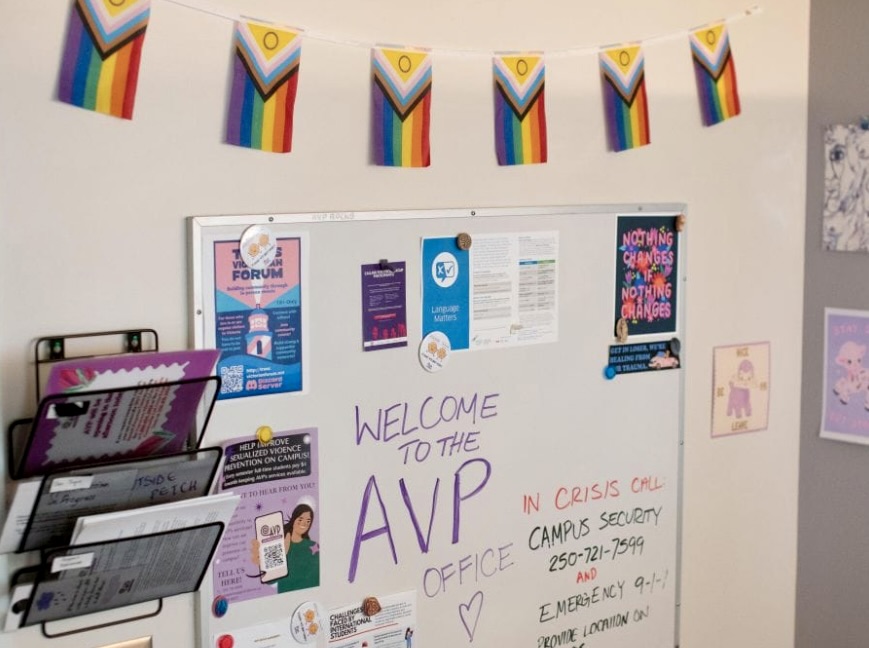
Photo courtesy of the Anti-Violence Project.
This article discusses sexual violence and gender-based violence.
A former Cornell University student, identified as Jane Doe, filed a lawsuit in September, alleging she was raped by seven members of the university’s Chi Phi fraternity chapter in their on-campus fraternity house in 2024. In the case, which has come to be referred to online as the “Cornell Seven,” Doe alleges that she was pressured into taking substances while highly intoxicated before being raped by the seven men for several hours.
Filed as part of the lawsuit are photos that appear to show Snapchat messages sent by some of the defendants sent to a group chat consisting of 57 members, “Chi Phi Actives.” One photo shows a message that reads “free p*ssy in alum.”
The lawsuit has sparked massive online and interpersonal discourse about the culture of sexualized violence, extending beyond social media and into the UVic community.
“A conversation that we’ve been having in our office is actually the disservice that referring to it as the ‘Cornell Seven’ has, when in reality it should be referred to as the Cornell 57,” said Alessia Servin, the Anti-Violence Project’s (AVP) Peer Support and Administration Coordinator.
The AVP is an on-campus sexual assault resource center, housed in the basement of the SUB, that provides peer-support, education, and advocacy on all forms of violence.
Servin said that they understands why people — especially men and masculine-presenting people “in toxic masculine spaces” such as fraternities — may hesitate in coming forward, or calling out their friends, but emphasized the importance of bystander intervention.
They provided examples of how individuals can act properly as bystanders, especially when hesitant, such as acting as an anonymous witness or checking in with a friend. “I think it is essential in this context, but also just in everyday practice that we understand how to be bystanders.”
Servin said that, while Greek life spaces have changed over time, toxic masculinity still persists in fraternities.
“The secrecy, this code of conduct, that a lot of the time is this brotherhood of keeping each other’s secrets and supporting each other, even if that means doing something like the Cornell 57,” they said.
Carl Haynes, a volunteer with the AVP, said that “we need to see accountability as a loving thing to do to someone you care about.”
Haynes said that, when he was an executive member of Delta Kappa Epsilon (DKE) in 2016, he found out that one of his frat brothers had raped someone. He said that he was first informed in a meeting of executives after an advocate of the survivor reached out to DKE’s president.
Haynes said the DKE executives unanimously voted to remove the brother from the fraternity and provided support to the survivor, who turned out to also be a friend of Haynes’.
DKE operates off-campus and independently, as the university and the UVSS do not recognize or sanction fraternities and sororities.
Later, Haynes said, he and the survivor entered into a romantic relationship and eventually got married, “so I got a very front row seat to the aftermath of sexualized violence.”
“It was very formative for me to see a man in a leadership position, someone I looked up to, really model how to handle these cases,” he said of DKE’s president at the time.
However, even though he felt sexual assault cases were handled well at DKE during his time as an executive, the casual misogyny and sexism that are “the underpinnings of rape culture,” weren’t properly addressed, he said.“Rapists aren’t born in a day. It takes a village to raise a rapist.”
The call for more men to get involved in sexual violence prevention led Haynes to begin volunteering with the AVP in 2023, where he was later hired on a two-year contract as an Education and Research Coordinator and Men’s Wellness Coordinator.
Under this role, he began facilitating the AVP Men’s Circle, a weekly drop-in session for men and masculine-identifying people that aims to deconstruct toxic masculinity and facilitate conversations about consent, boundaries, and healthy sexuality.
“A lot of men are taught that to be a man is to enact your inherent power and control over people…” Servin said, “whereas the Men’s Circle creates a safer space for men to come together and be vulnerable.”
DKE president Jimmy Watchell said that about a dozen DKE members have attended Men’s Circles, and that they’d love to be involved more.
“When we go to these Men’s Circles, we can definitely be a lot more vulnerable and open with our speech … I would like that it be like that always, but it’s not an easy thing to do,” he said.
Watchell said that in recent years DKE has done multiple consent workshops, and that moving forward they will try to make consent workshops a requirement for every new brother to attend.
“We take a lot of pride in how we’ve approached this topic in years past and continue moving forward,” he said.
Joe Rosette, who is in charge of risk management at DKE, is the “sober brother” at every DKE event tasked with helping anyone who needs it. “Anyone who feels [un]safe or anything like that, they can come up to me at a party.”
Watchell said that before each event, Rosette briefs brothers on potential risks, liabilities, and resolutions. While brothers’ are informed they can go to Rosette for direct support, “he’s also laying out the frameworks and foundations before the events,” Watchell said.
Servin wonders what the outcome of the Cornell case might have been if one of the 57 men in the group chat attended a men’s circle. “We really encourage folks to come see us, reach out to us,” they said.
The AVP is a free service that is open to anyone in the Greater Victoria region, with talk and text phone lines available Monday through Friday. Though the AVP continues to support survivors, Haynes said that “these resources on campus need more funding.”
He said that sexualized violence resources are not available on campus after 5 p.m., or on the weekends. “We are failing students,” he said, “and we need to fund these services much better.”
Students seeking support can visit the AVP, UVic’s Equity and Human Rights Office, and UVic’s Sexualized Violence Resource Office. The AVP offers anonymous support hours twice a week, the Men’s Circle, and training on supporting survivors and understanding consent.