
“Feel free to sit, look into the mirror, observe your surroundings, and engage in conversations with fellow passengers.”
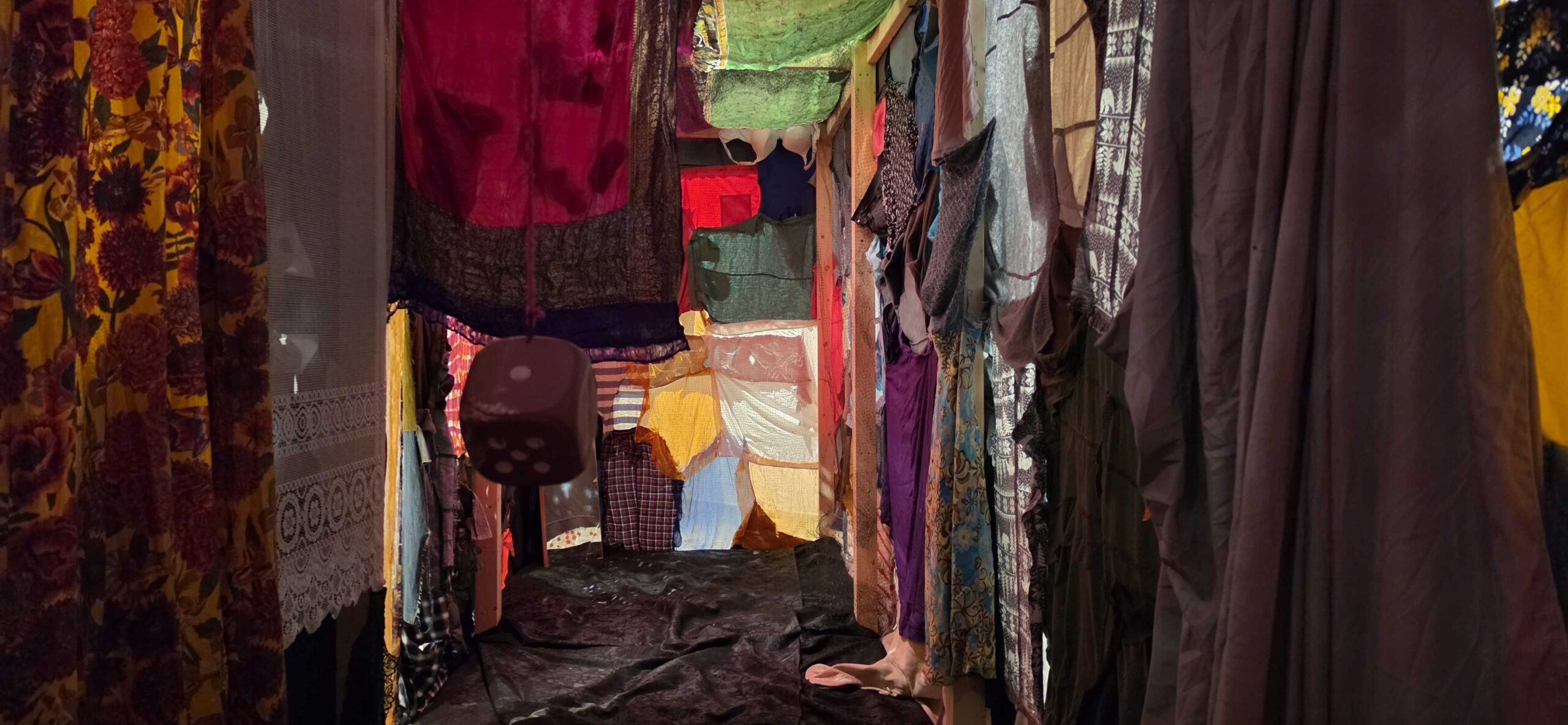
Photo by Amelia Watson.
Francis Okai is a Ghanaian multidisciplinary artist currently pursuing his Master of Fine Arts (MFA) at the University of Victoria. AYALOLO is Okai’s solo art exhibition, which ran from Oct. 19. to Oct. 23. at UVic’s Audain Gallery.
The title of the exhibition, AYALOLO, is a name in the Ga language, an Indigenous language spoken by the Ga people of Ghana. AYALOLO is also the name of the public bus and transportation system in Ghana, which inspired Okai’s exhibition.
The exhibition featured a massive wooden rectangular structure, draped from top to bottom with various textiles, fabrics, and items of clothing stapled and sewn on.
The interior of AYALOLO was filled with warm colour beaming through the textiles covering the walls, compared to its cooler exterior. Entering the structure, there was a wooden bench taking up the right end of the bus with stacked tires as support, and on the other end, a full length black framed mirror. There are finer pieces of fabric representing windows on the walls of the bus, making the already warm interior feel even more spacious and vibrant.
The structure represented a Ghanaian bus, and visitors were invited to take off their shoes, go inside it and interact with the structure and other passengers.
Okai wanted visitors of AYALOLO to be curious and to allow their own memories and experiences to shape their journey of the exhibition.
“Feel free to sit, look into the mirror, observe your surroundings, and engage in conversations with fellow passengers,” he wrote in a handout available for guests of the exhibition.
Okai’s work “explores identity as something fluid, shaped by our surroundings and the different roles we inhabit.” The exhibit has “no soundtrack, no assigned destination, and no single way to experience this journey.”
“The moment you enter, even if you want to be concentrated and rigid, the floor makes you think about a certain movement. I was trying to play with that idea from the perspective of being on the bus,” Okai said in an interview with the Martlet.
Okai is driven in his work by understanding other perspectives, and natural dualities in the world. For him, the bus is a space of duality, creating a bridge between Victoria and Ghana, “where public and private, presence and absence, familiarity and unfamiliarity coexist.”
“I’m interested in duality. I like to play with the law of opposites,” Okai said. I intentionally put certain things inside the [bus], certain elements, just to see how people react with all these things. They are everyday things we all do, and I wanted to see how different I am from other people.”
AYALOLO was accompanied by two smaller installations: The Bus Stop and By My Bed.
By My Bed represents the mess of bedside tables, and the unnecessary waste people produce more broadly. Okai wrote that the installation explores the relationship between “order and disorder, and the objects we live with.”
“When I was working on [By My Bed], I realized that this [pile of clothes and accessories] is what was left from all the things people brought to me, ” Okai said. “I gathered them, and I was looking at it, and I was like, this actually looks like my bedside, so I titled it By My Bed.”
The Bus Stop was inspired by bus stops around Victoria, and is a dedicated spot in the exhibition for visitors “to pause and observe.”
Inside the bus is another seating area that “encourages reflection, interaction, and conversation.”
“I’m sure my blood is even in this work.… If you’re stitching and you’re trying to get all the pins out, sometimes you forget, and the pins get into your hand, and I feel like my DNA is in the work,” Okai said.