
An Offbeat by CFUV review
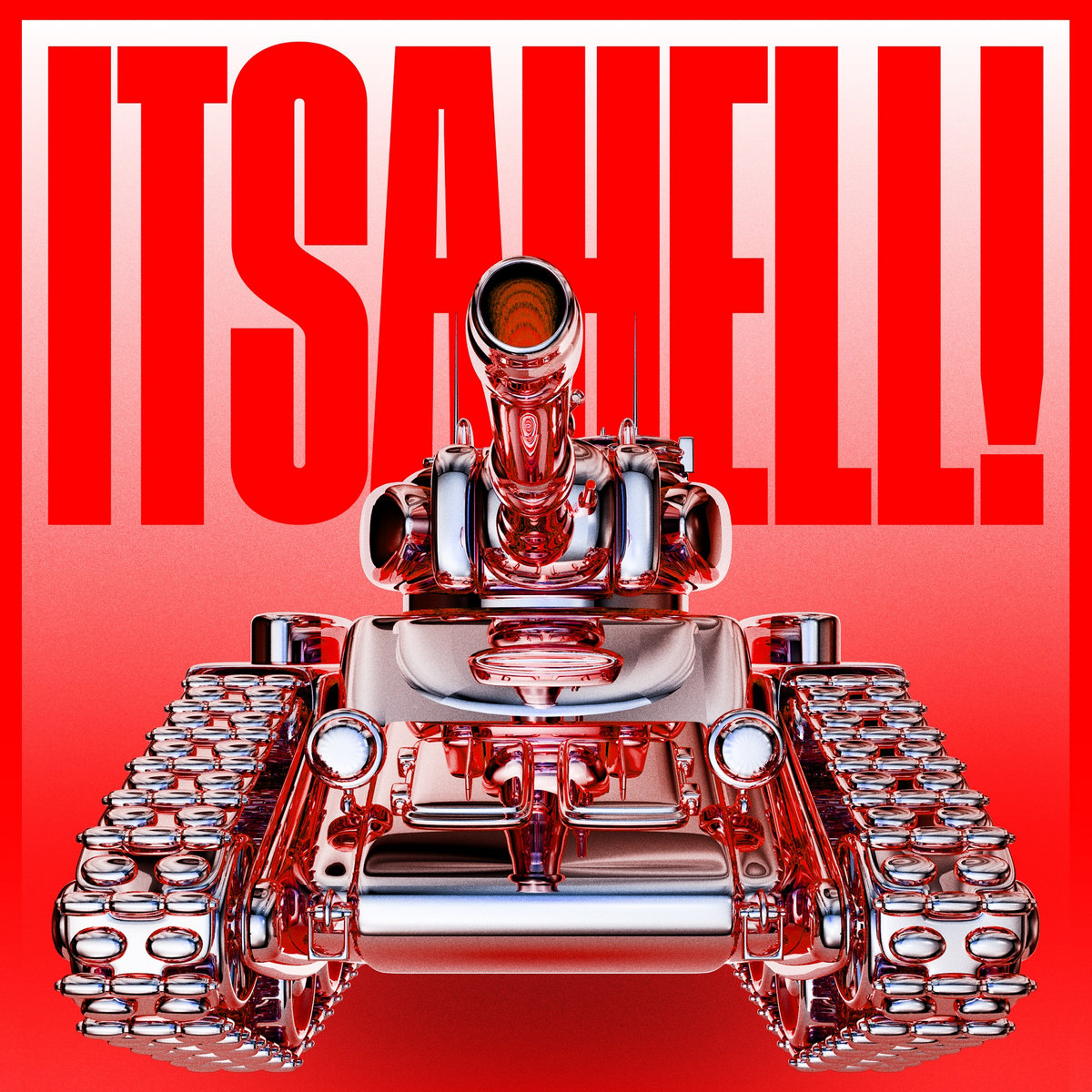
Image via Bandcamp.
In summer 2024, Bashar Murad released his EP, ITSAHELL!, across multiple platforms. The title, (It’s A Hell) aptly summarizes what the short form album is about: Israel, and the Palestinian experience under Israeli occupation and apartheid.
Murad, a queer Palestinian musician and filmmaker, was born in East Jerusalem in 1993. His father founded the musical group Sabreen, which Murad samples on the album’s second track, “Stone.” Murad says he uses his art to fight against all forms of oppression.
ITSAHELL! reflects Murad’s dreams for the future, a protest against the genocide of Palestinians carried out by the Israeli state, and a critique of Western culture. The titular song “ITSAHELL!” begins with a distorted version of Handel’s “Hallelujah Chorus,” sharp beats like gun shots, and then dives into an energetic and angry pop critique of Zionism and the dehumanization and oppression of the Palestinian people. Towards the end, the song shifts into a dream-like vision of a world where all people are free.
“Stone” opens on a melancholic note: part lament for what was taken from the Palestinian people — land, safety, and recognition — and part promise that Palestinians will return to their homeland. Unlike the distortion and anger of the title track, “Stone” is gentle and catchy, but similarly shifts toward the end of the track, taking on a more insistent rhythm, and introducing themes of persistence. It ultimately closes with a return to the opening mood, only with more hopeful lyrics, as Murad sings about the stone he carries with him from his homeland.
The final track, “Wild West,” was Murad’s entry in Iceland’s Söngvakeppnin 2024, the national contest to select which song would represent Iceland at Eurovision. “Wild West” placed second. As a country-inflected pop song, “Wild West” is suave and catchy, and hints at a satirical critique of the West, capitalism, and the precarious pursuit of fame. The music video leans into Palestinian symbolism, featuring Murad driving past orange trees, and later as a passenger in a truck full of watermelons — fruits associated with Palestine — and flying a plane over a massive wall topped with barbed wire, likely referencing the separation wall in East Jerusalem.
Towards the end, people perform the dabkeh, a traditional Middle-Eastern folk dance, popular in Jordanian, Palestinian, Syrian, and Lebanese communities, and the video ends in a showdown between two versions of Murad; One, wearing blue contacts, is armed with a gun, while the other is only armed with a snowball.
Though brief, ITSAHELL! is a testament to Murad’s skill as an artist. It is a powerful pop EP that is just as poignant and relevant now as it was when it was released. Murad is an artist worth watching, and I can’t wait to see what he produces in the future.