

As antisemitism surges globally, the failure to separate Jewish identity from the Israeli government puts lives at risk.
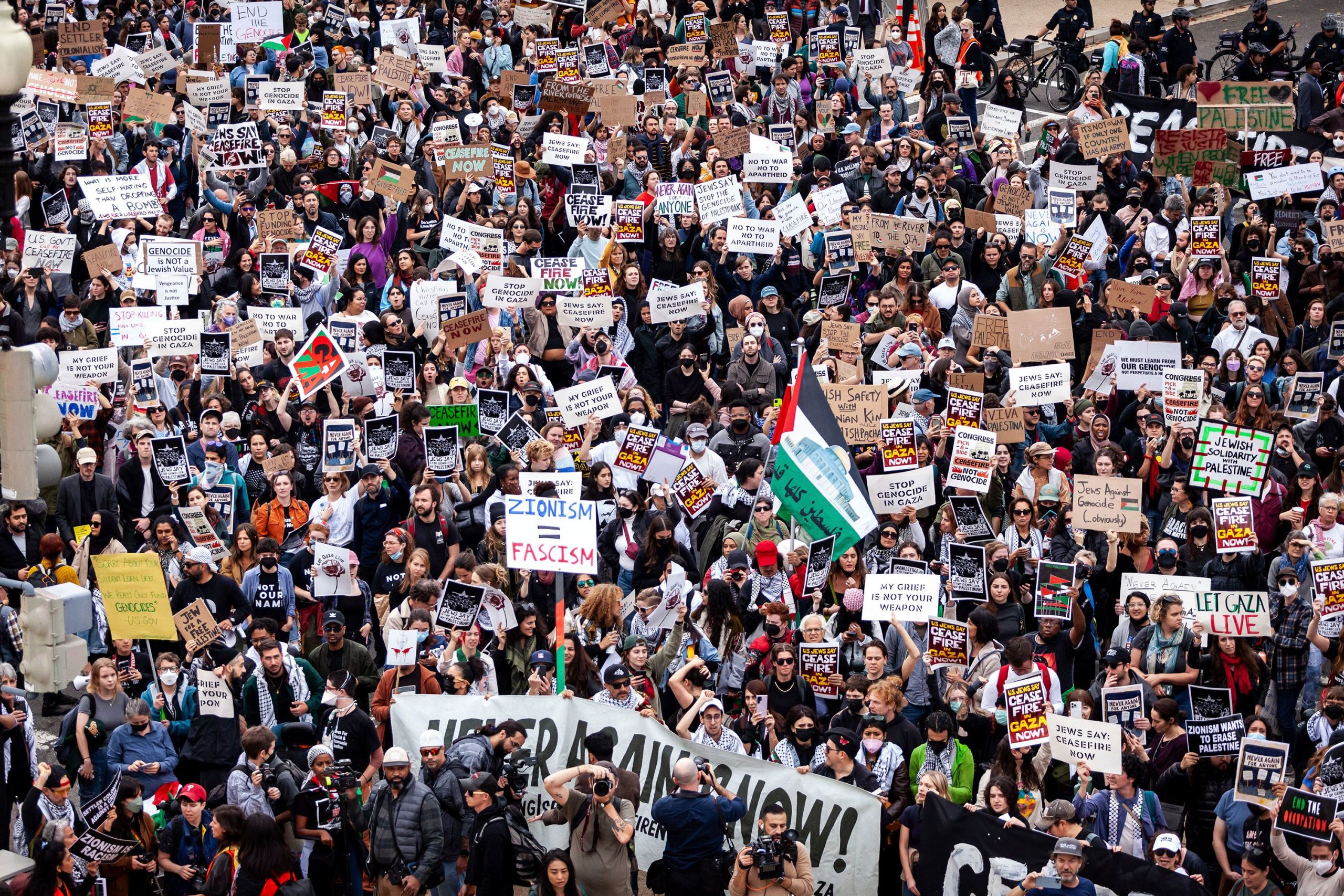
IfNotNow and Jewish Voice for Peace rally for a ceasefire in Gaza. Image via cnn.com.
We are living through a global surge in antisemitism, and it is unfolding alongside one of the most polarizing conflicts of our time. Since Oct. 7, 2023, attacks on Jewish people, schools, synagogues, and memorials have risen across the globe.
Amidst the ongoing military action in Gaza, which has widely been decried as a genocide by numerous international organizations — including a U.N. commission, — it has become increasingly clear that many people are struggling, or outright refusing, to separate Jews worldwide from the Israeli government. This failure reshapes public discourse to, at times, minimize, justify, and polarize people towards antisemitism.
One of the most recent attacks against Jewish people occurred on Bondi Beach in Sydney, Australia, where over 1 000 people gathered to celebrate the first night of Hanukkah. Two gunmen opened fire on the attendees of the event, killing 15 people and injuring dozens. Those killed include a ten-year-old girl, a Holocaust survivor, and two rabbis, as well as 11 other attendees who were celebrating with family and friends. This devastating attack is only one of many.
It is important that we remember: the targets of these attacks are not Israeli policymakers or military officials. They are Jews — in prayer, in school, in celebration.
As a Jewish person, I have struggled to condemn antisemitism without being met with certain assumptions — that I am a Zionist, that I support Israel and violence against the Palestinian people. None of this is true.
We should be able to grieve attacks on synagogues, speak out against hate crimes, and demand safety for Jewish communities in the same way people do for any other marginalized group. Instead, when Jews speak up, we are often asked first to answer for the Israeli state; its military strategy, its government, its history. Our grief is interrogated and our fear is politicized.
This dynamic stems from a profound misunderstanding of political responsibility and the idea of collective blame.
Historically, Zionism emerged as a response to the failure of Jewish emancipation and integration in Europe. In its original form, Zionism was a nationalist movement based on the belief that Jews were entitled to self-determination.
Furthermore, Zionism was never universally accepted within the Jewish community. Many feared, correctly, that tying Jewish identity to a nation-state would only intensify antisemitism rather than resolve it. Others opposed on religious or socialist grounds. Zionism was contested within Jewish communities from the very beginning — as it still is today.
This history matters, but does not justify the events that followed.
The way Zionists sought to create a state in Palestine created another injustice: the forced displacement and exclusion of Palestinians. Early Zionist settlement strategies, including land purchases that removed Palestinian tenants and the construction of separate Jewish and Arab economies, caused real harm. The declaration of the state of Israel at the end of the 1948 Palestine War occurred alongside the ethnic cleansing of three quarters of a million Palestinians. The consequences were not abstract; they were violent, and reshaped lives irreparably.
Acknowledging this history is not antisemitic — it is necessary. Criticism of Israeli policies and actions, past or present, is not antisemitic either. They are necessary, and part of a legitimate political debate. But in recent years, something has shifted.
For many, opposition to Israel and the belief that it is an illegitimate state has transformed into something broader and more violent: the belief that Jews everywhere are implicated in its actions.
This is where legitimate criticism diverges into collective blame. Rather than being treated as individuals with diverse political views, Jews, many of whom have no connection to Israel, are treated as representatives of a state thousands of miles away. No other diaspora population is held to this standard.
It is of no help that mainstream media outlets, Israel itself, and Western politicians make a concentrated effort to conflate Jews with the state of Israel and deepen their ties; President Joe Biden repeatedly made comments after Oct. 7 that Jews worldwide would “not be safe” if not for Israel — a disturbing sentiment to hear from the leader of a country which an estimated 7.5 million Jews call home.
Antisemitism is visibly growing on both sides of the political spectrum. On the left, there is a growing hatred towards Jews due to the actions of Israel. It is insisted upon that we prove our moral worthiness by denouncing Israel loudly enough, often enough, or in precisely the right terms.
On the right, nationalist and nativist movements that once supported Israel are now fracturing. This, on its own, would not be an issue. However, the recent rise in influential figures on the far right like Candace Owens, Tucker Carlson, and Nick Fuentes are increasingly espousing openly antisemitic views, on top of their usual racist rhetoric. Antisemitism is no longer confined to one ideology; it is being recycled and repurposed across the spectrum.
The result is a political climate in which Jews are being squeezed from both sides.
None of this brings justice to Palestine, or breaks political and economic ties to Israel. None of it advances peace. And none of it makes anybody safer.
We should be able to hold multiple truths at once: that Judaism, Islam, and Christianity all have a legitimate religious and historical connection to the land, and the city of Jerusalem in particular; that Palestinians have long-standing ties and history with the region they have been forcibly removed from, or continue to live in, under illegal occupation and rampant violence; that Palestinians have suffered, and continue to suffer, grave injustices at the hands of the Israeli government; that Israel, like any state, can and should be criticized; and that antisemitism, especially when disguised as political critique, must be confronted without hesitation.
If we cannot separate Jewish identity from the actions of the Israeli government, then we cannot engage in serious political analysis. We are reviving an old and dangerous idea: that Jews, wherever they are, are responsible for forces beyond their control.
History shows us where that idea leads. We would be foolish to pretend it won’t take us there again.