
UVic student Maxwell Sorenson’s production features 19 musicians, many of them students
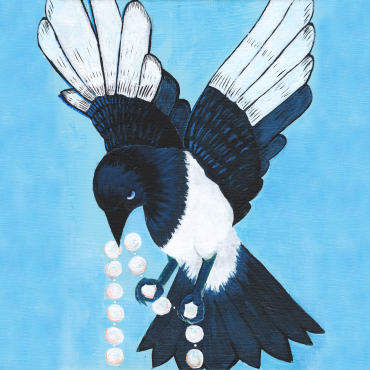
Album cover courtesy of Maxwell Sorenson.
Bad Luck Pearl is the project of Maxwell Sorenson, a fourth year student at UVic. The debut album, also titled Bad Luck Pearl, dropped in July under Funny Orange Label, a Victoria-based CD and cassette label.
Written largely in his hometown of Calgary, Sorenson composed many of the album’s tracks in his home basement, and produced demos which would eventually be recorded in Victoria.
Sorenson connected with over a dozen Victoria-based musicians for the project, as well as several from Calgary, Edmonton, and Whitehorse, through UVic’s Computer Music Course Union (CMCU) — of which he is currently president — and the Music and Computer Science combined program.
Bad Luck Pearl totals at no less than 19 accredited musicians and vocalists contributing to its formidable instrumentation.
Sorenson cited contemporary musicians in Victoria as a driving inspiration for the record, as well as influences of chamber rock and baroque pop groups such as Black Country, New Road and Vampire Weekend.
“It was largely inspired by other [student’s] work, and also a lot of it was done in the [UVic CREATE Lab] recording studio on campus,” said Sorenson in an interview.
“[The album] was written in Calgary but most of it is about things that happened in Victoria. There’s a lot of [material] about religion, specifically about Christianity. It’s something that I have been thinking about and struggling with a lot, specifically about the nature of truth.”
The opening track, “Blurs to Red,” wrestles with the nature of truth in the context of religious struggles, and the outlandish notion that any single person could accurately distill its essence. Sorenson sings listfully over a dizzying accompaniment of instruments that seem to fill the mix to every possible corner.
Other tracks, like “The Weight of My Head” showcase the reflection of genres like chamber rock and baroque pop in clear form, contrasting the driving drums and lyric-centric verses between the alto saxophone, violin, oboe, and clarinet, which elevate the songs. “Uriah” shows a direct line of influence to projects like Radiohead’s In Rainbows, featuring tireless acoustic guitar against spiraling horn arrangements, culminating in an anxious storm of sound.
Although Sorenson composed all the music together in advance of recording, he does not describe himself directly as a multi-instrumentalist. Instead, he says, he took on the role of producer and creative director, working one-on-one with musicians.
“I started [when] we ran CMCU events and started doing jams. I am not super proficient in any instrument, so I didn’t feel super comfortable playing…. But I started directing people,” Sorenson said. “I found I really enjoyed doing that … and that people really appreciate it when you’re good at it. They want direction.”
He states that a large part of the project revolved around building confidence and asking for feedback from fellow collaborators.
“[The process] was a lot of learning about myself and about leadership with directing all these people … what I have to stick with and not budge on.”
Despite being an album that was mostly written in advance, there are a few exceptions, those being the improvisational, collaborative tracks. Sorenson notes the contribution of Anthony Ryan, former CMCU president, who coordinated a feedback system using multiple speakers and microphones, providing a background of heavy reverberation for instrumentalists to improvise against. Segments of this recording were then worked into the album.
Transitioning from more traditional songwriting, “Naomi’s Interlude” is a deft and poignant addition of ambient music, utilizing dense layers of reverberated percussion, piano, and accordion — played by Naomi Harris — that shivers in its timbre. Harris also provides the song’s backing vocals.
“Having all these recorded pieces that I can’t change and fit together in such a structured way, it was a challenge to me. Letting go of that need to have meticulous control over everything was really helpful and I think it led to some really cool stuff.”
Sorenson noted working with soprano vocalist Sadie Karlsson as a highlight of the recording process, who’s most prominently featured on “Light Pollution, Pt. 1.”
“She understood what the songs were supposed to be,” said Sorenson. “She instantly was able to improvise over them very fluidly.”
Karlsson’s performance is a thread that brings together the track’s piano performance, turning it from lilting and daze-like to then frenetic, accompanied by a pulsating string performance. Karlsson’s vocals hang high among the entire track and are impossible to ignore.
If anything, the track seems to want to rest firmly in space before abruptly changing into a frantic drum beat and bass guitar jam supported by oboe and horn. “Pt. 2,” the sequel track to “Light Pollution, Pt. 1,” feels like the most energetic track on the album, and its drum performance by Ezekiel Dukart holds a vice-like grip on the track’s energy.
Sorenson also commented on how the album has been received since its release, and the number of inquiries he’s fielded regarding Karlsson’s vocals, as well as several of the instrumental performances by others.
“Going a step further, finding the names of the performers, especially because a lot of them are UVic students — and you may very well know some of them. I would implore people to do that if they hear something that catches their ear.”
Sorenson states he’s deeply missed performing live, and has hopes to collect instrumentalists for a performance of the album tracks within this semester.
The album is available on streaming platforms such as Spotify, Apple Music, and Bandcamp. A run of cassettes are available for order via Back Luck Pearl’s Bandcamp page, as well as Funny Orange Label.