
Director Glynis Leyshon says the production, originally slated for before COVID-19, may be more relevant than ever
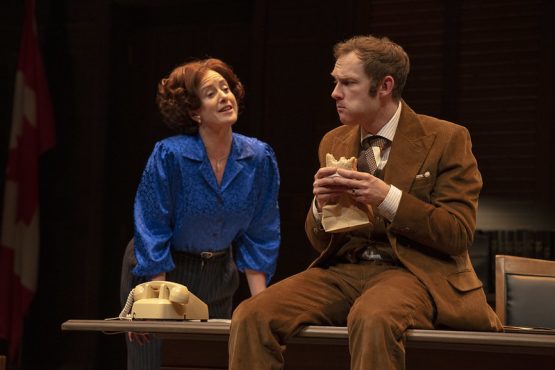
Photo courtesy of Mark Doussault.
The day is Dec. 13, 1979. Progressive Conservative Party of Canada leader Joe Clark has been the prime minister for just six months. Tonight, parliament will vote on Clark’s budget for the country, focusing on austerity measures and cuts to government spending. It’s obvious to everyone that the budget will not pass, and its likely failure will bring a premature end to Clark’s term in office.
Such is the moment of the Belfry Theatre’s production of 1979.
Originally planned to release when COVID-19 hit, 1979 was postponed, but director Glynis Leyshon said the play may be more relevant to audiences now than its original planned run, given today’s volatile politics, mirroring the dramatic and high-stakes setting of 1979.
The play takes place entirely in the Prime Minister’s office, with a revolving door of historic Canadian politicians to share their advice to Clark, whether he wants it or not. Three actors play a cast of seven — the only unchanging role is Nathan Howe as Clark, channeling the long-suffering straight man archetype in a cast of big personalities, while chaos ensues in parliament.
Of course, those big personalities are dramatized for the sake of the stage. “[The play is] not trying to pretend it’s naturalism,” said Leyshon. While the play is based on true events, these events have been heightened to draw out dramatic attention.
“It’s not a hatchet job on anyone, [rather, the playwright is] interested in finding the truth,” said Leyshon. The characters are heightened for comedic purposes, but they don’t represent an attack on specific political figures.
All three actors do a fantastic job in heightening the tension of the last few minutes before the climactic budget vote. Actors Jay Hindle and Luisa Jojic electrify the stage, jumping seamlessly from character to character as they charge through the office doors. Their larger-than-life performances grow even sharper in contrast to the understated “Joe Who” (a pejorative nickname given to Clark, regarding his lack of presence). During these tense last scenes, the play’s comedy hits hardest; each moment becomes a battle as Clark fights to hold his ground.
Throughout the play, political context is projected onto the wall of the Prime Minister’s office, featuring details like Clark’s gas tax, the 1979 approval rating of Clark’s successor, Pierre Trudeau, and the number of projected votes for and against the budget. The projector serves as a way to keep the audience up to speed. It becomes a character in its own right, and the actors break the fourth wall at times to react to its updates.
At the heart of the play is a debate about power and leadership, asking what it means to possess and exercise power. Each scene feeds into this discussion without offering a definitive answer. 1979 culminates in a long (fictionalized) exchange about power, which bluntly hammers this point home. Here, in the second act, the comedy recedes to let these contemplations about power resonate.
1979 is a witty political satire of a quietly seminal moment in Canadian politics. It is, at once, a historical look at Clark’s brief tenure as prime minister, the moment where the Progressive Conservative Party evolved into the Conservative Party, and a timely reflection on what citizens expect their politicians to do with the power they have given them.
1979 runs at the Belfry Theatre until October 5th. Tickets can be purchased on the Belfry Theatre website.