
A Climate Disaster Project feature series
The stories in this series were shared as part of the Climate Disaster Project (CDP), an international collaboration of post-secondary and media partners coordinated through UVic’s writing department. Students in CDP classes learn trauma-informed techniques from interviewing and working with survivors of disasters from wildfires to floods to extreme heat. They then take that work in the community. And, this year, those students submitted testimonies that were published in The Guardian to coincide with COP30. These stories cover wildfires in Brazil’s wetlands, flooding in India, and glacier melt in the Peruvian Andes. But before the students embarked on that work, they interviewed each other, sharing their own experiences with climate change and what they think can be done about it. These are some of their stories.
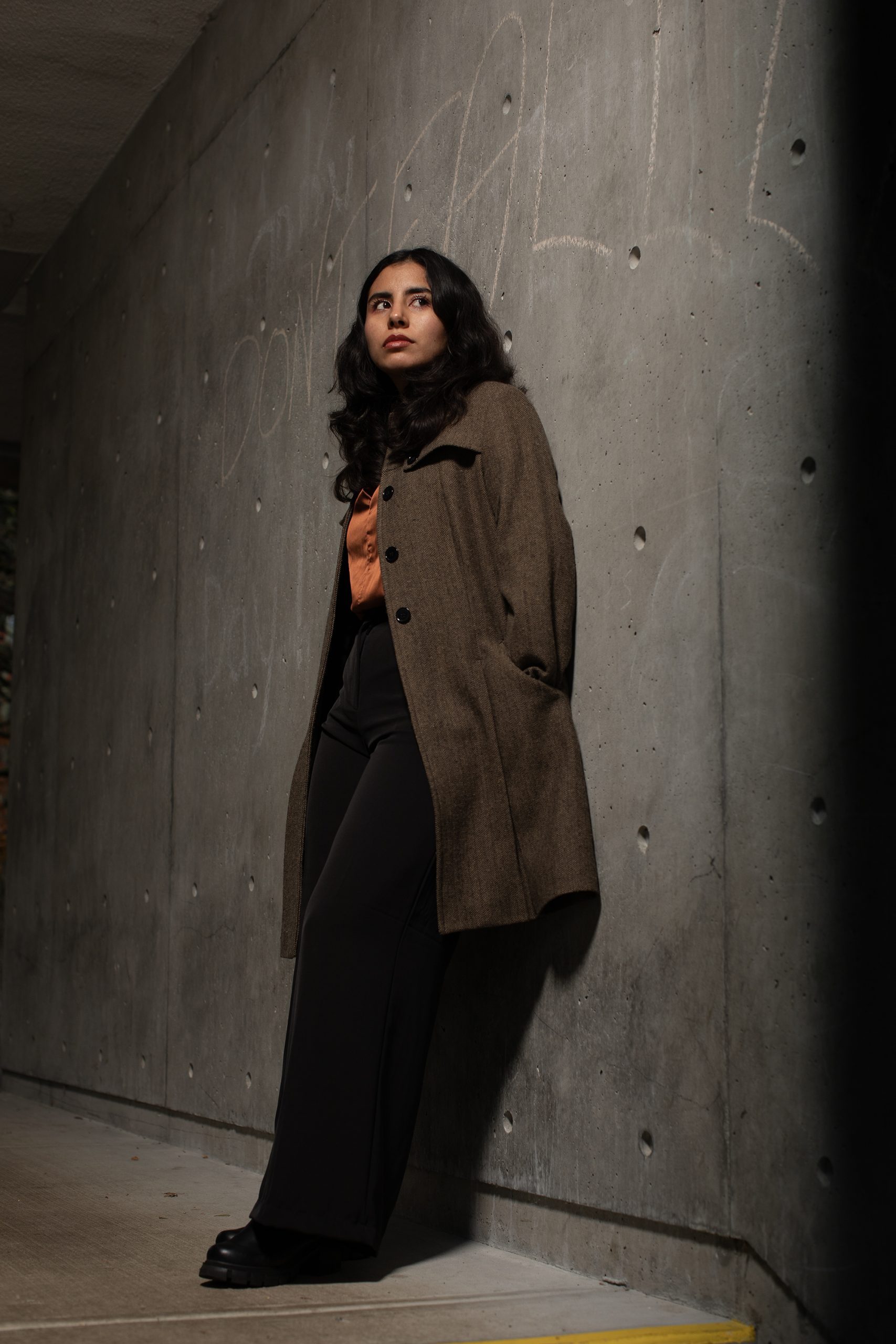
Fernanda Solorza. Photo by Chad Hipolito.
Durango, Mexico. Durango Floods, 2016.
Fernanda is a fourth-year international writing and journalism student at the University of Victoria, specializing in creative nonfiction and minoring in professional writing and publishing. Originally from Durango City, Durango, Mexico, she has two sisters, aged 20 and six. Growing up, Fernanda was a straight-A student, who graduated from high school at the top of her class. Although Fernanda’s parents hoped she would follow their path into medicine, she has always been “very passionate about social issues,” choosing to follow her own path. Studying in Canada has been a longtime dream for Fernanda, as opportunities to study writing are limited in Mexico. She believes that “there is a story in everything” and that sharing them can spark inspiration, instill hope, and challenge readers to see the world from fresh and diverse perspectives. When a devastating flood tore through her community, she was confronted with her own privilege, leading her to deeply reflect on how socio-political circumstances shape who bears the brunt of the effects of the climate crisis — and who is shielded from its worst effects.
My birthday was a couple days before the storm. I was 15 years old, and just started high school. I was living with my father, mother, and sister in a neighborhood called La Loma, which means “The Hill.” We were on top of this hill, in a two-story house. My father bought the property and made it very modern and beautiful, which was interesting because most of the houses are more traditional and old.
Durango is known as the Scorpion Land. It’s very hot, very dry. Scorpions love it. It’s usually pretty clear skies, the sun burning. During June and July, we have the monsoon season, and it just pours like the sky is falling down.
I remember thinking, “That’s weird. I don’t know why it’s raining during September.” Yes, we still get a couple rainstorms, but nothing major. You could tell there was something off about the clouds. They were really heavy and dark. The sky was completely gray. I went to school. There were all these winds going pretty intensely. I remember we didn’t go out during our recess. Everyone stayed inside. I took the bus back home alongside my sister. The rain was starting to get heavier.
We had our swimming lesson with the rest of my family. We thought, “Let’s just go.” The pool has these crystal doors/windows, so you could see that it was really gray outside and pouring rain, but nobody really cared. We finished our lesson, and the moment that we step outside, it felt like the sky was falling down. It was just this curtain of water. It was hard to even see beyond the water. My Dad was like, “I’m going to go get the car, and then you’re going to run.” He left, and then a couple minutes later he honked and we all ran towards the car.
It was raining so hard. The streets are pretty straight, but there was this little section that would go down and then up. There was a pool of water there, and the people in their cars were not moving. The car was pretty low; my Mom was scared. I remember her turning to my Dad and she said, “Do you think we’re going to be able to cross that?” My Dad said, “Yes. We’re going to cross, and we’re all going to be okay.”
When it was our turn to go, my Dad went pretty slowly. I remember feeling the water slapping the bottom of the car on my feet, but the car kept moving and we made it to the other side. The water did get in a little bit through the crevices of the car door. I remember turning around to see the next person that had to cross that ditch. It was a small, low car, and they actually got stuck.
We went home very slowly because it was impossible to see. Usually, that would be like a 10-minute drive. It took us 40 minutes to get back home. The four of us stood, looking outside. I remember putting my hand out, and the water was super cold. Those big droplets falling so violently. It had such force that it actually hurt when it hit your skin. Thankfully, we lived on top of the hill — any water would just start going down. My Dad made sure that the sewage on our house was not obstructed, so we wouldn’t flood. People were told to evacuate.
You know when it rains during the summer and you’re in a park? It just smells so delicious. Like life. Like all the plants just got some water, they’re going to grow, the sun is shining, it’s going to be great. This rain smelled like mud, sewage, and devastation. It had this very particular smell of all these things just mixed together and swept away.
We went to bed. It was a very loud, but silent night. In Mexico, it’s very common to hear people with music or talking. It’s usually pretty lively, even in the wee hours of the morning, but that day there was no sounds other than the rain. The next day, I woke up and our garage flooded. Nothing major — maybe one or two inches of water. There was some debris — mud and leaves — that obstructed a bit of the sewage. My Mom was able to sweep the water away.
Five blocks down, there is a dam called La Presa del Hielo, which is translated to “The Ice Dam.” Apparently, it overflowed. All those houses that were in that area were completely flooded. A lot of people went missing. There was a lot of efforts from rescue teams to find them. It wasn’t until 6:00 p.m. that it was confirmed that five people had died, including a child. It was a child and his mother, I think. They were driving, and the water just slipped the car away. They tried to get out of the car and were swept away by the current. I remember thinking, “Was it the car that we left behind?” I have no way of actually fact-checking that.
I remember thinking it was insane that the city would build a dam so close to people, especially in a zone prone to flooding. I think that’s just stupid. The other thing I thought was, “What if we had bought one of those houses instead of this one?” Those houses are definitely more affordable, so that is just to show how privilege really shapes life. My parents have the economic power to buy this house at the top of the hill, whereas some people can’t. And that means you’re going to face things differently. I don’t know if that’s fair.
We do get pretty intense storms during the monsoon season, but usually it rains for an hour, and then it’s gone. This one rained through the whole day and the whole night. It was just this very powerful storm. I think the news said that it was like 20 per cent of all the rainwater we get in the year, just in one night.
The winds were so strong. We didn’t have reliable electricity or internet for some time. It was strange going back to school and hearing people talk about how the storm had been for everyone, and people saying, “Oh, yes, my room got flooded,” or “No, thankfully, nothing happened to me,” or “Oh my gosh, it ruined all my shoes.” I went to private school, so the privilege was there. Most of the people were fine.
The water destroyed the soil completely. I remember that it was really bad on farmers, agriculture, and crops. In the city, all the trash, all the mud, and all this dirt was just all over the streets. Everything was so muddy. Me and my Mom cleaned our street as good as possible — taking all the trash out, getting rid of the mud, and trying to save the plants in the garden. A couple of them died because they were just ripped apart.
People were really upset. People were upset that people had died, and by the layout of the city, and things that could have been avoided. Everyone was really confused because we are not supposed to get rain this hard, and especially not during September. It was just a moment of like, “Why did the sewage system not work? Why did we flood? Where do we go from here? What do we need to do to ensure this doesn’t happen again?” I think those are questions posed toward the government.
During the storm, because it was such a harsh event, it felt like everyone needs to fend for themselves. After the storm, lots of people went out in search teams. People were donating food, clothes, and whatever they could give to the people that were struck the hardest by the storm. Me and my family donated a couple things.
I wonder what happened to the families of the people who died during the storm, how they went about that, and what help they received to overcome those tragic and traumatic deaths? I think people needed mental health help. At that point, it wasn’t something that was talked about. In my culture, we have this mentality of, “you’re going to get through things if you work hard.” We know that’s not true. There’s a lot of stigma around mental health. It is seen as a weakness of someone that is not trying hard enough.
It was a horrible thing to live through. I am very sorry to the people whose lives were completely changed. I feel sorry for future people that are going to live through things like that as well. I feel a lot of guilt as well. I’m trying to move past the guilt because it doesn’t fix the issue. It doesn’t help anyone.
The storm made it very obvious to me just how privileged I was. People that were so close, just five streets over, had died or their belongings and livelihoods were completely destroyed. That prompted me to become a better person and really see how circumstance shapes the way you suffer or don’t suffer a climate disaster. The way that you’re impacted is significantly diminished or enhanced by who you are in a socio-political way.
At the time, I was aware of what climate change was, but I didn’t really connect the dots of this happening because of climate change until much after. At that moment, I just thought it was strange that that storm was so heavy and violent at a time it was not supposed to be raining. It wasn’t until after that I learned that things like this were going to be much more normal and occurrent.
I think for my father, this storm really marked a before and after in the climate for him. He said when he was growing up, he saw fireflies, there were so many insects, and the rivers were flowing with so much more water — all things that I never saw. For him, this really meant things are never going to go back the way they were.
My father bought a piece of land towards the forest. The soil was horrible, and took many years to make lively again. I think my Dad is trying to make a little space, like a haven, that can survive. A space where we can go that has a little bit more life in it, where the climate is not so severe. That has become his personal project. I think that was what inspired him to do that.
Right now, we are stuck in this debate of, “Is it real? Is it not?” We are making our lives more difficult, and the human experience miserable. Why would we do that? Climate change is real. We are causing it. Once we agree on those two things, we will be able to change all these systems that are in place. There are many things that could be done. Regardless of what it is, it has to be done now. There is not any more time to lose. We all need to be on the same page.
What brings me hope is that education is becoming a lot better. I really think we are getting closer to that first step of all of us agreeing, “Yes, climate change is real.” I feel like more people are becoming educated and aware of how these systems really affect people — how they affect all of us. Billionaire or not, you’re going to suffer. I hope that we can engage in further conversations about climate change and how it affects people.