
The subsea observatory, launched with UVic’s involvement last year, is helping shed light on one of the least studied ocean environments in the world
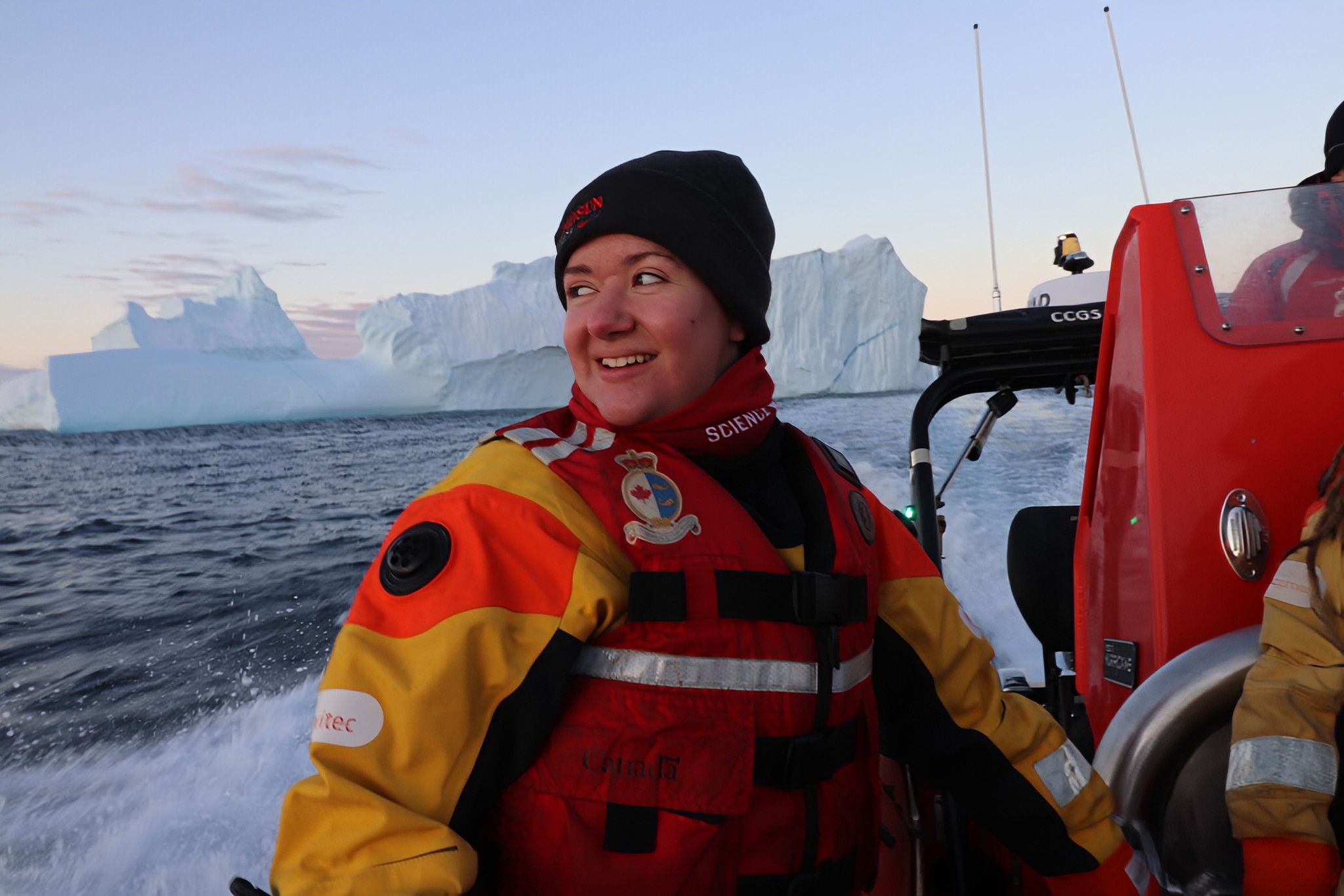
Photo courtesy of Tia Anderlini.
A subsea observatory, deployed on a recent expedition through a partnership between Ocean Networks Canada (ONC), the Spanish National Research Council (CSIC), and UVic, is bringing continuous, year-round monitoring to one of the most remote corners of the planet — the waters just north of the Antarctic Peninsula.
Suspended 23 meters below the ocean’s surface, near Spain’s Juan Carlos I Antarctic Station, the observatory will help to address the recent call from scientists worldwide for the urgent need for monitoring of the Southern Ocean.
While the observatory is a triumph of ocean engineering, it’s also a milestone in Canada’s Antarctic presence. Canada is not yet a voting member under the Antarctic Treaty System, which governs the continent and surrounding waters. To earn that status, countries must demonstrate an ongoing commitment to scientific research there.
For Kate Moran, President and CEO of Ocean Networks Canada, the observatory’s installation marks an important step in that direction. “[T]he fact that we’re actually physically there and providing new kinds of technologies,” she said, “[is a] part of the commitment Canada is making that we will continue to install these.” Collaborations to install subsea observatories at other nations’ bases are already underway.
The Antarctic observatory was developed in Victoria, B.C., before being installed in early 2024 by Spanish scientists at the Juan Carlos I station on Livingston Island, part of the South Shetland archipelago.
Using Iridium satellite technology, the system transmits data every 30 minutes to ONC’s servers in B.C., where it is processed and made freely available to researchers around the world.
The subsea platform carries a suite of instruments that measure conductivity, temperature, and depth, as well as oxygen, turbidity, and chlorophyll-a — key indicators of seawater quality and productivity. These readings help researchers monitor how glacial meltwater interacts with the open ocean and affects local marine life.
What makes this project especially significant is its continuous, real-time data transmission capabilities. Unlike traditional deployments, which often depend on battery-powered instruments that are then collected after months or even years, the technology developed and implemented by ONC uses a shore-cabled connection. This allows the monitor to send a steady stream of data even through the harsh polar winter, when research stations are unstaffed.
“It’s quite unique to have real-time data, 24/7,” Moran said.
Complementing the observatory are two of ONC’s deep-sea Argo floats, deployed in February 2024 — at the beginning of the expedition — in the Drake Passage, the body of water between South America and Antarctica. These autonomous instruments dive up to four kilometers — nearly the entire depth of the ocean — beneath the surface, capturing data on temperature, salinity, oxygen, and pressure. These measurements are essential for tracking how the Southern Ocean absorbs both heat and carbon dioxide.
In February 2025, the team of researchers travelled aboard the HMCS Margaret Brooke, one of the Navy’s Arctic and offshore patrol vessels. Moran described it as a turning point in how Canada’s Navy and scientists work together.
“[T]his was one of the first times that the Canadian Navy really did a large expedition in support of science,” she said. Moran explained the importance of military dual-use, that while military systems are important for security and protection, “the dual use means that they can also be used for science.”
For Dr. Tia Anderlini, a chemical oceanographer and recent UVic PhD graduate, this mission was an unforgettable experience. She joined the expedition only days after completing her PhD and defending her dissertation, leaving Canada immediately for Chile, before embarking on a five-week journey aboard the HMCS Margaret Brooke to the South Shetland Islands.
“[I]t was really a valuable experience,” Anderlini said, “for having a sense of Canadian pride, of seeing how an all Canadian team can work together… and [doing] impactful research.”
Anderlini’s research focuses on trace metals — essential micronutrients such as iron, manganese, zinc, and copper that microbes need to survive and photosynthesise. In the Antarctic, her focus was on the effects of tidewater glaciers — those that shed directly into the ocean. These glaciers can release iron into otherwise iron-limited waters, potentially boosting microbial growth and altering the nutrient dynamics of the region.
She conducted transects near the glaciers, collecting water samples to trace the movement of these metals from coastal areas into the open ocean. Her data will be integrated with that of the 14 other scientists aboard the expedition, creating a comprehensive picture of how Antarctic coastal waters respond to environmental changes.
This subsea observatory represents a major step forward in studying one of the planet’s most remote regions. By providing continuous, real-time data, it allows scientists to track changes in Antarctic waters and ecosystems that were previously impossible to observe.
“The Antarctic is one of the [least] studied areas on the planet,” said Moran. “Anytime we put sensors in a new place, we discover something … and [the discoveries will] be important and interesting and peak the public’s interest in following what’s happening on our planet in a positive way.”