
Whether its protesting or participating in a boycott, we in Victoria aren’t too far away to make a difference
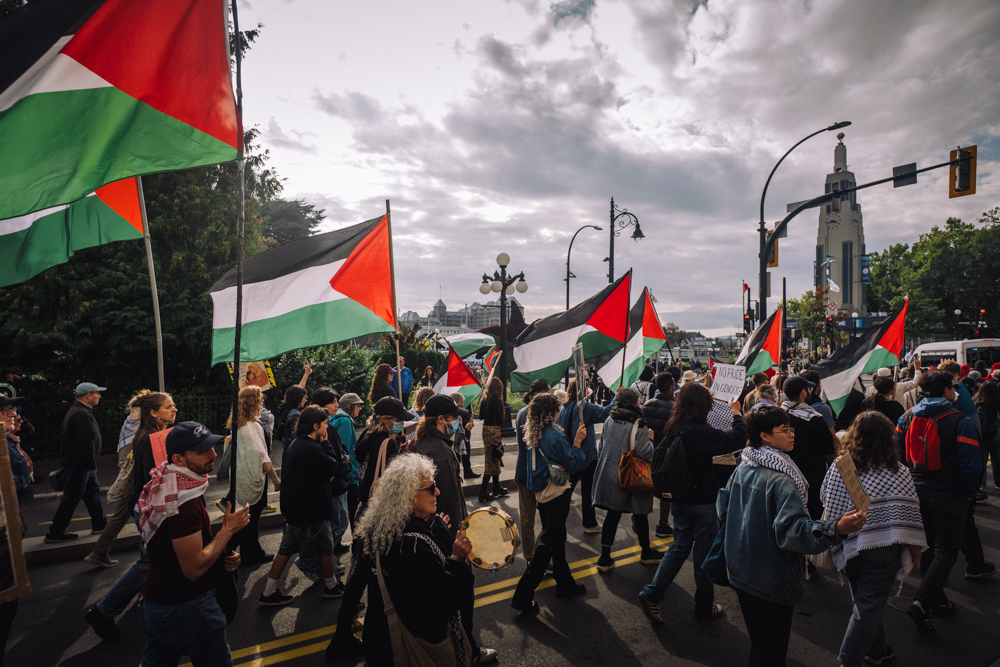
Photo by Mike Graeme.
I have been attending the weekly protests at the legislature, and was pretty impressed to hear that one of the protests in September was the 101st consecutive march for Gaza.
Within that time, I have seen an elderly woman appearing week after week on the balcony of her high-rise apartment, waving a small Palestine flag as we marched below her down Douglas street. One week, an enraged man attempted to drive his car into a group of protestors. Another week, a smaller than usual gathering marched together in a torrential rainstorm, deciding it felt better for our boots to be soaked than to sit at home and do nothing.
It seems like each week, more people join the march from the sidelines. Some people carry their sleeping infants, or pull them in wagons or strollers, and several times I have seen a woman in her nineties, whose family members push her in a wheelchair, because she can’t not come. I’ve marched with people whose lived experience include surviving other genocides.
I come to it myself as a second-generation activist, with memories of my mom clicking through slides in the early nineties — slides that showed wide-eyed Guatemalan children, hiding in the jungle from the U.S.-backed right-wing militia who were massacring indigenous Guatemalans. Then, there was the time I stood with doctors and other healthcare workers outside the Ministry of Health. We read out the names of healthcare workers killed in Gaza. “What brings you here?” I asked a young woman, who was also in attendance. Her reply was, simply, “I’m a human.”
In these times, sometimes there are no words. While I have the blessing of holding my children each day, hearing their laughter and petting their soft heads, I marvel at the fact that I take for granted their perfect arms, legs and eyes, their ears unaccustomed to the unearthly hum of the drone. If we allow this genocide in Gaza to unfold, how long until these killing machines are used against people in our backyard? I have seen, in the past two years, too many mothers holding lifeless bundles the same sizes as my four- and seven-year-olds. Too many videos of parents trying to put terrified children to sleep in tents, as they listen and wait. Mosab Abu Toha, the Pulitzer Prize-winning poet who has lost countless family members in the genocide often posts videos showing Gazan children, either dead or dying, their bodies bloodied and broken by shrapnel.
It’s too easy to turn away, and decide that Israel is too far away, Trump and Netanyahu too stupid, and governments too detached for any of us to really make a difference. Maybe the refrain of defeat is: “What can I do? I am in debt, struggling to pay rent, just one solitary guy.” Not so fast! Consider all the times people in Gaza might have given up, but couldn’t. Al-Dahdouh lost his entire family in an airstrike but kept on reporting. Why? Because he knew his images were making a difference. Or Abu Toha, who continues to write poetry and post on social media, because there are still a million people in Gaza, and all they have left is the hope that it might end, and they might one day again eat chicken. You don’t need a big reach like these and other icons, like Bisan Owda, Anas Al Sharif, Shireen Abu Akleh, and Refaat Al Areer who, living or dead, have all suffered merely because they were born Palestinians, to make your voice heard. You don’t need to be Palestinian to care. Everyone has the right to care about children.
Use your voice to talk about Gaza, and what’s happening there. You can call it a genocide, as a U.N. commission, Amnesty International, and the International Association of Genocide Scholars (IAGS) have said it is, while so many of our politicians and public figures are afraid to do. If you’ve seen images that are upsetting, it’s okay to talk about it. Many are afraid to do so publicly for fear of backlash, but isn’t it worse to do nothing, while a genocide unfolds before our very eyes?
In 1939, the Canadian Government turned away a ship of Jewish refugees, fleeing genocide in Europe. and later apologized for it. Today, the Canadian Government says the reason they can’t transport injured Gazans to Canada for treatment is because they need to get Biometrics done before they can be processed. However, there is nowhere currently in Gaza to get your photograph taken, or your fingerprints done, according to a spokesperson for Immigration, Refugees and Citizenship Canada.
Yet somehow, the Canadian government was able to supply mobile biometrics kits to help Ukrainian refugees seek refuge here. To date, less than 900 Gazans have been able to come, despite having family members in Canada. The only way to explain this double standard is racism. No doubt a very compelling apology will be made years later for Canada’s complicity in the Gaza genocide, but by then it will be too late.
Individuals unsure of how else to make a difference can participate in boycotts, like those targeting Indigo Books and Scotiabank, who have particularly close ties to the IDF and Israeli arms manufacturers. You can attend one of the weekly protests at the legislature, or start going on the regular. I’m proud to say Victoria is one of two cities in Canada that have a weekly protest for Palestine.
If you have the money, the Global Village store at Hillside Shopping Centre has Palestinian olive oil, soap, and pottery for sale.
Further educating yourself is another important task in times like these. You can learn about the thousands of “hostages” languishing in Israeli jails. You can learn about the roads that cars with Israeli license plates can drive on, but cars with Palestinian plates can’t, or the checkpoints that even stop ambulances carrying critically ill patients.
You can watch the BBC-banned documentary Gaza: Doctors Under Attack, that documents the targeting of Gaza’s healthcare workers. Or the films No Other Land and Tantura, documenting the encroachment of illegal settlements in the West Bank, related violence, and the censorship within Israeli academia concerning the events of the Nakba.
You can see the thousands-strong protests in other cities like Sydney, Paris, Rome, and Barcelona — protests that make Victoria look, well, a little meek. However, no protest is insignificant. Each person protesting represents many others who don’t feel comfortable occupying the streets, but share the same sentiment. Protests are also a loud, bothersome representation that something is very wrong.
Do they occupy resources of Police and taxpayer dollars? Certainly, but if governments don’t want taxpayer money to be wasted on protecting protestors, they should address the requests of their constituents — stop arms shipments to Israel, close the Israeli embassy until they respect the human rights of neighbors like Lebanon, Iran, Qatar, and Palestine, and stop making the U.N. a place where war criminals need only to raise their hand to condemn thousands more to die.