
A Climate Disaster Project feature series
The stories in this series were shared as part of the Climate Disaster Project (CDP), an international collaboration of post-secondary and media partners coordinated through UVic’s writing department. Students in CDP classes learn trauma-informed techniques from interviewing and working with survivors of disasters from wildfires to floods to extreme heat. They then take that work in the community. And, this year, those students submitted testimonies that were published in The Guardian to coincide with COP30. These stories cover wildfires in Brazil’s wetlands, flooding in India, and glacier melt in the Peruvian Andes. But before the students embarked on that work, they interviewed each other, sharing their own experiences with climate change and what they think can be done about it. These are some of their stories.
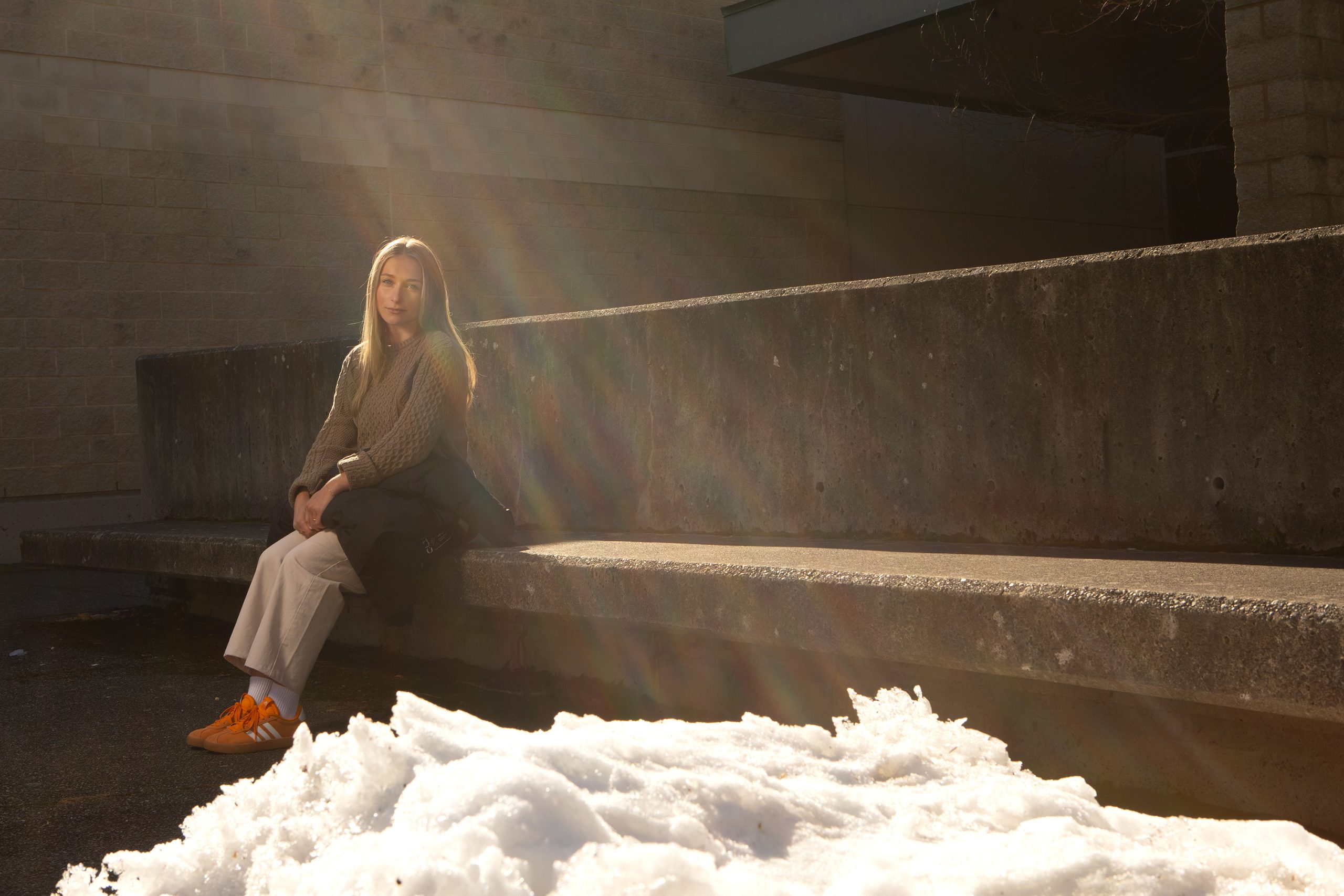
Ashley Ciambrelli. Photo by Chad Hipolito.
West Vancouver, Canada, B.C. extremely low snowpack, 2023
A recent writing graduate from the University of Victoria, Ashley was born and raised in West Vancouver. A shy but active only child who was always caught between a book and sports, the surrounding mountains looked like freedom to Ashley. Indeed, it was on the ski hill that she started to explore her independence. So it was shocking, as the holidays approached in 2023, that Ashley saw no snow on those hills for the first time in her life.
Every year that I’ve been in university, I get a job over Christmas break. My first three years, I worked at a clothing store in a mall. Christmas is busy and hectic, but it’s not like, “Oh, I’m doing something great.” It’s just kind of, “Okay, I folded a sweater three times.”
In 2022, I got a job working as a ski technician and rentals cashier, so I could be up on the mountain. I loved being on the mountain because I was doing stuff on my feet. You get a free ski pass. They give you free rentals if you work in the rental shop. I snowboard, but I started skiing while I worked up there. I got paid really well. I was making $10 over minimum wage, which as a student was awesome.
The mountain’s really special because, on a clear day, you can see way into the distance: all of Greater Vancouver, the mountain ranges spreading out on the left and climbing back up Whistler way. You can also see Vancouver Island, and all the little islands in the Howe Sound. When you go up there at sunset on a clear day, it’s just the ocean, and islands, and evergreens spreading out. The snow glimmers and shines when the sun hits it. I love breathing in snow air and feeling a crisp, clean, deep breath.
Cypress Mountain has an Instagram page. Any time it gets to November, I turn post notifications on for the ski hill, because if the conditions are good, I’ll go over reading break. In 2023, there was no snow. I would check, and it would be like, “The mountain’s closed. The mountain’s closed. The mountain’s closed.”
Normally November is when I reach out to my bosses about a job, but, end of November, still no snow. They would only hire me because it’s busy and they need extra hands. I didn’t even bother applying. I know they’re not going to hire me for three weeks if their full staff isn’t even working right now. I was like, “What the heck? I still need a job.”
I applied at the mall. The pay was the first thing that hurt. I was like, “Okay, I’m not going to make as much money.” I think I was getting paid $17 or $18. It makes a difference when you’re a student and you’re only working three or four weeks. During this time, my chronic injury was still pretty bad. Basically it means sitting around a bunch. And when everything’s gray, it’s not so pretty to walk outside. I just remember it feeling like a very gray and very quiet time. I was like, “I’m going to work at this mall and oversell people on gifts that they don’t need and things that they don’t want. Then I’m going to sit at home and look at the gray sky and everything’s dead.” I just felt like I was in the corporate wheel. It was so sad.
Normally I have very high sensory memories of Christmas, and that year I feel like I have a gap. It wasn’t super muggy because it wasn’t raining a whole bunch, and it wasn’t dry because it wasn’t cold enough. It felt just like a random fall day.
There’s a bunch of local mountains in Vancouver and every single year, you could look and see the snow line on the mountains from our backyard. But there was no snow line. There was no snow on any of the local mountains. I don’t remember seeing a whole Christmas of no snow on the mountain. It was the same conversation with my mom and dad every single night: “It’s so weird that there’s no snow line right now.”
I was sad that not only could I not work on the mountain, but I also couldn’t go skiing or snowboarding. One of the bonding things I do with my cousin, David, is we go skiing on the mountain. I’m an only child. I didn’t have siblings to lean on or talk to. So I put more effort into my relationship with my cousins. Just sitting and watching TV together over Christmas break wasn’t as memorable as when I would take him up the mountain with me. I would be really worried if the ski hill had to close because they didn’t get enough snow. It’s the threat of losing a really special place to me that brings people I love together. I just want normal, just a little bit of snow. I just want it like my childhood again.
I’ve always been aware of climate change just because of courses that I’ve taken in university, but seeing it really scares me. Now I’m just like, “Oh my God, it’s in my backyard. We’ve gotten to a point where we can’t even enjoy the natural world around us because we’ve changed it so much. We’re going down a path that’s going to be really hard to reverse.
I think with climate change, this is bigger than me. This is bigger than me wanting a good-paying job. That makes me upset at government, and really upset at all of the big corporations that are responsible for a lot of these things. I think the real change and solution is the government taking action. Part of what holds me back is knowing that it’s things beyond myself that are truly responsible for this.
It gives me hope that people my age and people in Victoria care about climate change. More people believe in climate change now because almost everyone has experienced something tangibly. People still care about being outdoors and enjoying these spaces. Even though it seems like a lot of the world doesn’t, there’s more people than I thought that really do care. I think that if enough people get together, we can make something happen.