
The café is a popular option for students, but some former employees say you should ignore their siren song

Photo via delish.com.
Many students choose to work at Starbucks due to the company’s promise of flexible hours, competitive benefits, and self-expression at work, as well as a prestige that’s not associated with other entry-level food service jobs.
However, the company has also been at the centre of several controversies, including being notoriously anti-union, calling the police on two Black men in a Philadelphia Starbucks in 2018, and suing their U.S. union — Starbucks Workers United — for using a similar logo to Starbucks’ in a pro-Palestinian social media post.
Employees of the company are similarly polarized. Many stay with the company for a long time, while others leave positions with corporate horror stories. The Martlet spoke to several UVic students to find out what it’s like day-to-day as a student working for Starbucks.
One aspect mentioned by students is their coworkers seeing the company as more than just an employer. While many fast food companies try to create a “family” atmosphere, Starbucks is particularly successful in getting some employees to see the company as a part of their identity, rather than just a job.
“It’s like any other business, but Starbucks definitely tries to make you join the cult more than others.” said Joe, a former Starbucks barista.
Starbucks has a suite of language that seems to be used to create a particular narrative for their company, and help with employee management. Most conspicuously, Starbucks employees are not simply called workers or baristas; they’re “Partners”.
“Their excuse for saying this is that you have stocks in the company, shares in the company. ‘Bean Stock’ is what they call it,” a former Starbucks employee of five years told the Martlet anonymously.
The Starbucks website gives more details, reading, “Eligible partners are granted Bean Stock Restricted Stock Units (RSUs), which turn into shares of Starbucks stock over a two-year period.” It goes on to say that employees have to be “vested” — or continuously employed — while they wait for their shares.
However, “Partners” don’t have much say in changes that will greatly affect their day-to-day work.
“They don’t really take us into consideration when they’re making big changes,” said a current Starbucks employee who spoke with the Martlet on the condition of anonymity.
Another former employee who asked to remain anonymous said that the word ‘partner’ evokes an equal relationship, and that “the CEO of Starbucks calling us Partners … felt disingenuous, because we aren’t partners.”
“It’s a nice idea,” they said, “[but] in practice there is a really obvious hierarchy.”
“Partner” is just the first crack in what many current and former employees see as the erosion of the personal-professional boundary at Starbucks.With the “Back to Starbucks” campaign, launched by Brian Niccol, the company’s CEO since September 2024, Starbucks has doubled down on trying to be a neighbourhood coffee house, a “third place,” to use former CEO Howard Shultz’s favourite words.
Coined by sociologist Ray Oldenburg to mean a place to gather other than work or home, the term “third place” was not meant to include corporately-owned spaces. Lack of seating, as well as restricting bathroom use and free water to paying customers, further undercuts a vision of Starbucks as a true third place.
The company’s “Culture of Connection,” referring to staff and customers alike, seems to be part of this PR push. A former employee said that baristas have to make sure they “connect” with every customer, and remembers a “mechanized” list by the till “saying ‘smile’, ‘[grab] names’, ‘ask how their day is going.’”
Further, the word “connect” is also used in some workplaces as a euphemism for what could be characterized as supervision. As a supervisor, he said that it was never a “conversation” or a “chat.”
“If I wanted to talk to someone about something they did, maybe a transaction got messed up or something, I’d be like ‘can I connect with you, really quick?’”
According to him, every six months, managers meet with each “Partner” to go over their PDP, or “Partner Development Plan”. He said the plan features two sections: a professional development section — three things you can improve on at work — and a personal development section — three things you can improve on in your personal life.
“I never filled it out. I actually refused,” said the former employee. “I said, ‘I’m not gonna do that, because I don’t find it appropriate that I have to detail any part of my personal life at work.’”
He thinks that “it’s particularly sinister because they’re trying to synthesize this corporate sense of identity with your personal sense of identity, so that you feel compelled to work harder for them.”
And it’s worked. A Starbucks employee who spoke to the Martlet on the condition of anonymity said that at their location, “we have a bunch of people who are like ‘Yeah, we are part of the family, I love the company.’”
Starbucks seems to expect a lot from its employees. Joe told the Martlet that “managers and supervisors get burnt out very fast,” and the managers “[a]re always on call and they’re always working. I’m sure they get a day off but … they always feel that pressure to reply to employees’ messages.”
“Shift supervisors get the most of the Starbucks corporate messaging,” echoed another former employee, “They’re the ones who have to enforce it on the floor.”
He continued to say that some managers are “really passionate about doing their job right, that even though they are being underpaid and just as disenfranchised as the rest of them — the Starbucks corporate messaging bred a lot of those kind of people. And I don’t blame them for it.”
Joe echoed this former employee’s message, stating that “a lot of [managers] are lost in the Starbucks sauce.”
“My manager was a lovely woman but … she broke her back for that company,” said the former employee. Even though she was a salaried worker, being paid a set amount, “she would… regularly be pulling 12 – 14 hour days … and she was celebrated for it,” he said.
It seems important for the company to have managers truly living the Starbucks lifestyle, because it falls to them to “clamp down” on union talk when it comes up. After the Douglas Street store unionized in 2021, he remembers that “our manager … would shut down union talk immediately.”
He claims he was told by his manager, and the district manager, about how Douglas Street workers don’t get the same wage increases, benefits, training, or Bean Stock as other partners did, because they unionized.
In June of this year, another Victoria location joined Douglas. The Oak Bay store unionized swiftly, citing the company’s new, stricter dress code, and a new requirement to write a personal message on each cup.
Concern with the new requirements were shared by employees at other locations, too. “My store in the summer makes $10 000 a day, maybe more,” another student said. “We have rushes of 50–60 people during a 30 minute period, so writing on cups is the last thing any of us wants to do. It feels like such a small task, but when you are getting threatened to get written up for missing too many cups, it feels … so over the top.”
The new dress code, mandating black shorts “came at very short notice and right before, they made a big sale on the website … of clothing in other colours” said one Starbucks employee.
“People put their own hard-earned money into it,” said another employee, and “all they did in compensation was you get one free black shirt.”
This employee “also had four piercings in [their] face,” which is against the new dress code and said that “it feels like a personal, ‘oh I don’t like piercings, so you can’t have them.’”
Starbucks’ recent crackdown on the dress code seems, to many, to contradict their stated aim of “creating an environment so you can show up as your whole self.”
“One of their big promises was self-expression,” said a Starbucks employee, “and that’s something they’re taking away from us.”
The Martlet reached out to Starbucks, but they declined to comment.
What many students told us is that the make-or-break factor in having a good time working for Starbucks is the culture at your given store. One key difference dividing stores is corporate stores versus licensed stores like the UVic Starbucks.
Licensed stores — those inside grocery stores or bookshops — don’t have the same products or services that corporate stores do. Joe explained that licensed stores are at the whim of the company that is licensed to sell Starbucks.
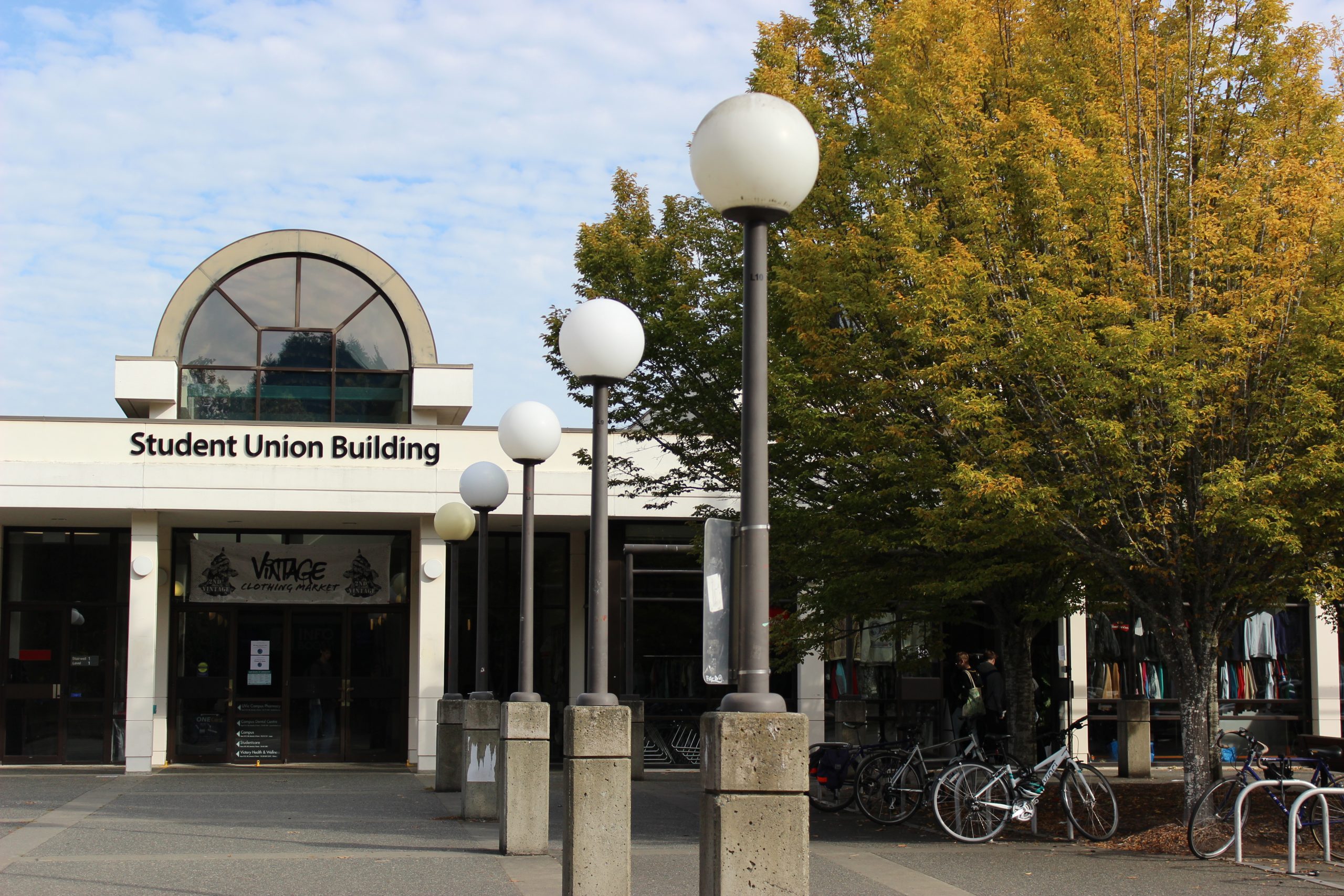
“As a licensed store we are… [part of] the UVic Bookstore, [and] licensed to sell Starbucks products,” said a former UVic Starbucks employee. “As licensed store employees, we were never partners.”
UVic Starbucks employees are part of the same union as other bookstore employees, CUPE 951. “It worked well.” said the UVic Starbucks barista. “I didn’t really feel the need to participate.”
According to the barista, the specific store culture at the UVic Starbucks is influenced by the “perpetual line” outside of it. “We would get lineups that were out the door, up the stairs, to the bus loop,” they said, “and they would last hours, and at that point you … cannot be focusing on how fast you’re gonna get through that line, because that line will never go away.” They told us that, in their experience, speed was never really stressed by management.
“Corporate employees would tell us that it felt very different” they said.
Ironically, it may be that the stores that Starbucks keeps on the longest leash — licensed stores — have more of the “human connection” that Starbucks corporate craves so badly.
So, if you’re thinking of working at Starbucks, like any job, a personalized cost-benefit analysis is in order. One Starbucks employee is staying for the $1 000 student bonus each year and the health benefits, which you only need to work 20 hours a week to get. She told the Martlet that her medication is “$600 without it and I pay $14.00,” she said. “It would be silly to leave.”
She said “I don’t think it’s a bad place to work, but you have to be prepared for it.”
However, Joe said he “doesn’t suggest” the job for introverts. The former UVic Starbucks barista agrees, saying “if you are someone who gets overwhelmed and [ends] up having to remove yourself from a situation that’s highly social … I would say it’s not going to be a great job, because you have to do a lot, and you have to be competent and you have to deal with a lot of people.”
On the other hand, the fast-paced environment is exactly what some people are looking for in a job. A Starbucks barista said, “I hear from people who liked working retail and try Starbucks that they can’t handle [it], but … me, I can’t handle retail because it’s too boring.”
Many students told us that people you’re working with can make or break your experience at Starbucks, too. A former employee said that his coworkers were why he stayed at Starbucks for so long. “I was lucky that everyone was around my age and had similar upbringings and educations … and understood a lot of the same things about Starbucks,” he said, “we all became really good friends.”
The UVic Starbucks is no exception according to a former employee, who stated that “all the staff are tightly knit.”
“If you want to trauma bond with people, Starbucks is a place to trauma bond with people.” Joe joked. So, it seems, community can be found at Starbucks — but it doesn’t always happen on the company’s terms.
A former employee’s final piece of advice is “go for it … as long as you remind yourself that it is just a job, it is just coffee, it is not your life, it is not who you are.”