

Proposed legislation includes federal Bill C-16 and new provincial framework to combat intimate partner violence
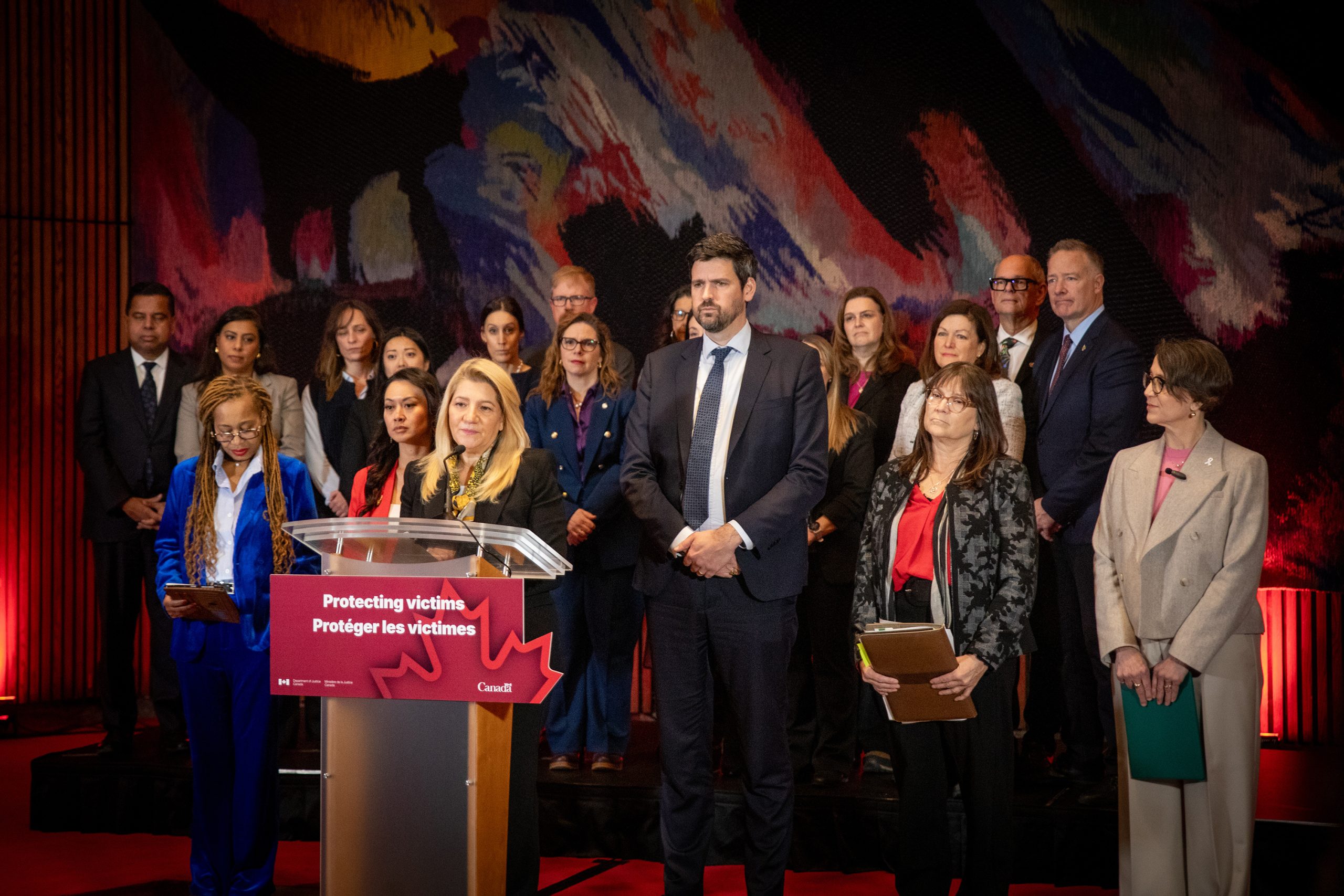
Photo via www.justice.gc.ca.
On Dec. 9, 2025, the Government of Canada introduced major revisions to its gender-based violence (GBV) legislation under Bill C-16, the Protecting Victims Act, calling the proposal “one of the most consequential updates in generations.” Despite the monumental changes, the bill’s focus on expanding protections for victims and making punishments harsher for perpetrators encapsulates only part of what advocates have been calling for.
The bill follows closely on the heels of two other legislative proposals that will impact how GBV is handled across Canada: B.C. Attorney General Niki Sharma’s proposal to create a framework designed to help the provincial justice system respond to intimate partner violence (IPV) by standardizing risk assessments across the justice system, and October’s introduction of Bill C-14, the Bail and Sentencing Reform Act, intended to make bail and sentencing laws stricter for violent crimes at the federal level.
The Canadian government’s national action plan to end GBV states addressing GBV necessitates “coordinated and collaborative,” actions from federal, provincial, and territorial governments “in close partnership with victims/survivors, Indigenous partners, civil society, front-line service providers, municipalities, the private sector, and researchers.”
However, stricter penalties for instances of GBV are only part of the conversation. Many argue that preventative measures need to be made even more robust, and options for pursuing justice should more overtly centre survivor autonomy by including viable pathways for pursuing restorative justice (RJ) options.
Bill C-16 aims to strengthen current legislation in three broad categories — judicial responses to intimate partner violence (IPV), protections against child predation, and protections for victims of crimes — through amendments to the Victims Bill of Rights and Criminal Code.
Notably, Bill C-16 intends to designate all instances of murder “involving control, hate, sexual violence or exploitation” as murder in the first degree and define these murders as instances of femicide when the victim is a woman. Previously, instances of femicide may have been classified as either first or second-degree murders. The Government of Canada defines femicide as “the gender-related killings of women and girls” and considers it “the most extreme form of violence” they face.
In a statement, the Department of Justice told the Martlet, that “the measures proposed in Bill C-16 are intended to respond to long-standing calls for reform from advocates addressing intimate partner violence … and provide a clearer denunciatory and deterrent framework for such conduct.”
Recent conversations on Vancouver Island about reforms to GBV and IPV legislation have taken an urgent tone following the death of Saanich resident Dr. Laura Gover in January of this year. Times Colonist reported that Gover’s former partner, Muhammed Ali Basar, has been charged with second-degree murder, and that the case is identified as a “K file,” indicating it is related to intimate partner violence.
In response to a request for comment about Bill C-16, Bahar Dehnadi, executive director of the Victoria Women’s Transition House (VWTH) appealed to Gover’s death, stating that it “reflects systemic gaps in protection, intervention, and accountability” for GBV.
“Effective prevention requires coordinated efforts across multiple sectors, including healthcare, law enforcement, social services, and community organizations. It also requires adequate funding, evidence-based programming, and policy frameworks that prioritize survivor safety,” Dehnadi said.
On Wednesday, Jan. 21, community and anti-violence organizations from across Vancouver Island gathered at the provincial courthouse in Victoria for a press conference to both “honour the life of Laura Gover and to speak collectively about intimate partner violence as a social and public safety issue that requires action before harm occurs,” a media release from the VWTH stated.
At the press conference, Angela Marie MacDougall, executive director of the Vancouver-based anti-violence organization Battered Women’s Support Services, urged lawmakers to take preventative measures more seriously. She stated that femicide is “always predictable,” and called for “mandatory coroner’s inquests in femicide cases where a protection order or a peace bond was sought or granted.”
“The problem is not the absence of tools,” MacDougall said. “The problem is the failure to apply them consistently. We know that governments know how to own complex and high risk infrastructure — when they choose to.”
MacDougall compared the implementation of GBV and IPV policy to the building of pipelines and highways, stating that projects like those come with timelines, oversight, and consequences for failure, but allegedly, current GBV and IPV policies do not.
In response to a question from the Martlet about the timeline for the new provincial framework, the B.C. ministry of the attorney general stated they were focusing on “immediate actions that can make a difference in the short term” and noted that work was “already underway” on improvements to the framework.
“As noted by Dr. Stanton in her report, some of the recommendations are easier to implement while others will require caution and patience to minimize potential long-term risks,” the statement continues.
In November 2025, the Office of the Federal Ombudsperson for Victims of Crime (OFOVC) released a report following an 18-month investigation into the experiences of survivors of sexual violence in Canada’s criminal justice system. The report defined restorative justice as a “voluntary, consent-based” approach to justice that aims to “repair harm” by providing “opportunities for those harmed and those who take responsibility for the harm to communicate and address their experiences and needs.”
“RJ differs significantly from an adversarial, retributive approach to justice: Wrongdoers recognize the harm they have done and accept responsibility for their actions. Those affected directly by the harm may come forward to share the impact of the harm on their lives,” the report states.
Indigenous people are currently overrepresented among both incarcerated people in Canada and victims of GBV. However, many RJ programs draw from Indigenous legal traditions, which, the report says, “have been used by Indigenous peoples to resolve disputes for thousands of years.”
“As we’ve seen with most other laws, it’s going to be unequally applied to Indigenous and racialized men,” Dr. Tamara Humphrey, social justice studies director and associate professor of sociology at UVic, said in an interview with the Martlet about Bill C-16.
Humphrey’s work centres the negative impacts of imprisonment on individuals’ lives, as well as the systemic causes that contribute to poor outcomes within the Canadian criminal justice system.
“These [problems] aren’t being solved by sending more people to prison on murder charges already. It’s still an issue because we’re still looking at having not tackled the root causes,” Humphrey states of GBV.
She said that when going on “ride-alongs” with police officers in Calgary as part of her research, calls from Indigenous communities and calls about instances of GBV were allegedly often ignored, sometimes “for days,” according to Humphrey.
“Evidence and lived experience consistently demonstrate that punitive responses alone do not prevent violence, nor do they reliably meet the needs of survivors. In some cases, they can increase risk, particularly for marginalized communities who already experience disproportionate harm within criminal legal systems,” said Jae M. Day on behalf of Survivors 4 Justice Reform (S4JR), a global, volunteer-run and survivor-led coalition of advocates for the use of restorative justice models.
The ministry said in a statement that the province has already begun taking “meaningful steps” to address the issue of GBV and IPV disproportionately affecting Indigenous and racialized people. This includes initiatives like the Indigenous Justice Centres, the Path Forward Community Fund, and implementing the Gender-Based Violence Action Plan “supports Indigenous-led approaches that center Indigenous knowledge, cultural practices, justice systems and structures and support Indigenous-led healing and well-being for survivors and their families.”
The ministry also stated that the province will be establishing an Anti-Racism Action Plan later this year, “which lays out a roadmap for public bodies to remove racist barriers that inhibit access to government programs and services.”
The Department of Justice said in a statement that the government “carefully assesses the impacts of any potential criminal justice reforms on populations that are overrepresented in the criminal justice system, including Indigenous people.”
The Department also stated that the Youth Criminal Justice Act (YCJA) would be amended to “state that particular attention must be given to the circumstances of Black youth, in addition to the current requirement concerning Aboriginal youth, as these are the two groups currently demonstrated by evidence to be overrepresented in the youth criminal justice system.”
“Survivors’ needs are not uniform. Many prioritize safety, stability, housing, financial security, access to culturally responsive supports, and healing over prosecution or punishment. A justice framework that centres only on courts and incarceration risks overlooking these realities and may unintentionally limit survivors’ choices rather than expand them,” Day, from S4JR, said.
The ministry said that long-term reforms will involve their coordination with the ministries of Public Safety and Solicitor General, Finance, Health, and Children and Family Development, alongside a “Reference Group of leaders of provincial organizations supporting front line services to survivors.”
The ministry stated that input from both the Parliamentary Secretary for Gender Equity’s Gender-based Violence Advisory Committee and the Minister’s Council on Indigenous Women will also be sought out.
The ministry went on to point out efforts made in the past decade to address housing needs in particular, citing the creation of the Women’s Transition Housing Fund (WTHF) in 2018 “as a $734 million investment to build and operate 1 500 transition housing, second-stage housing, and long-term housing spaces for women and children leaving violence.”
They also cited part of the Province’s housing plan, which will invest a further nearly $1.2 billion to double the number of WTHF spaces, up to 3 000. As of Dec. 31, the ministry said, 1 450 spaces are delivered or underway.
Despite these reforms, going through the criminal justice system can also be retraumatizing for survivors when it comes to reporting instances of GBV and IPV
“There’s so much literature out there about how re-traumatizing it is to report to police, when survivors do choose to report,” Caitlin Feeley, a UVic sociology graduate student under the supervision of Humphrey, said in an interview with the Martlet.
“I think it’s really important to look at what … survivors [are] advocating for.”
At this time, official recommendations to implement restorative justice options for GBV and IPV have been made at both the federal and provincial levels.
In the 2025 report from the Office of the Federal Ombudsperson for Victims of Crime (OFOVC), the ninth of 10 official recommendations to the Government of Canada in response to their systemic review of survivors’ experiences within the criminal justice system is to “allow restorative justice options.”
The recommendation states that “the federal government should provide sustained operating funding to sexual assault centres to support access to independent, community-based survivor advocates. It should also fund Indigenous-led survivor advocate programs that reflect the needs of Indigenous communities.”
The Office made this recommendation after demonstrating in their report that “RJ remains largely inaccessible to survivors of sexual violence due to provincial and territorial policies that prohibit its use.”
According to the report, RJ can only be used in sexual assault cases if the attorney general of a province or territory allows it, and there is significant variance among governments’ assessments of which cases would be appropriate for its use.
The report identified multiple other barriers that survivors currently face to accessing RJ, including criminal justice actors not being aware of RJ options, and that despite the Department of Justice Canada maintaining a directory of restorative justice programs which currently lists 395 programs across Canada, these programs operate at different stages of the criminal justice system and vary in scope, funding, and accessibility.
The report also stated that, while 86 per cent of stakeholders agreed that survivors should be provided with information about RJ automatically, only seven per cent of interviewed survivors had actually been informed about it.
The Department of Justice said in a statement that Bill C-16 will include the enactment of a new Part of the Criminal Code dedicated to promoting the “increased and appropriate use” of alternative response measures to GBV, including RJ, and would also “amend” the YCJA “to explicitly recognize the role and value of restorative justice for young people.”
The Department says the proposed Part will take “personal circumstances and characteristics of the offender and victim” into consideration when promoting uses of RJ, and that the development and availability of RJ programs will ultimately remain with the provinces.
At the provincial level, B.C. released a report in June 2025 containing a systemic review of the province’s treatment of victims and survivors of GBV and IPV in the legal system, conducted by the appointed Dr. Kim Stanton.
This review contained 21 system-wide recommendations, including a recommendation that the Ministry of the Attorney General “create a working group to explore the use of restorative responses to sexual violence and intimate partner violence in BC.”
A fall 2025 update to the Stanton report stated, “Along with improvements to the current system, it’s clear that a new restorative approach is needed to better respond to sexual and intimate partner violence. The Province will work to establish a working group to explore ways to better incorporate restorative approaches into existing systems. This includes looking for ways to connect in with ongoing work in B.C. and beyond.”
The ministry said in a statement that the province has begun implementing recommendations from Dr. Kim Stanton’s review, and said their priority actions include making sure all actors responsible for responding to GBV receive “clear guidance … establishing an internal accountability mechanism to track reforms; and exploring the implementation of timely, appropriate, and standardized screening, risks assessments, and safety planning in both criminal and family court processes.”
Coming five months after the release of Stanton’s systemic review, advocates await to see if the newly proposed framework will increase access to RJ options.
According to Feeley, part of the problem implementing RJ is a “dominant mythology” that justice is synonymous with the criminal court process. She said that learning about RJ has made her wonder, “What alternatives are [out] there?”
Despite efforts to address GBV and IPV that are already underway, survivors and anti-violence advocates still want policymakers to ask the same question.