
The monument is made up of 100 granite panels with approximately 25 000 survivors’ names etched into them
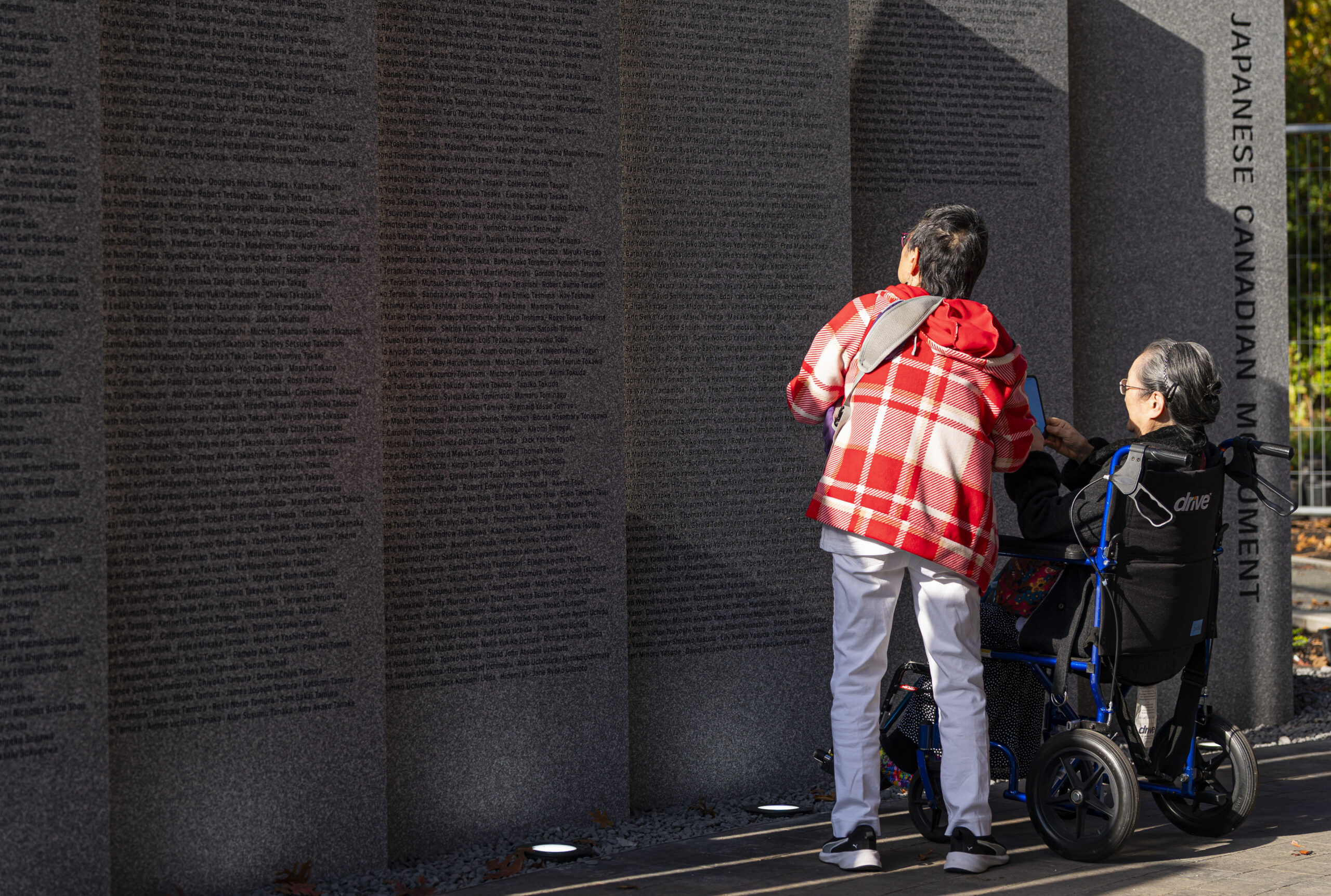
Photo by Rich Lam.
A recently unveiled Japanese Canadian Monument, spearheaded by the Japanese Canadian Legacies Society (JCLS), seeks to honour the legacies of displaced, dispossessed, and interned Japanese Canadians in British Columbia during the Second World War.
The monument displays the names of approximately 25 000 Japanese Canadians from 195 different communities across B.C. who were displaced during the Second World War. The names are organized by location based on the communities they were displaced from. It sits south of St. Ann’s Academy, between Superior St and Academy Close.
Susanne Tabata, CEO of the JCLS, said the purpose of grouping the survivors’ names into the communities they previously inhabited was to “break an old narrative” that there was nothing more to Japanese Canadian history other than being wrongfully interned.
“Beginning in the late 1870s, Japanese Canadians moved into B.C., built families, businesses, networks, and communities, and were well entrenched in British Columbia into their second and third generations,” said Tabata, “when in 1942 they were abruptly uprooted, dispossessed, and displaced twice.”
The monument consists of exactly 100 tall, door-length panels of granite — slightly spaced to let light through each gap. The names of approximately 22 000 victims of Japanese Interment Camps are etched into the granite panels, as well as the 3 000 names of children born after displacement. The monument was designed by architect Bruce Kawabura.
Since the opening on Oct. 3, survivors of displacement have travelled from B.C. and Canada to visit the monument. Tabata said the society toured over 1 900 visitors through Oct. 4 to 7, the majority of whom were locals curious about the monument.
Now, the JCLS have closed the monument to complete construction, and it is expected to remain closed until the end of November.
The concept for the monument started six years ago, Tabata said. UVic helped organize a list of survivors’ names into communities they had inhabited, and created the monument’s website — a comprehensive, interactive public database through which users can search for names of survivors and trace their communities of origin.
The original dataset used by the JCLS was supplied by UVic’s Humanities Computing and Media Centre (HCMC), specifically those of the Landscapes of Injustice Project’s research database.
The Landscapes of Injustice Project, directed by Dr. Jordan Stanger-Ross, a professor in UVic’s history department, aims to recover and grapple with the dispossession of Japanese-Canadians and the forced sale of their property in 1942.
The database contains the names of Japanese Canadians who were uprooted, and the property taken from them.
HCMC collaborated with UVic students, and spent a year reviewing the database to harvest metadata – data about the data collected from the Landscapes of Injustice Project. According to Tabata, Martin Holmes, a programmer with the HCMC, was the “central figure” in the work done by UVic.
“The data we collect in any kind of humanities environment can often be repurposed for other things. The fact that the data had been collected for this one research project presented an opening for the JCLS to invite UVic to take that dataset … that pertained to B.C. and then do more with it,” said Dr. Janelle Jenstad, an English professor and academic director of the HCMC.
Djuna Nagasaki, a UVic alumna, was one of the students who worked as a research assistant on the project. Nagasaki primarily worked to help organize over 26 000 names of internment camp survivors, as well as contacting each of the survivors’ families to verify certain information.
“It really was an opportunity to … see how many people were impacted and to see when people started changing their names from Japanese to English,” said Nagasaki.
“To learn that my own great-grandfather, who we called John, never actually had that as a legal name. His name was Nobuo, but after … his forced uprooting from Vancouver, he started going by John.”
The JCLS also intend the monument to be educational, serving as a permanent reminder of B.C.’s racism against Japanese Canadians that is often not talked about, Tabata said.
“The silence, coupled with what happened to [the Japanese Canadian] community – through the violence of uprooting, dispossession, and two forms of displacement — has really led to a shattering of identity,” said Tabata.
Similarly, Nagasaki worked from a young age to unveil her family’s history with Japanese Internment Camps, and to articulate her personal struggles with those findings to both herself and her peers. She attended the opening ceremony for the monument with family members across generations, including her baby cousin.
“Just to see this little baby hand… touching his name [on the monument] — I think I was really surprised by how much seeing that impacted me,” said Nagasaki, “and to know that this little baby will never know a world where he has to fight for this history to be acknowledged.”