
B.C. gray wolf captured on camera recovering a crab trap and opening the bait box, which researchers say is potential evidence of tool use
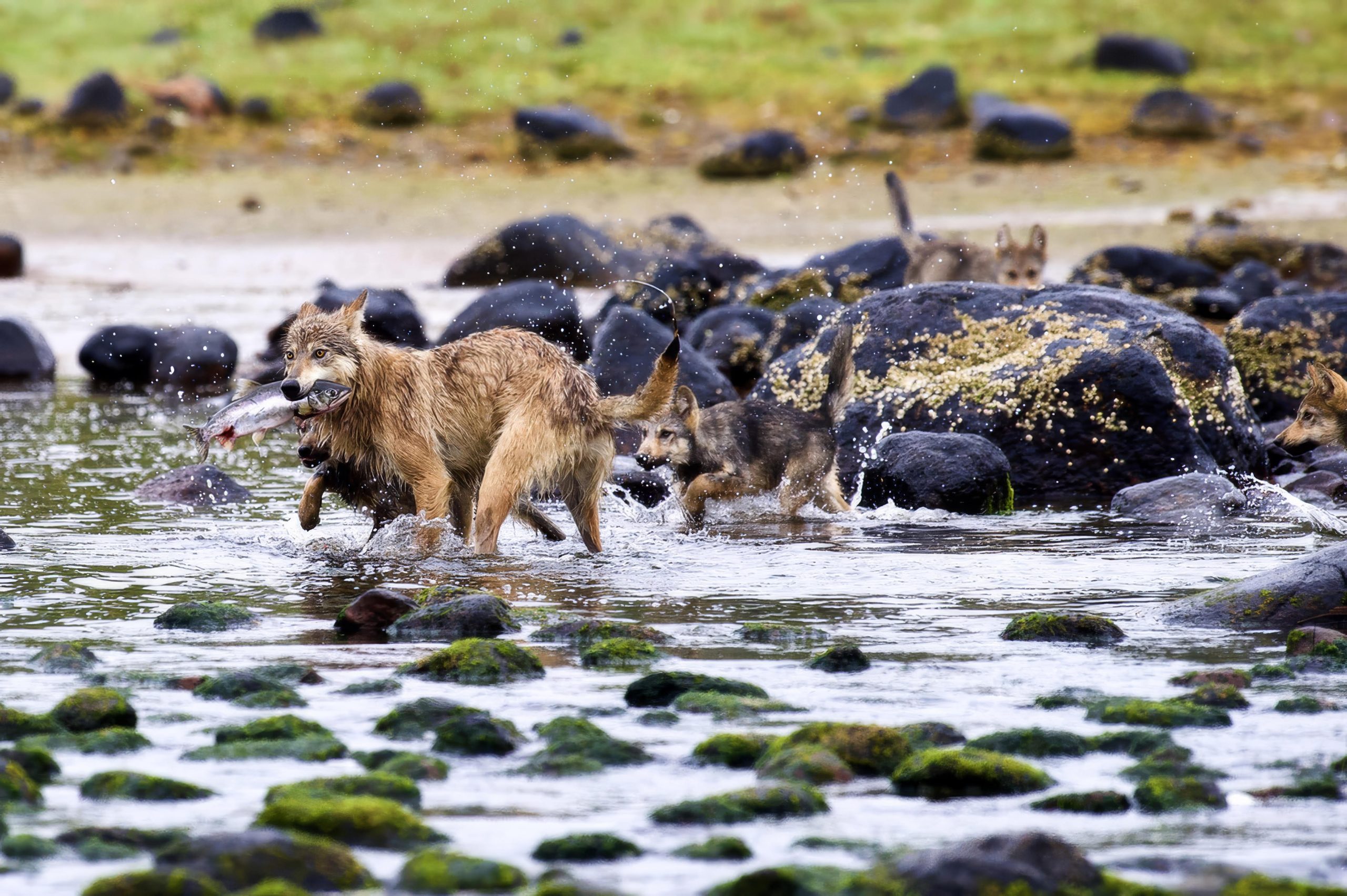
Photo by Klaus Pommerenke.
On Nov. 17, 2025, Dr. Paul Paquet, an adjunct professor in UVic’s geography department published an academic study, purporting to be the first potential evidence of wolves using tools. The study was co-authored by Paquet and Dr. Kyle A. Artelle, a conservation ecologist with the University of New York College of Environmental Science and Forestry.
The origins of the study came from a reported invasion of European Green Crabs — an invasive species in North America — by the Haíɫzaqv Nation. To contend with the crabs, Haíɫzaqv Nation Guardians set up a number of crab traps, which they noticed were continually being damaged, leading them to set up a number of cameras to find the cause.
The cameras captured a gray wolf retrieving a crab trap from the ocean, opening the bait box inside the trap, and eating the bait. At the time of publication, it is unknown if other wolves are performing the same feat. Currently only one wolf has been observed doing this.
At present, it is also up for debate whether this can be considered tool use. Some academic definitions of tool use exclude rope pulling — how the wolf retrieved the trap from the water — due to the animal not creating a proper set up between the rope, or tool, and the reward/incentive.
The study says this may be an exception to the rule, since the process of retrieving the trap and opening the bait box requires a sophisticated understanding of the trap. The study also says that, since rope pulling is part of how humans retrieve the trap themselves, it could further be argued as an exception.
In an interview with the Martlet, Paquet noted that this instance is just considered “potential” tool use. Regardless, he said, it’s a “significant” demonstration of the wolf’s cognitive abilities. Noncaptive wolves are rarely observed and documented in academic literature, the study notes, making it hard to determine how common this level of intelligence is.
Paquet told the Martlet human presence can be disruptive for wolves in a number of ways. Since people often hunt or kill wolves, they have to avoid humans, or otherwise alter their behaviour to account for them.
“We don’t have a lot of good examples of studies of wolves where wolves are not being exploited in one way or the other,” Paquet said.
According to Paquet, the study of wolves has been moving toward less intrusive methods over the past 30 years. He credited the pioneering of less intrusive methods of study to Indigenous peoples, who have extensive knowledge of the wildlife they’ve lived with “for millennia.”
The Martlet asked Paquet what theories exist for how this wolf learned how to use the crab traps.
“It’s always speculation,” Paquet said. “I think the most common theory [is] … this wolf in particular likely observed [humans] doing essentially the same thing.”
“The Guardians — who are part of the Haíɫzaqv [Nation] … do similar sorts of things, where they’ll haul in the buoy to shore to bring the traps in to rebait them.”
Other theories, Paquet said, suggest the wolf could have learned it from other wolves, that a wolf found a buoy in shallow waters, or found one that had come to the shore, and figured out how to open the bait box from there.
“Having … [worked] with wolves for more than 50 years, they’re really, really intelligent, and I wouldn’t put it past them to … on their own, figure out how to do this.”
While working on the study, Paquet consulted with Dr. Jane Goodall — the world renowned ethnologist, conservationist, and humanitarian famous for studying primates, who passed away on Oct. 1.
“She did close up work that was unparalleled, observing things in primates, including tool use,” Paquet said. “She … was helpful in this work as well. I had shared the videos with her, and we had discussions about what they mean, and what they don’t mean.”
“Most people don’t know that, although she studied primates … she loved dogs,” Paquet said. “She really knew [animal] behavior.”
“[These discussions] were good lessons for all of us … From the work that she did, and the kind of example that she provided.”
Paquet also credited William Housty — who works for the Heiltsuk Integrated Resource Management Department (HIRMD) — as being a huge help. “[He] gave us a lot of insight into their relationship with wolves, both culturally and currently.”
“People are [becoming] more familiar with wolves, and there might be more of an affection for them … I hope that in the long-term, [our study] helps wolves, so they’re not always thought of as targets … I think that might be the most important thing that actually has occurred,” Paquet said.