
The Fraser Building expansion nears completion while the Engineering Building project is predicted to run until 2026
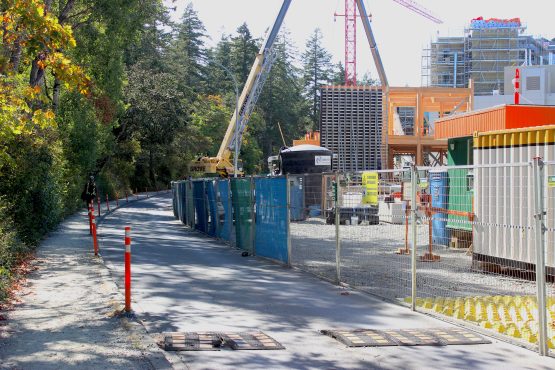
Photo by Abigail Fishman.
Construction on two major building projects has reduced traffic on parts of Ring Road to a single lane since construction began in 2022, with one closure expected to lift soon while the other will remain in place for at least another year.
At the Fraser Building, the university has added a new wing to house the National Centre for Indigenous Laws (NCIL), a facility that has been in the works since 2019. The vision for the centre is to create a physical space that both celebrates Indigenous legal traditions and provides a culturally appropriate setting for teaching, research, and knowledge sharing. The project’s design was guided by four purposes: conveying, sharing, stimulating, and researching Indigenous laws.
Design work for the NCIL took place between 2020 and 2022, followed by the start of construction in November 2022. The foundation was completed in 2023 and, by late 2023, the steel and mass timber structure began to rise. Through the spring and summer of 2024, crews completed the majority of the building and the roof. The building was completed in the fall of 2024 followed by interior framing.
The NCIL opened this September, however, some finishing work is still underway on the site.
As the final work on the project nears completion, its impact on Ring Road traffic will be lessened. In a statement to the Martlet, a university representative said that site fencing is expected to come down in early October, at which point the lane closure outside the Fraser Building will end.
Alongside the reopening of the road, the pedestrian and bike crossing, as well as the sidewalk, will be reinstated, and improvements will also be introduced, including new bike racks and a landscaped plaza with seating.
The closure at the Engineering and Computer Science (ECS) project, however, will last much longer. Planning for this expansion also began in 2019, with design work continuing through 2023. Construction began in 2024 and is scheduled to continue into late 2026. The project includes both a new academic space and the High Bay Research and Structures Lab (HBRSL), which the university said is part of an effort to meet the growing demand for post-secondary engineering graduates.
The ECS expansion is envisioned as “a beacon of innovation, collaboration, and learning for an adaptive and sustainable future,” according to the project’s webpage. ‘
When it is complete, a UVic representative said, it will not only provide modern research and teaching facilities, but will also reshape the surrounding area with bike lanes, accessible parking stalls, bike parking, and — similarly to the NCIL — a landscaped plaza. The university predicts that one lane of Ring Road at the site will remain closed until late 2026.
UVic acknowledges that construction has changed traffic flow, but said that the impacts have been limited. Traffic control and signage are in place to guide drivers, and the occasional full closures are scheduled during off-peak times to reduce disruption. The university has not reported significant congestion at either site.
A university spokesperson noted that the start of the academic year often brings an increase in traffic regardless of construction, and that congestion is expected to ease as people settle into routines.
The university has also received feedback from the community about the disruptions. Most comments, UVic told the Martlet, have been requests for clear signage and slower vehicle speeds near construction zones. In response, the university installed additional signs and speed humps.
The university also said notices about closures have been sent by email, posted on the UVic website and social media, and reinforced by signage and traffic flagger personnel at the sites.
For those looking to avoid traffic altogether, the university representative pointed out that the campus is well-served by walking, cycling, and transit. These modes are being further integrated into the ongoing projects, which emphasize improved safety and accessibility for people who travel to campus without a vehicle, the representative said.
Looking ahead, UVic anticipates that Ring Road will continue to be affected by maintenance and projects in the coming years. The university said that they work to minimize disruptions through coordinated scheduling, clear communication, and traffic management.
In the longer term, both the NCIL and ECS expansion promise to add more to campus than just new buildings. UVic said the associated upgrades to landscaping, bike lanes, sidewalks and pedestrian crossings will make the campus safer, more accessible, and more welcoming for years to come.