
In the name of fun and radical expression, these contests bring students together through satire and self-mockery
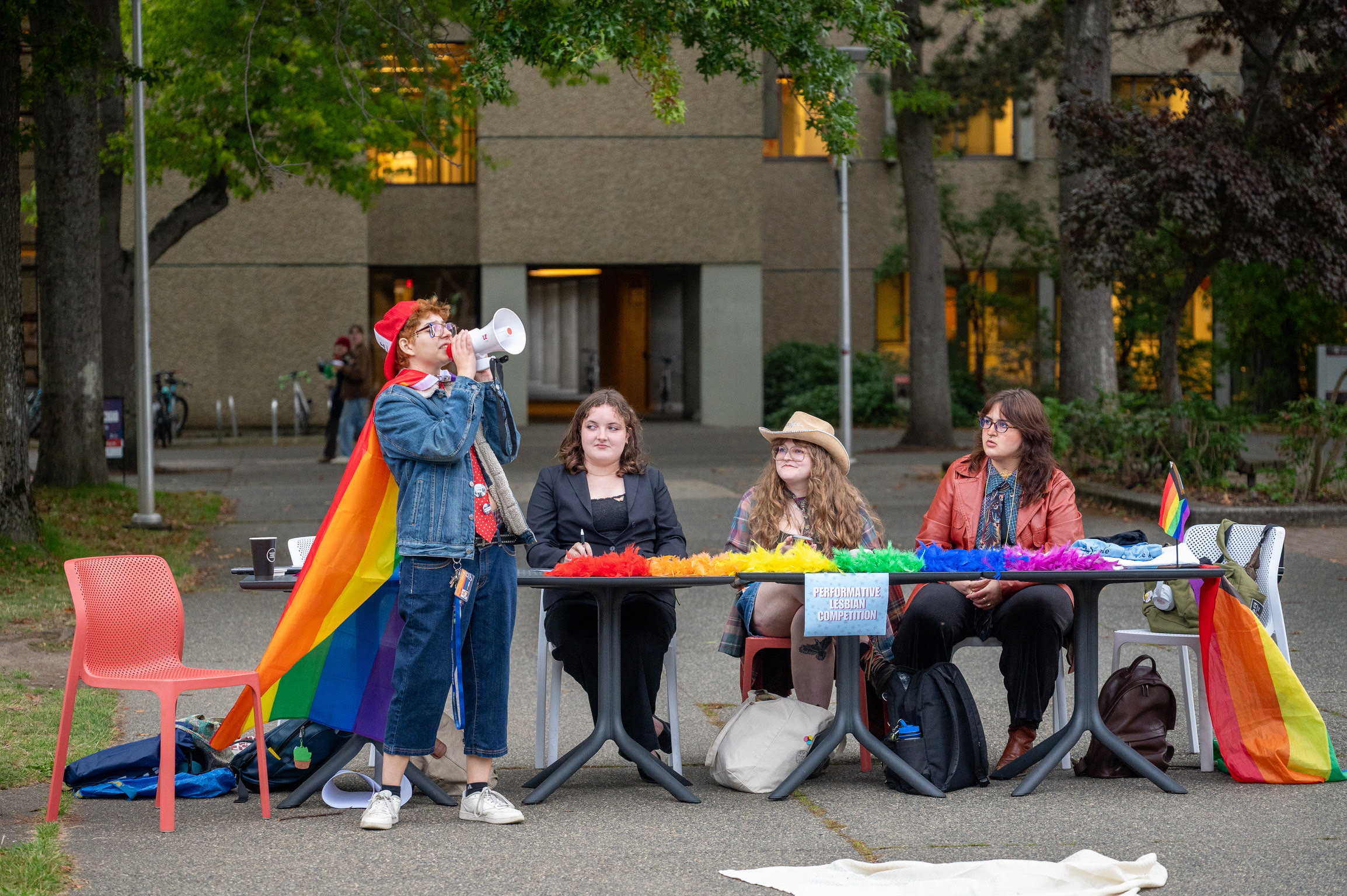
Photo by Haida Davies McDermott.
“Performative” contests made their way to UVic’s campus this fall, with multiple student clubs jumping on the trend during the first week of October.
In just one week, UVic Climbing Club, Dykes Nation UVic, and an independent group, UVic Performative Males, hosted their own versions of the performative contest trend.
What was initially a social media trend has been translated into in-person contests across university campuses in the United States and in Canada. The contests typically include participants who exaggerate a stereotype, whether that be the so-called “performative males” or another more niche group, with a panel of judges to decide upon the winners.
The trademarks of a “performative male” contest include common accessories such as a tote bag, a piece of feminist literature, and an iced matcha, among other trendy items. While all of these were present at the performative males contest, the “performative lesbian” contest held by Dykes Nation offered another window into what the contest can mean for a community.
“I think this is actually a lot bigger and more significant than just a satirical, fun, silly event for people to come together,” said Dykes Nation founder and contest participant Jordana Pangburn. “It was very political and radical to see so many people taking up space and unapologetically expressing their relationship to gender and sexuality.”
Around 200 students gathered for the performative lesbian contest that took place beside Petch fountain on Oct. 3. Prizes were awarded to participants who had the best tote bag, carabiner, earrings, literature, and performance. The attendees’ props and performances ranged from things that are stereotypically associated with the lesbian and sapphic community, such as climbing equipment and sapphic poetry readings; however, many brought their own individual spins to the contest, too.
“The performative male contests are a reflection of modern Western capitalism, but [at] the performative lesbian contest, everyone was referencing queer and sapphic history and culture.… There’s not that same depth and cultural connection within the male contests,” said Pangburn.
While the performative male contests did have many of the typical trend elements to it (i.e. presentation of feminist literature and iced matcha), the organizers of the event acknowledged that it was all in good spirits and not meant to be harmful.
“The emphasis is not on ‘we are making fun of feminism,’” said co-organizer of the performative males contest, Violet Bertram. “We’re making fun of that genre of people who think that they can use it as a tool to perform for others to get attention.”
Other performative contests have popped up on campus, aimed at bringing community members together and having fun, similar to the idea behind the performative males contest. UVic’s Climbing Club held their own version of the trend on Oct. 8 at the Centre for Athletics, Recreation, and Special Abilities (CARSA) Climbing Wall.
Climbing Club executive member and photographer Kai Brown Jones said they hopped on the trend because “we want the club to be a social space for people. … It makes people want to come, [and] it’s a conversation starter. We thought, ‘why not do performative climbing?’”
The heart behind all of the contests is a sense of satire, and a community being able to turn around and poke fun at itself, but the importance of that satire was especially powerful for those at the performative lesbian contest.
“There’s never going to be proper equality if we can’t make fun of ourselves and do goofy things,” said Dykes Nation member Linnea Stevens. “The fact that we can do that is a very powerful thing. If everything is always serious and not super fun, it’s kind of demoralizing.”
Dykes Nation also made a nod to past activism on campus from the late UVic professor Dr. Michèle Pujol, who used to organize Lesbian Walks around campus, and taught UVic’s first lesbian studies course in the Women’s Studies (now Gender Studies) Department.
“I see the performative lesbian contest as being a continuation of the legacy of dyke organizing in this city,” said Pangburn. “It might not seem political on the surface, but it definitely was.”