
From books and board games to pet accessories and plants, Victoria’s Little Free Libraries bring neighbors together
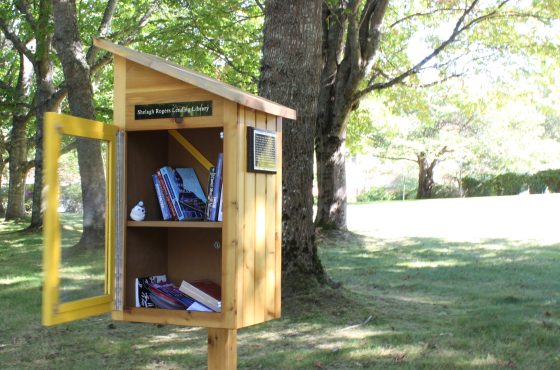
Photo by Abigail Fishman.
Teale Phelps Bondaroff, Saanich city counsellor and marine conservationist, has spent the last eight years running the Little Free Library (LFL) project across Greater Victoria. On Sept. 20, 2025, the community came together to celebrate the installation of the 1 000th LFL.
Phelps Bondaroff first became involved in this project in 2015, after noticing more and more LFLs during his commute, cycling to work in Oak Bay every day. He reached out to The Greater Victoria Placemaking Network and soon after, he and his partner launched a campaign to update the LFL map. They added 86 previously unmapped libraries, bringing the number on the map from 25 to 111.
From there, the goal became to reach 150 LFLs for the 150th anniversary of Canada in 2017. This meant building new ones, but they reached their target. Reaching this goal didn’t mark the end of the LFL project, but the beginning, and the project took off from here.
This project goes beyond the mere sharing of books, and into a deeper sense of creating community. Phelps Bondaroff believes that LFLs are an entry into “place-making” — which he describes as, “the idea of people coming together to shape the public spaces they live in.”
LFLs are often managed by one or two people, but sustained by the community. They also often go far beyond books. Today, there are boxes for plants, seeds, puzzles and board games, art supplies, food, household items, children’s toys, and pet-related items. Some neighborhoods even have LFLs that specialize within the book category, such as libraries solely for kids’ books or poetry.
“I always describe them as coral reefs for the community,” Phelps Bondaroff said. They introduce people to the idea that they can actively shape their neighborhoods. LFLs become small hubs of interaction, creativity, and sharing, connecting people in ways that go far beyond lending a book.
Local businesses and organizations also support the initiative. Some local pizza shops have LFLs outside their storefronts, local nurseries donate plants and seeds, bookstores provide surplus or discarded titles, and some organizations use the LFLs to distribute information.
Over the years, challenges such as wear-and-tear have arisen, but Phelps Bondaroff emphasizes the resilience of the project. Broken doors or cracked plexiglass are quickly repaired or replaced, and instances of intentional damage are rare. The whimsical nature of the libraries, he says, encourages respect from those who may be inclined to commit an act of vandalism.
The 1 000th LFL milestone was celebrated on Sept. 20 at the Oaklands Community Association, with an event titled “Books, Bites, and Beats.” The celebration included an LFL petting zoo, and LFL auction (with proceeds going to the Victoria Literary Society), a DIY zone for kids, placemaking information booths, live music, and food trucks.
Phelps Bondaroff said the event also included a functioning lighthouse LFL built by a local craftsman, which was included in an auction, cosplay superheroes to entertain kids, and the launch of the Greater Victoria Little Free Library Awards.
The awards allow community members to nominate libraries in their neighborhoods across numerous categories such as “cutest library” to “best library for puzzles.” Voting will close in October, and winners will be announced in November.
Looking forward, Phelps Bondaroff hopes the project continues to inspire placemaking and community-building. While the LFLs may have reached a high number, he emphasizes the importance of quality and diversity, encouraging libraries to focus on different items or themes, and fostering opportunities for others to actively shape their urban space.