
The proposed committee faced criticism for unclear terminology, a lengthy timeline, and a lack of student representation

Illustration by Sage Blackwell.
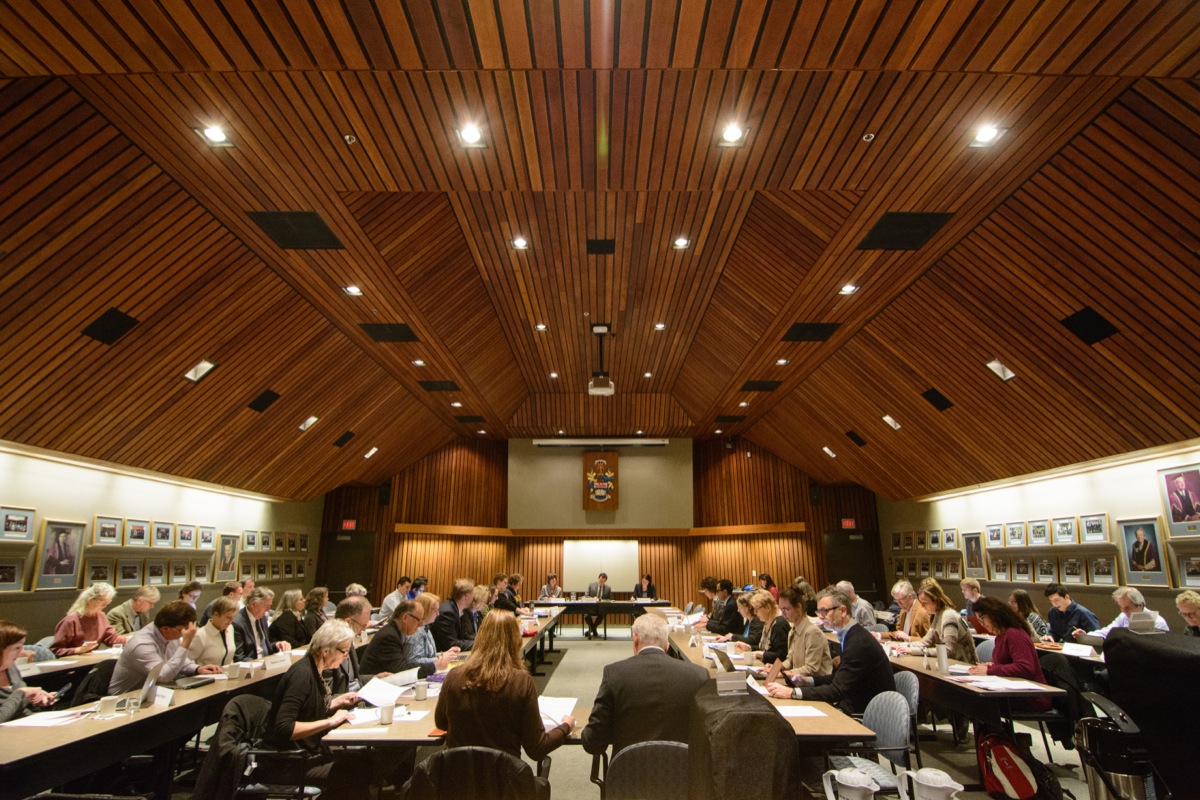
A new senate committee slated to tackle the growing accessibility and accommodation needs on campus was proposed at the last Senate meeting on Oct. 3, but not without concerns from student and faculty senators.
The proposal for an Academic Accessibility Committee comes after the recent implementation of UVic’s new Academic Accommodation Policy and a petition from the University of Victoria Faculty Association and many other on-campus groups, calling for changes to the university’s current accommodations system.
Over an 18-month-long investigation, the committee would research and recommend strategies to better accommodate student and faculty needs when it comes to accommodating accessible learning — with an extra emphasis on “access-centred” support.
The meaning of “access-centred” roused confusion and concern among senators. UVic’s Accessibility Plan defines access-centred as the following: “accessibility is a process that is forever changing versus a static state of being. Access is a constant process that changes in each space and with each individual.”
“My concern … was that this is a rather empty [definition] in terms of the actual direction it would provide a committee,” said faculty senator and philosophy professor Dr. Colin Macleod. “It’s a kind of vacuous concept as it’s defined in the Accessibility Plan.”
In practice, an access-centred approach to accommodations means that courses themselves would be tailored to have universal design so “simple” accommodations (i.e. extra time, distraction reduction) would be generally applied to all students — while additional individual needs would still be met through the Centre for Accessible Learning (CAL).
“The terms of reference are skewed towards the administration’s narrative that all will be well if UVic moves more and more, and as quickly as possible, towards what they call this ‘more accessible’ education and away from an accommodation focus,” said faculty senator and history professor Dr. Lynne Marks. “No other university in Canada that we are aware of is moving at this speed in this direction.”
Other concerns raised over the proposed committee included the lack of student representation.
The proposal reads, “It is strongly recommended to include perspectives from students and those with lived experience.” Some senators questioned how this advice would be met, however, as the makeup of the committee only allots two seats to students — one undergraduate and one graduate — out of 16.
At the time of publication, it does not reserve a spot on the committee for a Society for Students with a Disability (SSD) representative. Student senator and UVSS Director of Campaigns and Community Relations Michael Caryk said the lack of representation from the SSD is “deeply concerning.”
A similar sentiment was echoed by fellow senators.
“It is absolutely essential that we have input from students with disabilities on what is needed,” said senator and Associate Professor of Educational Technology Dr. Valerie Irvine. “But also we need to have voices from the people in CAL who [are on the] frontline.”
After the proposal was brought to the senate, Dr. Elizabeth Croft, VP Academic and Provost, said in a statement to the Martlet, “academic accommodation … requires thoughtful, collaborative approaches.” No specific groups were named explicitly in the proposal, nor the statement, but the proposal does say the committee would be responsible for considering impacts on campus units like the CAL, the Office of the Registrar and Enrolment Management (OREM), Division of Learning and Teaching Innovation (LTI), and UVic Libraries, among others
While the proposal itself highlights the need for “practicality” and outlines the committee’s responsibilities, some senators were concerned with the proposal’s language around funding. The proposal states that allocation decisions—including budget, capital, hours of operation, and staffing — are “overseen by Executive Council under the authority of the Board of Governors” and would therefore be outside the proposed committee’s purview.
The “Guiding Approach” of the committee would prioritize, under the current proposal, recommendations that are “high-impact and feasible within existing or modest additional resources.”
The provincial government mandates that universities meet students’ accommodation needs; however, they provide no additional funding in order for post-secondary institutions to do so properly, unlike at the K–12 level. The current proposal makes no mention of what funding limitations the committee would be required to work around.
“Given that we have legal and moral responsibilities to meet the accommodation needs of students at the university, I am a little bit worried about an approach [where] the financial constraints are controlling the agenda,” said Macleod. He later clarified in a statement to the Martlet that although financial considerations are relevant, the committee ought to know exactly what their financial constraints are.
Senator and earth and ocean sciences professor, Dr. Andrew Weaver, having had experience being on a past climate committee, brought forward concerns over how much action the committee itself would be able to take. “What we have is a deficit of decision making,” he said. “Sometimes people don’t like the decision you’ve made — you have to actually consult, you have to bring people with you, you have to be transparent about the process. But make a decision.”
Amendments to the proposal range from increasing student representation, moving the committee to operate outside of the senate, or even arranging a town hall-style meeting to include a range of voices and feedback.
The proposal is still in early stages, and there has been no formation of a committee yet. At the November 21 senate meeting, the revised proposal will be presented to members of the senate with the intention of the committee commencing its activities in January 2026.
Although no revisions have been made public at this time, there are still concerns about the committee as a whole that have yet to be addressed.
“If this is the single biggest issue facing instructors on the frontlines, surely it should be at the top of [the university’s] decision-making list,” said Weaver. “But, it clearly isn’t, if you want to strike a committee that will take two years.”