
‘The salmon don’t have a voice’ says Tsartlip First Nation member ZȺWIZUT Carl Olsen
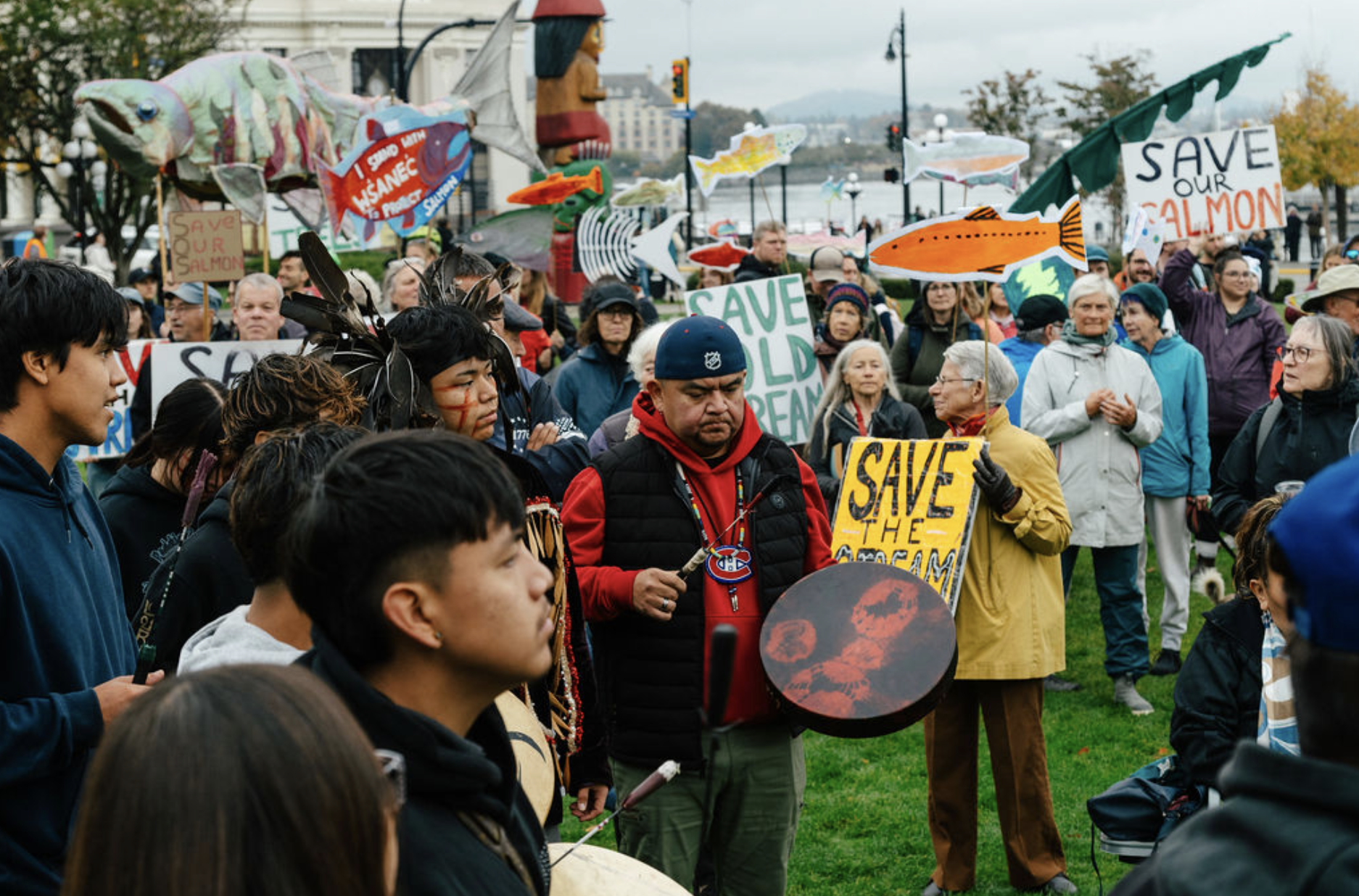
Photo by Agathe Bernard/Wilderness Committee.
Since January 2023, ZȺWIZUT Carl Olsen of the Tsartlip First Nation, has been protesting the proposed expansion of the Malahat Highway at Goldstream Provincial Park. The project plans to add a median barrier leading up to Finlayson Arm Road intersection. In the proposed area of construction are the spawning grounds of coho salmon.
“The reason I’m there is to protect the salmon,” said Olsen. “The salmon don’t have a voice, the environment there doesn’t have a voice or anyone speaking up for it. But that’s why I’m there.”
An environmental assessment of the project found that the construction is expected to result in the “permanent loss or alteration of aquatic salmonid and amphibian habitat.” Other projected impacts include the permanent loss of “mature coniferous forest habitat,” “loss of wildlife habitat,” and “potential loss of bat roosting habitat in cliff areas.”
“This construction will kill the species of salmon. For the four years [of construction], there will be blasting, and all sorts of things that will directly affect the salmon,” explained Tobyn Neame, Forest Campaigner for the Wilderness Committee –– a registered non-profit organization –– who has been supporting Olsen for a year and a half. “Salmon require a . . . very specific temperature and substrate to nest in . . . If you have a concrete tube that has water in it, a salmon can swim through it. But they can’t lay their eggs in that. They can’t nest in that, they can’t breed in that.”
According to the environmental assessment, the project “intends to remove some trees and to modify four cliff faces via blasting to expand the transportation corridor.” As explained by Neame, salmon need a specific temperature in order to lay their eggs. The project could “ take away the canopy [of trees] that keeps the water temperature cool enough for fry (young salmon) to survive,” said Olsen.
The assessment also noted that the proposed blasting may produce shock waves that can damage the swim bladders of fish, rupture internal organs, and kill or damage fish eggs or larvae. Neame elaborated that, while breeding, adult salmon might not be in the stream during construction, but there are still eggs, fry and alevins (newly hatched salmon) in the stream. “And it’s four years — it’s a four year project. [That’s] four years of interrupting salmon run,” said Olsen.
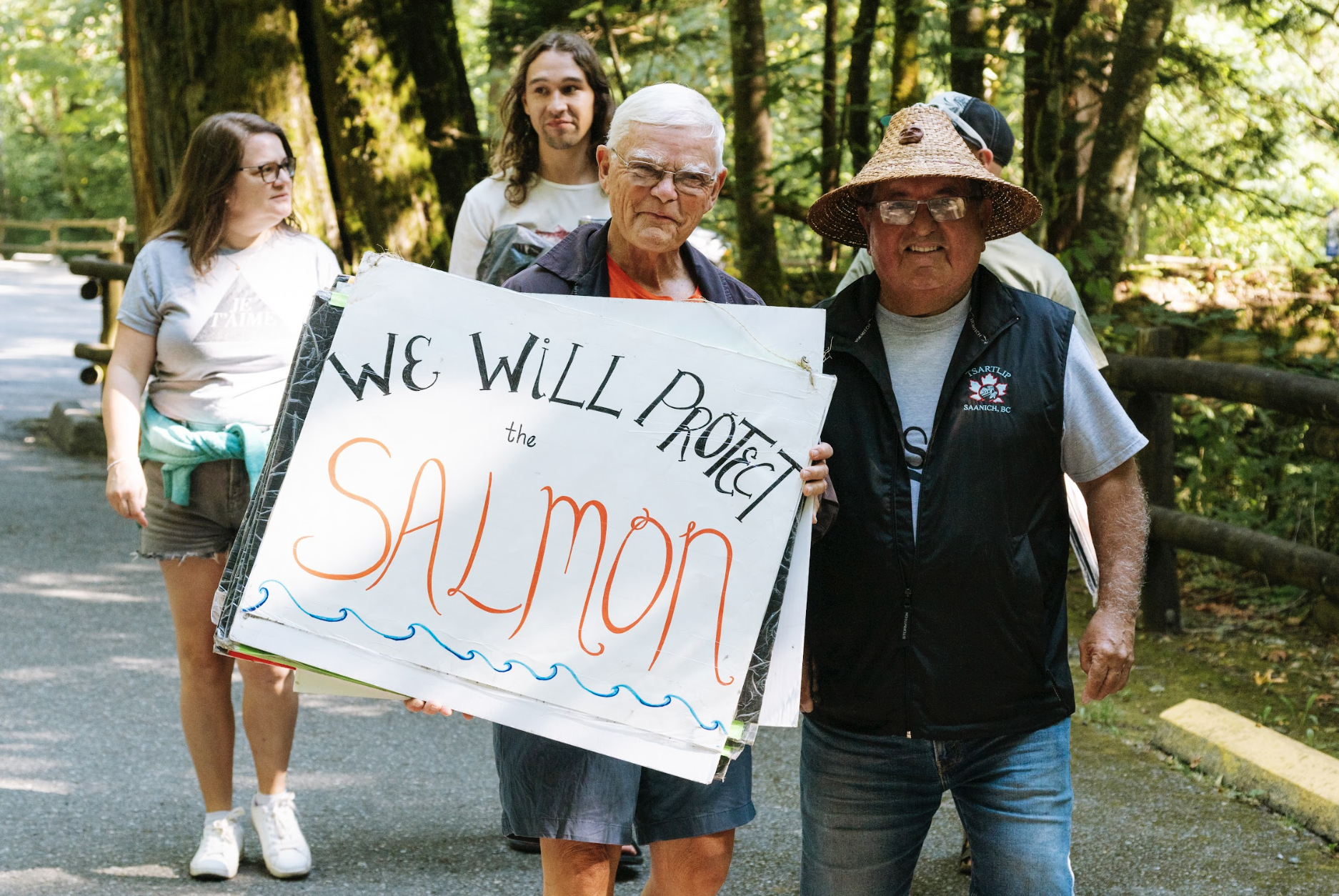
Photo by Agathe Bernard/Wilderness Committee.
A protest against this project took place in front of the B.C. Legislature on Oct. 22, and saw a turnout of around 400 people. Olsen, who said he thought 100 people would be nice, was overjoyed with the turnout. The Wilderness Committee helped him plan the rally. During the protest, Olsen quoted a letter he received from a student from North Saanich. “‘If you kill the stream, you kill the salmon. If you kill the salmon, you kill the orca.’ Tell me how come people who make decisions like that don’t think that way,” he said. “Because you kill one spot, you’re not only killing that, you’re killing a whole string of other things that are at risk.”
Turnout at Goldstream continues to remain consistent. What began as Olsen, his granddaughter, and a member of a book group he runs has now grown to 45 to 70 people every Tuesday from 10 a.m. to noon.
When asked what people can do to support Olsen and Goldstream, Neame said, “Write a letter. Show up on Tuesdays. We have a letter writing [guide] on our Wilderness Committee website, and that targets all of the key players and key power holders in the B.C. government. And telling personal stories. Just saying, ‘I go to Goldstream. I bring my kids there. I’m studying this course and I went to Goldstream to watch the salmon run in it.’”
“Whatever it is that you’re doing, whatever relationship you have to the place, writing about that is what gets those emails opened in the Ministry of Transportation, in the Ministry of Forest, in the Ministry of Parks, and in David Eby’s office,” Neame said.
“I’ve been there for coming up to three years, and I intend to stay there as long as I can,” said Olsen. “And hopefully, we can win a decision in my favour, or in favour of our people. It’s not just for me, it’s for everyone.”