
Senate made various changes to the existing nursing and francophone programs and proposed a new accelerated nursing program
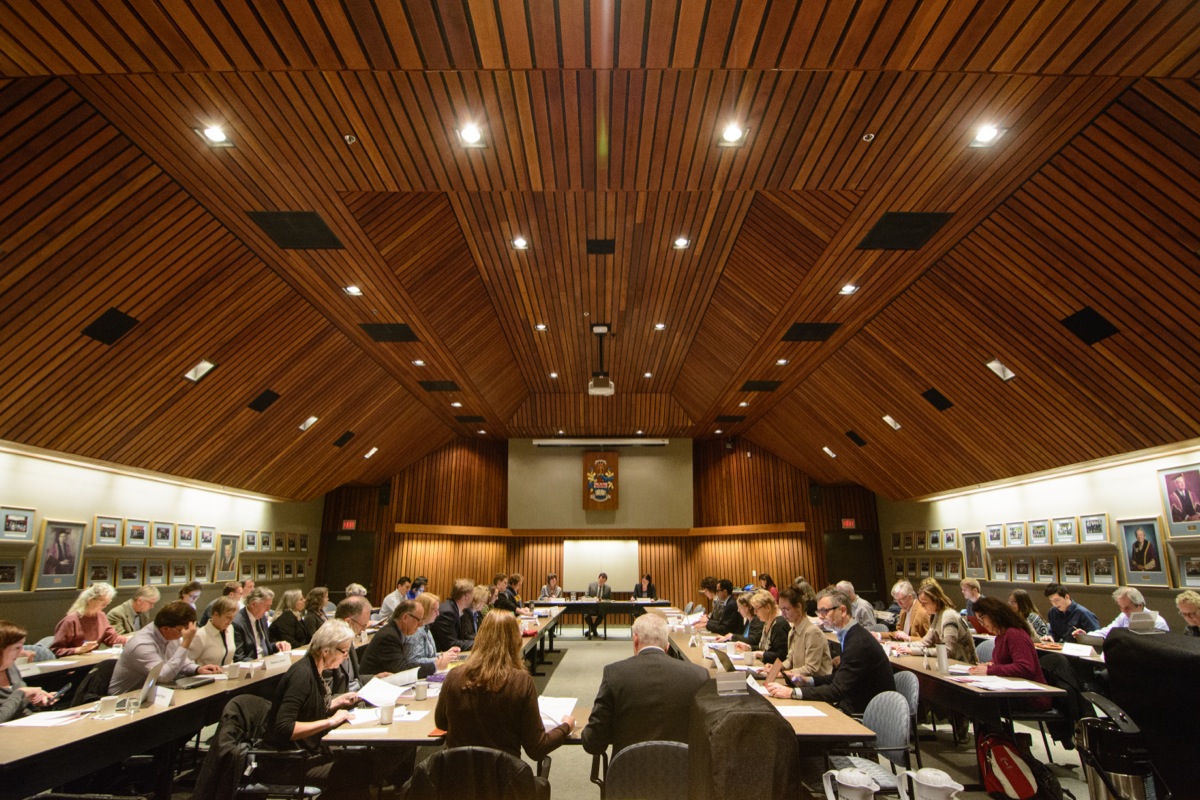
File photo by Hugo Wong.
During the Nov. 6 meeting, the Senate changed various nursing and francophone programs and proposed a new accelerated Bachelor of Science in Nursing program. Senators gave no dissent for any of the motions presented.
Rhonda McEwan, UVic’s new president, kicked off her first Senate meeting by thanking the senators and their service to the university. She said there “will likely be an evolving fiscal and post-secondary environment” following the dual provincial and municipal elections that took place last month. She also said the university would be there for students who are “anxious” following the election results.
Following her remarks, the Senate Committee on Agenda and Governance motioned to approve various appointments to standing committees, which passed without any dissent.
The Senate Committee on Awards then gave their annual report. According to the report, “there were 5,689 (4,616) scholarships and awards given to 4,038 (3,841) undergraduate students, with a total value of $15,429,827.03 ($14,191,645.70)” in the May 2025 to April 2026 academic year.
The same committee then passed a motion (without any dissent) to approve and revise various awards.
The Senate Committee on Planning then introduced a proposal for a new Accelerated Bachelor of Science in Nursing, which intended to “increase access to BSN education on Vancouver Island and beyond through opening admission to a new and diverse set of applicants who wish to leverage their post-secondary education towards a BSN degree.”
The degree will require completion of 12 lecture-based courses and six practice-based courses, over five consecutive terms. Applicants must have already completed 30 non-nursing, transferable units at a recognized university to gain admission.
The same committee also motioned to approve, and recommend the Board of Governors (BOG) approve, the discontinuation of the Nursing Education Graduate Certificate, the discontinuation of the Nursing and Health Informatics Double Degree program — both of which did not attract enough students — as well as revisions to the Master’s and PhD programs in nursing.
The revisions to the Master’s program include structural changes that would divide the current program into two streams: one stream for nurse practitioners, and another for all other streams, including Indigenous wellness. Changes for the PhD program including reducing the number of mandatory courses and seminars.
All passed without any dissent.
The Senate Committee on Planning then motioned to revise the French and Francophone Honours, Major, and Minor programs. The changes were described as “clean up,” and clarified existing language. All three programs were revised without any dissent.
Later in the meeting, the Senate Committee on Academic Standards introduced several motions to approve changes to the academic calendar, admission requirements, and progression requirements for various nursing and francophone programs, which all passed without any dissent.
The Senate Committee on Planning also moved to revise admission requirements for the Engineering Technology Diploma and Bachelor of Engineering in Biomedical Engineering and Management program.
A senator had concerns over part of the proposal, which said no individual with a grade below a C is eligible for admission to year two of the program. His concern was that this could “shut down” students who have previously failed a course or received a D, and that other policies specify that students can have a grade below a C, provided they repeat the course and achieve a C or higher.
The speaker for the committee said that from their understanding, students could repeat failed courses and gain admission. The Senator who had concerns over the language said he would be comfortable passing the motion with the understanding that the language be amended. The motion then passed without any dissent, marking a full meeting without any dissent on motions.
During the meeting, there was a presentation on UVic’s enrollment numbers. According to the presenters, UVic currently has its largest enrollment to date, despite many other B.C. post-secondary institutions being largely underenrolled.
The presenters also said “90 per cent of [UVic’s] operating revenues … occur because of enrollment-related activities.” McEwan later said it was risky to have almost all of our revenue from so few sources, and that the university would need to broaden their sources of revenue.
The 2025-2026 annual report on Non-Academic Misconduct Allegations and Resolutions was also given. According to the report, the university investigated 468 allegations of non-academic misconduct in the year, an increase of 20 per cent from the 2024-2025 academic year.
Lastly, the chair noted there was also a Senate resignation resulting in a byelection for a faculty position, with nominations open till Nov. 13. Neither the chair nor the agenda clarified who resigned.
Meeting schedules and agendas are available here. The next open meeting of the Senate is on Dec. 4.