
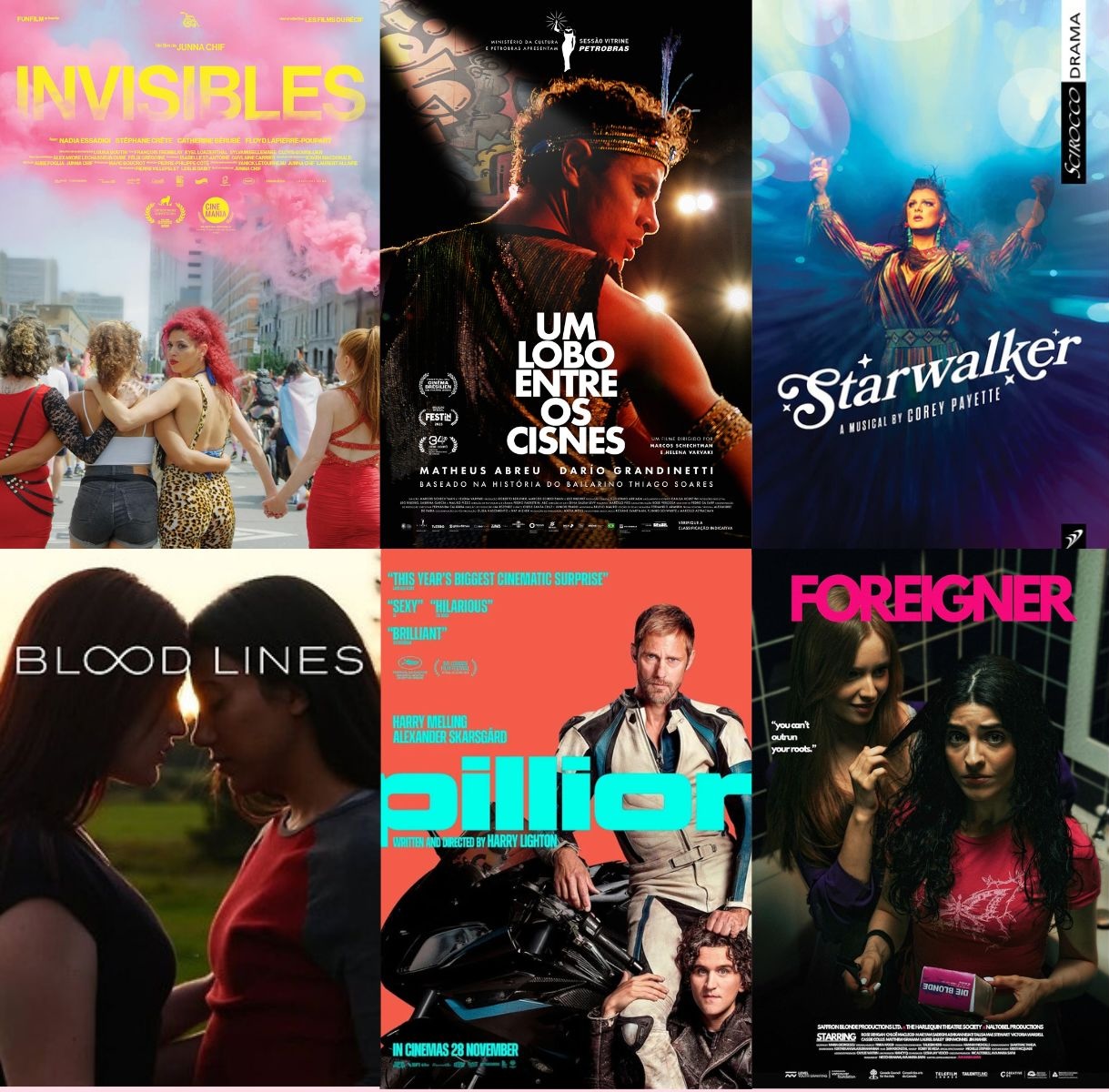
Images via Victoria Film Festival, collage by Sage Blackwell.
A Wolf Among Swans
The 2024 film, A Wolf Among the Swans, directed by Helena Varvaki and Marcos Schechtman, follows the career of Thiago Soares (Matheus Abreu), a young hip hop dancer from the suburbs of Rio de Janeiro, who is offered the once-in-a-lifetime opportunity to evolve himself as a competitive ballet dancer.
The film follows Thiago’s adaptation to ballet and the relationship with his instructor, premier Cuban dancer Dino Carrera. Whereas the protagonist is a young man, strong and full of hubris, his teacher is wise, levelheaded, but suffering in a body that has betrayed him with an AIDS diagnosis.
Thiago’s own resistance towards ballet is the all-too-common trope that it somehow “reduces” him as a man, even while Carrera makes him practice exhaustively, and condition himself by carrying cement bags overhead with the same amount of care needed to lift female ballerinas –– his initial motivation to remain in training.
The central message of the film is that “a real man will dance anything, including ballet,” as said by Thiago’s hip hop instructor in the first act. It’s a triumph by screenwriter Camila Agustini, who successfully guides the film’s audience, along with Thiago, to understand the complex feats by male ballet dancers who leap and poise with a precise combination of strength, balance, and grace — all while holding a smile. The film is confident in its statement that ballet is a physical craft that expresses masculine and feminine elements in harmony.
The film also maintains a balancing act in its attitude towards choreography and framing bodies. Cinematography by Pedro Faerstein gracefully follows the film’s performers; at times the framing mimics a pirouette in time with the dancer’s spins and lifts. Viewers will also notice the striking contrast in locations and lighting throughout the film, from neon and graffiti clad venues of Rio’s barrio dancehalls to the milky white ballet practice rooms and golden concert halls in Paris.
Also worth celebrating is the film’s soundtrack, which features a mixture of careful needle drops, from the classic hip hop tracks era of Grandmaster Flash to a kalimba rendition of Tchaikovsky’s “Dance of the Sugar Plum Fairy.” The energy of the film is not merely formalist, but sincere in its interpretation of contemporary dance and its multitude of expressions.
My only concern with the film is its use of Carrera’s diagnosis at convenient intervals in contrast to his protégés’ successes in international competitions. While the film is largely respectful in its representation of the lived experiences of AIDS victims and survivors, Carrera’s diagnosis feels in danger of being overused as a narrative device. The reminder of Carrera’s ailing body does feel at times heavy-handed in illustrating how Thiago grows increasingly strong in his own skin as a dancer, and he moves beyond a bias against ballet as “exclusive” to queer and gay men before eventually submitting to the blunt, and often unsympathetic, support from his teacher.
And for how well the film is paced throughout, its ending rushes somewhat to deliver a poignant end note, after summarizing several years’ of Thiago’s journey, culminating in his earning the position of principal dancer with The Royal Ballet of London. Nonetheless, A Wolf Among the Swans is a deeply affecting film which acts as a love letter to dance culture, ballet, and the city of Rio de Janeiro.
Invisibles
Invisibles, directed by Junna Chif, who attended the VFF screening, is a profound achievement in storytelling. The movie was presented by Tournée Québec Cinéma alongside La Société Francophone de Victoria. Before the film began, the audience at VFF was treated to a beautiful poem written by Floyd, a disabled person featured in the film, and read by Chif. From that moment on, an enrapturing and powerful story unfolded, making evident Chif’s years of research and investment in the subject matter.
The story centres on Élizabeth (Nadia Essadiqi), a burlesque dancer and sex worker who, after engaging with a disabled client (Floyd Lapierre-Poupart), decides to work exclusively with disabled clients. The movie tackles two different yet intertwined justice issues: protection for sex work and accessibility, showing how marginalizations across society intersect.
In Canada, sex work itself is not criminalized; however, related activities, including clients and advertising, are. Therefore, all the disabled clients Élizabeth interacts with are technically criminals under the law. The film treats its disabled characters with compassion and empathy, and features a range of disabilities and desires among the clients and other disabled people Élizabeth meets. In depicting Elizabeth’s efforts to become more educated and proficient in assisting them, the film adeptly avoids using disability as a trope or plot device. Instead, navigating life with a disability is portrayed as one of the film’s thematic centerpieces.
The movie also avoids the trope of depicting disabled people as purely virtuous, including a disabled character (Stéphane Crête) who is manipulative toward Élizabeth, mirroring the reality that disability does not equal innocence or heroism, and resisting a black-and-white portrayal of the issue it explores in favour of greater depth.
The movie’s many sex scenes are filmed with dignity and respect. Sexuality is part of life, and should not only be depicted through able-bodied people. The film challenges typical depictions of sex and shows the beauty and fun — but also the difficulties — of sexual intimacy involving a wide range of disabilities.
Following the film, Chif answered audience questions, and spoke about her extensive research process, the casting and filming, and the film’s positive reception, especially among disabled communities. However, Chif also said that many film festivals did not screen Invisibles, saying that audiences were “not ready.”
Overall, the film shares vivid, flawed characters, and speaks to the near-universal need for affection and tenderness. It creates deep empathy for the issues it explores while remaining an engaging and enjoyable watch.
Blood Lines
Blood Lines, directed by Gail Maurice, tells a story of familial relationships — blood or otherwise — and love. The film follows Beatrice (Dana Solomon) as she develops a relationship with Chani (Derica Lafrance), a newcomer in her town, and navigates Beatrice’s tribulations with her now-sober mother (played by director Maurice), who returns to town unexpectedly after years away.
Beatrice is a journalist for the local newspaper, and an employee at the gas station in her small Métis community. She connects with Chani after a friend overhears that she is searching for her biological family in the community where she was born. Beatrice suggests writing an article about Chani, in hopes of reaching her biological family. Though Chani is initially reluctant — about both the idea and Beatrice — they form a friendship that turns into something more.
Packed with stunning landscape shots, the movie has a distinctly scenic feel. The town where Beatrice lives, along with its people and nature, is a key element of the film. From the shenanigans of some of the town’s older women — the Granny Gang — to bring Beatrice closer to her mother, to scenes of local festivals complete with delicious bannock and competitive jigging, and shots of Beatrice adding items to community members’ never-ending tabs at the gas station, community and belonging play a central role in the film’s themes. People look out for each other there, creating tender yet funny moments of casual intimacy within the town.
The movie takes its audience through a whirlwind of emotion, from laughter to tears, with gasp-worthy twists. Each moment is engaging, and the family saga and romantic plot are brimming with tension and excitement. Switching from English to Michif to occasionally French, the film provides an intimate glimpse into its characters and their culture. While some scenes are overacted at times, featuring moments dialogue and character expressions that ring a bit cliché, the story ultimately feels both true and resonant.
Starwalker
What makes someone get on stage for the first time? What makes someone want to perform? What makes someone become a drag performer? What is the appeal? For Star, played by Dillan Chiblow, the world of drag, specifically the House of Borealis –– a drag house featured in the film –– offers him a place to belong and thrive.
Starwalker explores the world of East Vancouver drag as Star explores their voice, craft, and community at the House of Borealis. A musical adapted from the stage show of the same name, the songs and dances performed within the House of Borealis capture the feeling of standing on stage, and the thrill of performing for an audience.
A standout scene in the film is Star’s first performance, and the moment of silence when the curtains are flung open and the lights are on them, obscuring the in-film audience to the viewer before the singing begins. The song carries an explosive energy, building as the song progresses, as we witness Star simultaneously find themself in the music and integrate their identity into their drag persona.
The musical shines in bringing a behind-the-scenes feel to the songs and performances within the House of Borealis. Within dressing rooms, the camera feels right next to the characters, like another character in and of itself, making us privy to the most personal conversations. The cinematography is very intentional in what it focuses on on stage, capturing the feeling of being on stage from the performer’s perspective, rather than the audience.
Starwalker’s choreography and staging does stumble a bit in the songs outside the drag house, as they become very simplistic in comparison to the larger-than-life stylization of the world inside. While this may be intentional, it was definitely noticeable.
At it’s core, though, Starwalker is a very earnest story of reclamation, identity, and healing, and its heart shines through every song.
Foreigner
Foreigner, the winner of the Victoria Film Festival’s (VFF) Cultural Currents award, is Ava Maria Safai’s directorial debut that blends coming-of-age, cultural erasure, and the horror of assimilation.
The film follows Yasamin Karimi (Rose Dehgan), who has recently immigrated to Canada from Iran and, in order to fit in, reshapes herself in the image of the school’s Queen Bee, Rachel Stanford (Chloë MacLeod) and her two disturbingly similar two best friends, (Talisa Mae Stewart and Victoria Wardell) who follow her wherever she goes.
Foreigner’s biggest strength is its stylization. Combined with an atmospherically unsettling soundtrack, simple scenes are rendered with a deep unease as the audience watches Yasamin get closer to Rachel, even as she smiles eerily in sync with her two followers, and delivers microaggressions that Yasamin isn’t sure how to address. With striking lightning decisions and lingering camera shots, Safai is able to capture the unique hell that is high school, and desperately wanting to be liked by people who may not really like you.
A building dread lingers in the shots of Yasamin practicing English by watching the same sitcom episode over and over again, or Rachel giving Yasamin a box of hair dye called ‘Die Blonde’. Even if the audience doesn’t know the source of that dread, that uneasiness keeps growing as the lingering camera shots grow longer and growing the deeper Yasamin falls into the void of assimilation.
Foreigner’s flaws, however, are noticeable with the introduction of its supernatural element. It’s pretty obvious that something supernatural is occurring throughout the film, but it doesn’t get named until two thirds through. It would have benefitted from a little more set up, and a slightly longer runtime to tie off some threads that are never fully resolved as the movie hurtles towards its climax.
Despite its stumbling blocks, Foreigner is a striking directorial debut that is a must watch for every horror fan.
Pillion
On the fourth night of the 2026 Victoria Film Festival, the Vic Theatre was swelteringly full for their second sold-out showing of Pillion, directed by Harry Lighton. Thrilling, heartwarming, and gut-wrenching, Pillion follows naive and awkward barbershop quartet singer Colin (Harry Melling) as he navigates an unusual relationship with stoic biker Ray (Alex Skarsgård).
The pair engage in a kinky relationship that explores consensual but extreme power-dynamics, complete with matching chains around their necks with a lock for Colin, and the key for Ray. As their relationship progresses, Colin’s naivety is slowly stripped away as he discovers his love for being submissive, and Ray begins to dominate every facet of his life.
While the promise of high octane sexual scenes seems to be the draw of the film (on which it absolutely delivers), Pillion is a heartfelt coming-of-age film that explores how grief is ultimately what makes us mature. Throughout the film, Colin is miraculously presented with juvenile ideals: the attention of an unbelievably attractive biker and an all-consuming sexual relationship. However, Colin eventually finds himself craving softness in his relationship, and realizes that fulfilled immature desires often end up hollow.
Melling gives a stellar performance, embodying endearing awkwardness in pursuit of authentic desire through stuttered sentences, desperate glances, and tense stillness. Colin’s sexual coming of age is a flipping coin of joy and grief. As his relationship matures and empowers him, Colin must manage his well-meaning family’s distress at his unorthodox relationship, his growing dissatisfaction with a lack of affection from Ray, and his mother’s terminal illness.
After Colin’s mother passes, he steals Ray’s motorbike and realizes he is no longer the pillion in his own life, but the driver. Their relationship ends abruptly, with Ray disappearing as it becomes clear he is incapable of offering Colin the softness he craves. Though Colin still enjoys and pursues sexual power play, his grief at the loss of his first relationship and mother matures his desires and grows his confidence in his relationships going forward.
Pillion is a deeply vulnerable film that explores the role grief plays in maturation, and pursuing authentic intimate desire without letting someone else hoard the driver’s seat.