

The project aims to provide over 500 beds for upper-year undergraduate and graduate students
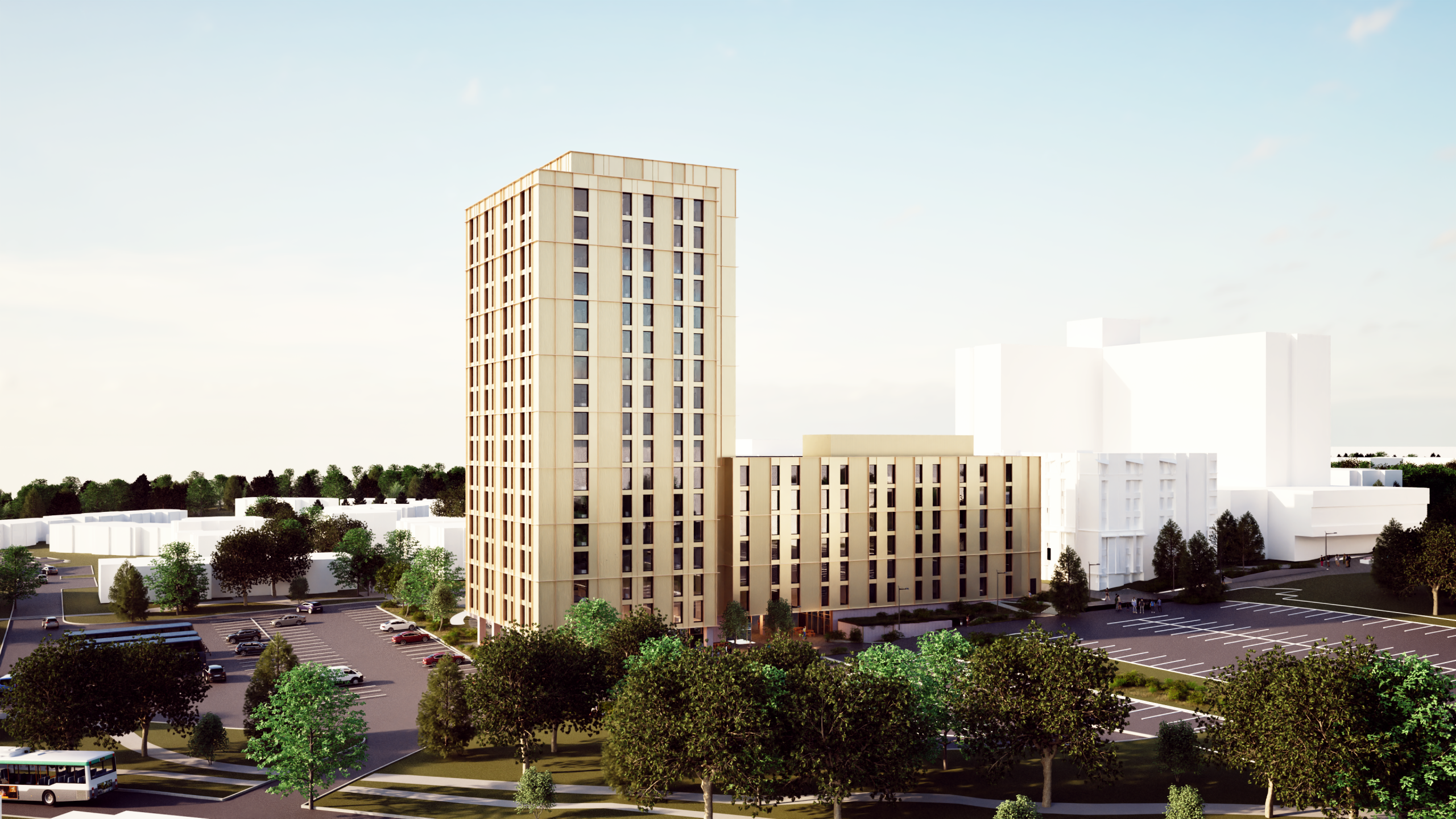
Photo courtesy of the University of Victoria.
A new student housing development is underway on campus, which UVic says will provide beds for over 500 upper-year undergraduates and graduate students. The project is expected to be completed by fall 2029.
The housing project, which remains unnamed at time of publication, is anticipated to be the largest residence on campus yet, surpassing Cheko’nien and Sngequ House in scale and size.
On Oct. 3, the B.C. government announced it would commit $121 million to the project, with the remaining $57 million coming from UVic.
The building will include a 17-storey highrise and an adjacent seven-storey midrise. UVic is submitting a development permit to the District of Saanich, as the building “proposes variances from” current zoning regulations in Saanich, according to a UVic spokesperson, and Saanich council is expected to review the application in the new year.
Mike Wilson, director of campus planning and sustainability, stated that the community’s response to the proposed development has been largely positive. He spoke at an open house at Gordon Head Recreation Centre on Sept. 25.
“The response in terms of the [building’s siting and design] has been very supportive,” said Wilson. “Lots of folks are excited about a more housable campus.”
Occupying a portion of parking lot five, the building will displace 120 parking spaces. Construction is expected to begin late spring to early summer of 2026.
“One of the reasons why we selected this site is that it allows us to continue the expansion of the campus greenway,” said Wilson.
Proximity to the campus greenway corridor is a key feature of the building’s location, as well as the various design features, including outdoor green spaces and sustainable transport. Exterior areas will feature outdoor seating, expanded green spaces, indoor and outdoor bike parking, and sustainable design features meeting LEED Gold certification.
“We wanted to continue to have a strong pedestrian connection to the main part of campus, the Cove, the transit exchange and all the amenities as soon as you’re on campus.”
“That was a large piece around [the planning and construction of] Cheko’nien and Sngequ — how we oriented the building around a major public pedestrian pathway. It’s a huge public realm improvement,” said Wilson.
In the last two years, UVic Residence Services received 2 000 more applications for residence than there were available beds, with over 80 per cent of on-campus housing requests submitted by first-year students.
The proposed development will add 510 student beds through 150 single-occupancy studio units for graduate students and 90 quad-occupancy units, or 360 beds, for upper-year undergraduates. This will increase UVic’s student housing capacity to 3 500. Each studio unit includes a private washroom, a compact kitchen, a bed, a desk, and a small dining table.
“It’s a portion of the student body that’s often overlooked in terms of housing,” said Rosemary Webb, chair of the Graduate Students’ Society (GSS) and a PhD candidate in Linguistics at UVic. “The first year guarantee [for undergraduates] is hugely important, but also ensuring that students have housing throughout their degree.
If they have first year housing and then they’re thrown into the wild, having to navigate the Victoria housing crisis is shocking. A lot of students fall to desperate measures and [end up] living in accommodations which are really not good for them,” they said.
16 quad units are designed to be fully accessible as well as 12 studio units for students with accessibility needs.
“As a student with disabilities, I have been really invested in hearing how the accessibility considerations are put into the units,” said Webb. “It’s been really good they’ve been transparent with us about the accessibility standards they’re holding the university to.”
Webb also highlighted discourse by the GSS that the graduate student section of housing was physically separated from the undergraduate section, as well as having dedicated work and study spaces within the mid-rise section of the building.
“Now with the proposed layout with the undergrad in towers and the grad students in its separate [section] of the building is really great just to get that noise separation, understanding that lifestyles are different.”
In line with UVic’s goal to cut campus greenhouse gas emissions by 50 per cent by 2030, the project is planned as the most energy-efficient building on campus. The building construction will use locally sourced, durable materials to reduce maintenance and minimize energy usage for heating and cooling.
“We look to find materials that are very durable, things that aren’t going to weather or wear quickly. It increases maintenance costs,” Wilson said. “Generally, the cost of maintaining the building is funded through student revenue, so we want to be sure we’re creating a durable and long-lasting product.”
“Many buildings of yesteryear would operate on a natural gas boiler, which produces greenhouse gas emissions that are released into the atmosphere. This building will include heat pumps, so students will have comfortable year-round air temperature in their units.”
The building will also include “high-efficiency envelopes,” Wilson said, meaning the building will be well insulated around the entire envelope of the structure, keeping out heat in the summer and warm air inside during the winter.
Chad Dalrymple, associate director of residence facilities within UVic Residence Services, was also available at the Sept. 25 open-house to provide comment on the building’s proposed features.
“There [will be] amenities on the ground floor that are meant to improve the overall residence lifestyle, not just for undergrads and graduate students,” said Dalrymple.
“There’s a community kitchen, a lounge, and a multipurpose space that is open to the residence portfolio students. It’s supervised, not just open to the public, but it’s intended for the entire
3 000 residents [on campus], said Dalrymple.
Jitendra Palaparty, a current UVic graduate student completing a graduate certificate in health terminology and interoperability standards, was also in attendance at the Sept. 25 open house. Palaparty previously lived in Cheko’nien house on campus and is a member of the Gordon Head Community Association.
“[I visited the open house] to check out what our community feels like … from people [outside of] the UVic community,” she said.
“Considering they say every year we receive more applications than available units… 2 000 [beds] is what we need.”
Palaparty stated, considering the regular surplus of applications to available units on campus, the university could do significantly more to meet the current demand.
With over 3 000 graduate students attending UVic and 50 beds available to them, less than 2 per cent get housing opportunities on campus.
“These [proposed] units are definitely an upgrade from [ones already available]. They are much smaller, they have no kitchen… They’re pretty much designed for first years, ” said Dalrymple.
“It’s 500 more beds on campus and I know there’s a need for that. More beds on campus means more basement suites in the community that can be rented to people who need them. It’s a good project to keep moving forward, and I know there’s a desire for more [accommodation].”
The university has already collected survey data from students, alumni, staff, and nearby residents, through a SurveyMoney poll held from Jan. 28 to Feb. 9. Additional feedback can be provided via SurveyMonkey until Oct. 13.
A final engagement phase is anticipated for Spring 2026, which will share the building design and provide updated information on the construction process.