
The university says it will offer pop-up and anonymous drug checking options this fall, will collect data towards possible permanent service in the future
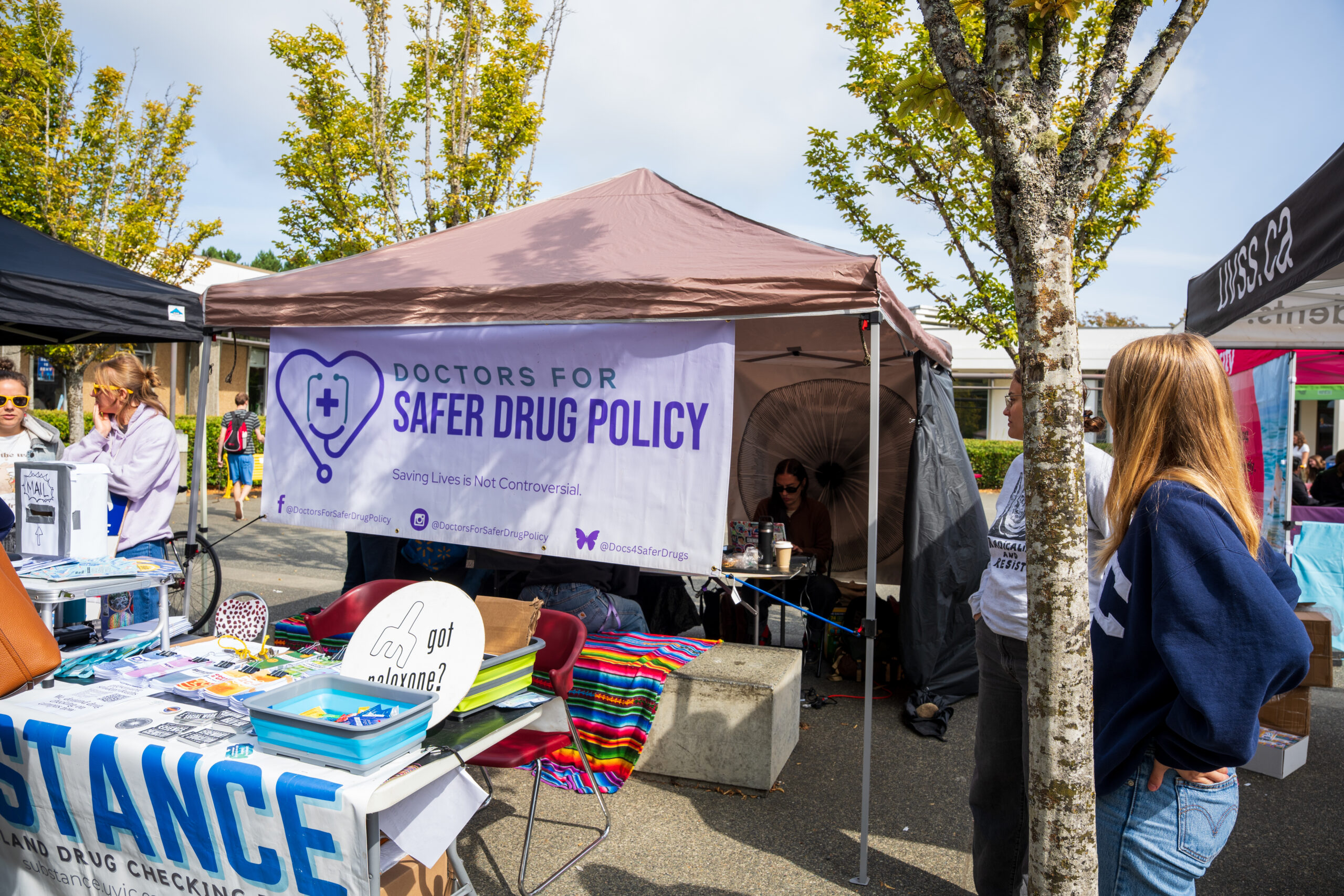
Photo by Declan Snowden.
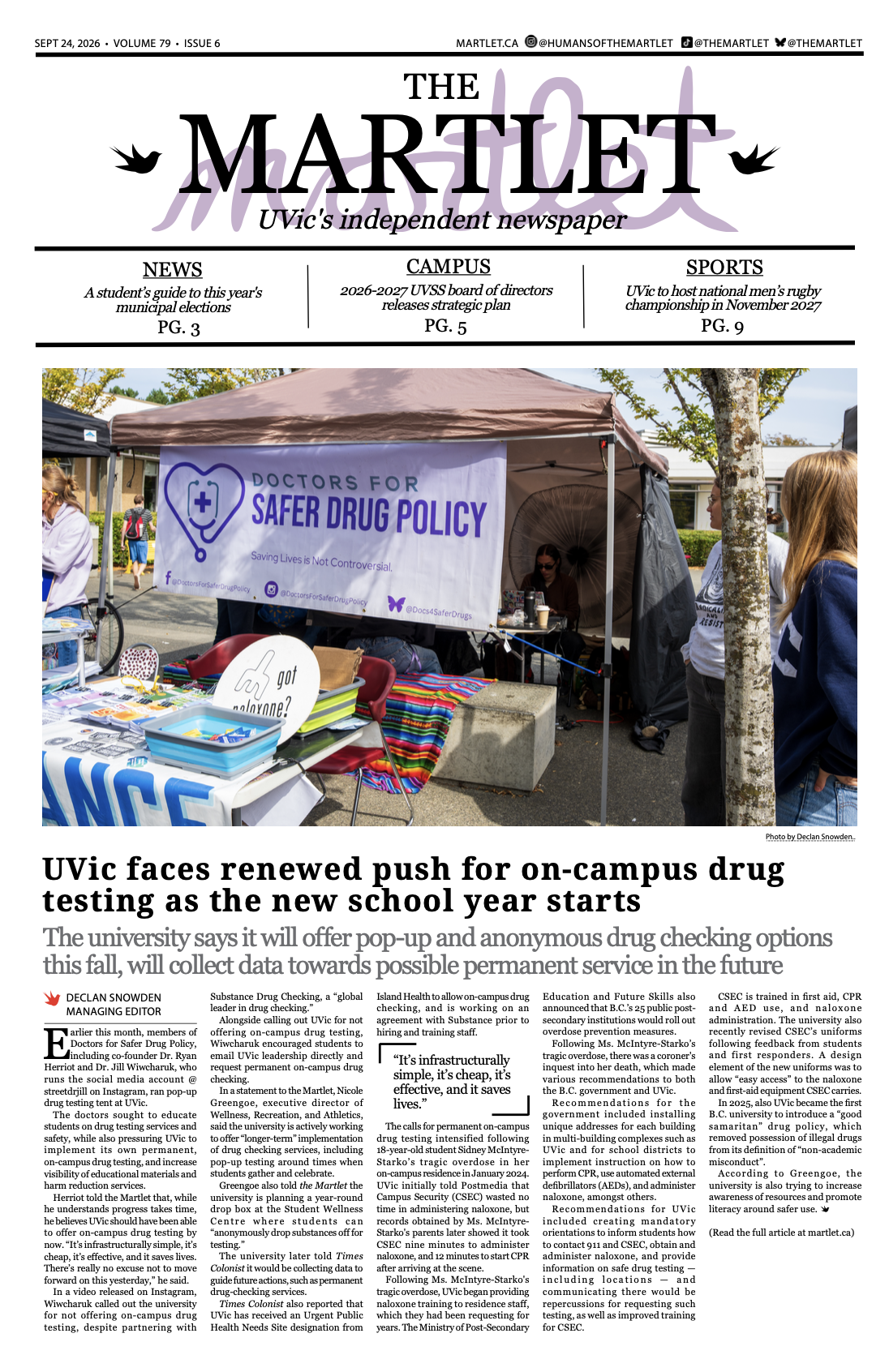
Earlier this month, members of Doctors for Safer Drug Policy, including co-founder Dr. Ryan Herriot and Dr. Jill Wiwcharuk, who runs the social media account @streetdrjill on Instagram, ran pop-up drug testing tent at UVic.
The doctors sought to educate students on drug testing services and safety, while also pressuring UVic to implement its own permanent, on-campus drug testing, and increase visibility of educational materials and harm reduction services.
Herriot told the Martlet that, while he understands progress takes time, he believes UVic should have been able to offer on-campus drug testing by now. “It’s infrastructurally simple, it’s cheap, it’s effective, and it saves lives. There’s really no excuse not to move forward on this yesterday,” he said.
In a video released on Instagram, Wiwcharuk called out the university for not offering on-campus drug testing, despite partnering with Substance Drug Checking, a “global leader in drug checking.”
Alongside calling out UVic for not offering on-campus drug testing, Wiwcharuk encouraged students to email UVic leadership directly and request permanent on-campus drug checking.
In a statement to the Martlet, Nicole Greengoe, executive director of wellness, recreation and athletics, said the university is actively working to offer “longer-term” implementation of drug checking services, including pop-up testing around times when students gather and celebrate.
Greengoe also told the Martlet the university is planning a year-round drop box at the Student Wellness Centre where students can “anonymously drop substances off for testing.”
The university later told Times Colonist it would be collecting data to guide future actions, such as permanent drug-checking services.
Times Colonist also reported that UVic has received an Urgent Public Health Needs Site designation from Island Health to allow on-campus drug checking, and is working on an agreement with Substance prior to hiring and training staff.
The calls for permanent on-campus drug testing intensified following 18-year-old student Sidney McIntyre-Starko’s tragic overdose in her on-campus residence in January 2024. UVic initially told Postmedia that Campus Security (CSEC) wasted no time in administering naloxone, but records obtained by Ms. McIntyre-Starko’s parents later showed it took CSEC nine minutes to administer naloxone, and 12 minutes to start CPR after arriving at the scene.
Following Ms. McIntyre-Starko’s tragic overdose, UVic began providing naloxone training to residence staff, which they had been requesting for years. The Ministry of Post-Secondary Education and Future Skills also announced that B.C.’s 25 public post-secondary institutions would roll out overdose prevention measures.
Following Ms. McIntyre-Starko’s tragic overdose, there was a coroner’s inquest into her death, which made various recommendations to both the B.C. government and UVic.
Recommendations for the government included installing unique addresses for each building in multi-building complexes such as UVic and for school districts to implement instruction on how to perform CPR, use automated external defibrillators (AEDs), and administer naloxone, amongst others.
Recommendations for UVic included creating mandatory orientations to inform students how to contact 911 and CSEC, obtain and administer naloxone, and provide information on safe drug testing — including locations — and communicating there would be repercussions for requesting such testing, as well as improved training for CSEC.
CSEC is trained in first aid, CPR and AED use, and naloxone administration. The university also recently revised CSEC’s uniforms following feedback from students and first responders. A design element of the new uniforms was to allow “easy access” to the naloxone and first-aid equipment CSEC carries.
In 2025, UVic also became the first B.C. university to introduce a “good samaritan” drug policy, which removed possession of illegal drugs from its definition of “non-academic misconduct”.
According to Greengoe, the university is also trying to increase awareness of resources and promote literacy around safer use.
“We are doing this through: a new Student Essentials Video series, tabling at Residence check-in, including naloxone kits and other safer use supplies and information, targeted emails to campus residents, [and] messaging from the President during the new-student orientation,” she said in her statement.
She said the university is also doing more tabling throughout the term, and running social media campaigns “including toxic drug alerts to the campus community.”
Greengoe also said the university will launch a five-module Substance Use Health Foundational Learning series for students, staff, and faculty that will provide education on overdose prevention, harm reduction, recognizing and responding to overdose, and more.
Lauren Airth, a post-doctoral fellow at UVic and registered nurse, told the Martlet that having on-campus access to information and resources on how to reduce harm is essential, particularly because students are in a demographic where experimentation is common, and many students may be living without parental supervision for the first time.
“Students use drugs, and they need to be able to access information to make decisions in a way that is going to reduce their risk of harm,” she said.
Airth also criticized the lack of visibility of harm reduction supplies and services on campus, noting that a key resource for students, the Harm Reduction Centre (HRC), is located in the basement of the SUB.
“I’m super grateful to the folks who put the time and energy in over the years to make sure these resources are available like that. The problem is that they’re out of sight; they’re in a closet in a basement, and so while there are resources here, they need to become much more accessible, much more visible, much more destigmatizing.”
Alongside the HRC, students can get naloxone kits at the campus pharmacy, and the UVSS offers naloxone training from UVic nurses through its Safer Use campaign. Students can also book a private appointment with a UVic nurse for naloxone training, and they can learn about it for free at Toward the Heart, Canadian Red Cross Society, and the Canadian Pharmacy Association.
Free and confidential drug testing can be done at Substance on Cook Street.
Greengoe said the university is grateful for the support of their partners, including Substance and Island Health, and that the university is working to navigate recent changes to provincial and federal legislation around substance use.
Herriot told the Martlet that he would like to see more than statements of support from the university.
“You may see some communications from UVic administrators saying that they support [on-campus drug testing] and they intend to establish this in a repeated or in a permanent way…. someone with experience working on the front lines of this crisis, I would like to be able to take these sorts of statements at their worth, but the reality is we’ve been let down many times before by those kinds of statements,” he said.
“We’re going to keep coming back and keep raising the issue until [on-campus drug testing] materially happens.”
UVic students who call 911 to report an overdose — even if they are in possession of drugs or have taken illicit substances — have legal protections due to the Good Samaritan Drug Overdose Act, and will not be punished by UVic either.