
‘Indigenous Theatre Festival: Staging our Voices’ focused on language reawakening and honouring language through performance
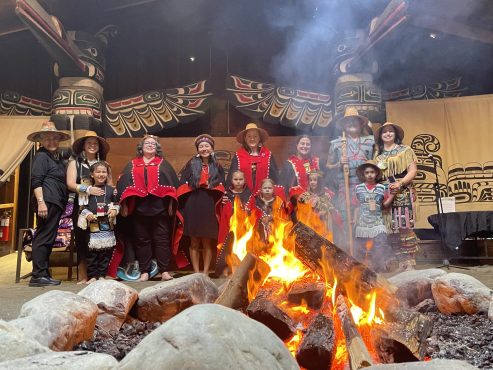
Photo courtesy of Indigenous Theatre Festival.
On Sept. 12 and 13, UVic’s Phoenix Theatre hosted the second Indigenous Theatre Festival: Staging Our Voices — a free festival for all attendees that honours Indigenous languages through the power of performance and workshops.
The first Indigenous Theatre Festival took place in 2022, at the Phoenix Theatre and First Peoples House. Dr. Kirsten Sadeghi-Yekta, an associate professor in UVic’s theatre department — who is also the festival producer — said the idea came after she was invited to work with the Hul’q’umi’num’ community in 2015 to experiment with theatre for language reactivation.
“We realized that a lot of Indigenous Artists feel isolated, specifically artists that are working with the language and they would love to find ways to gather, to share food, to share stories, and be in one space together,” said Sadeghi-Yekta. “That was the reason we initiated the first Indigenous Theatre Festival in 2022, and that urge is still there, so we wanted to do it again to have more people involved.”
The shows featured at the festival ranged from dances, drumming, an in-progress stage play and a completed one, a clown show, and an opera. All touched on language revitalization and all brought something new to the stage. Some drew from personal experiences with language, while others were part-language lessons, part-performance, and some were traditional performances, untranslated into English. There were nine shows in total.
“Language is culture,” said Tara Morris, Suwsiw, of the Cowichan Tribes, who is on the organization committee for the festival. Morris also ran the From Page to Stage workshop at the festival, which explored the adaptation of an Indigenous oral story into a staged production.
“Along with language is culture, and the beauty of being able to express in theatre is embedding the culture. Exploring yourself, exploring identity and doing that without judgement I think — a lot of the people in these language programs aren’t fluent — it’s just a playful, fun way to explore, to build identity, and build that confidence and pride in who we are,” Morris said.
That pride was evident in every single performance on Saturday. A palpable feeling of excitement filled the Phoenix in between shows and workshops, and as attendees gathered together, a real sense of community encompassed the entire festival.
The workshops focused on how to apply the mission of the festival to the participants’ future work. Morris’ workshop, for example, focused on adapting a story into a stage production. Participants were given the freedom to try anything with the script, such as a silent, choreographed dance.
Using theatre for language revitalization was the overarching focus of the festival. “The positive thing for me is seeing that actually happen,” said Morris. “It’s just very, very, empowering to witness people who have the dedication,the passion and the drive, and know the importance of it. The reason why theatre is such an amazing tool is [it shows] the possibility of language learning for youth.”
For Morris, revitalization is a way “to celebrate what our world views are, and what our knowledge systems are, and what our truths are, and who we are and what’s important to us and looking at how they’re expressed in our songs, our dances, our legends, our stories, and all our histories and our longhouses. I think that’s the ultimate key — is to find ways to carry on the teaching of passing down those to the next generation,” Morris said.
Regarding what she hoped attendees would take away, Sadeghi-Yekta said that she not only hoped it would be a safe and healing space for attendees, but that it would be “a playful space” too.
Lawrence Thomas, the ceremonial speaker on Friday night, said walking away at the end of the festival felt like “walking on air.”