
The program, Studiosity, was previously piloted at UBC, who opted not to implement it
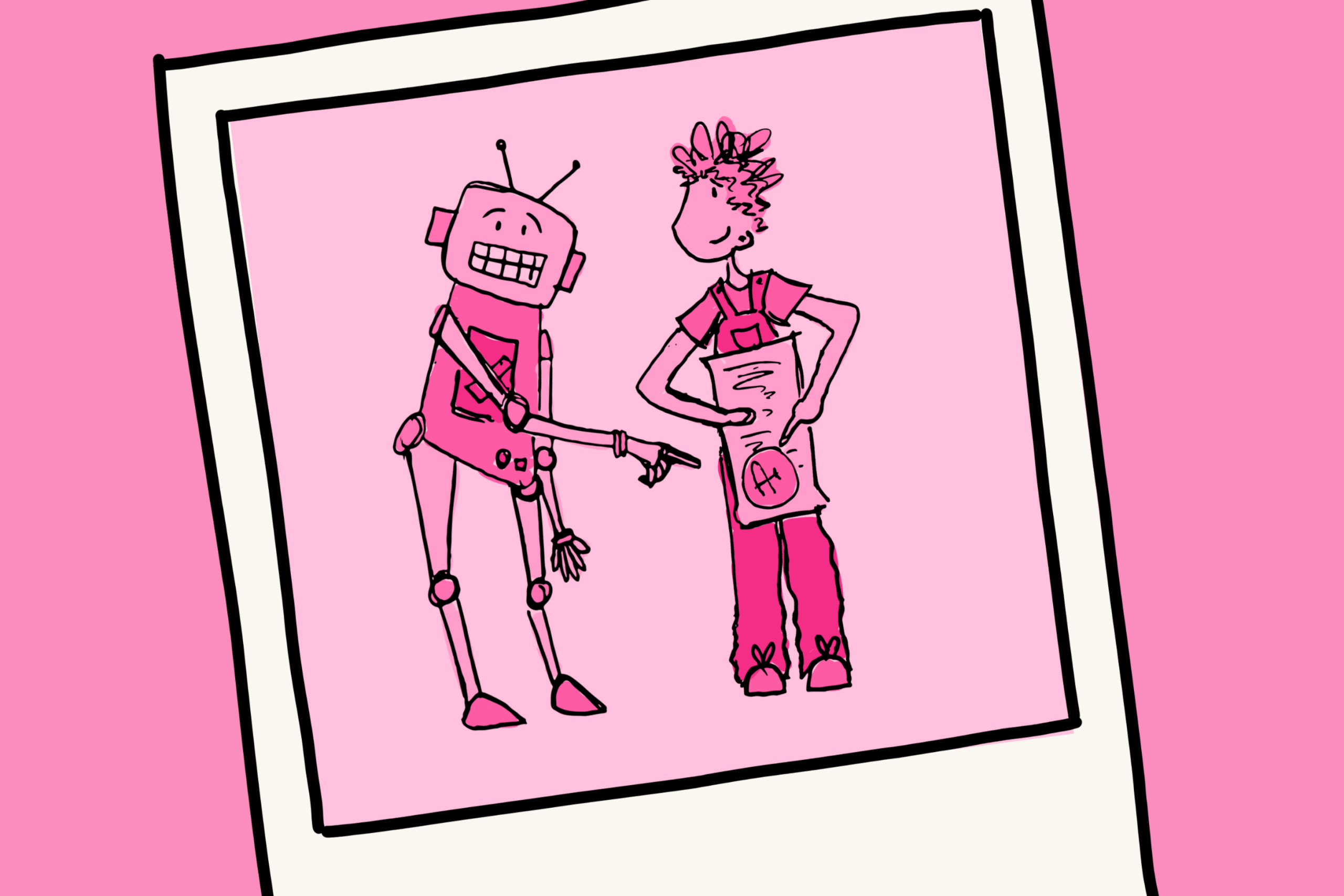
Illustration by Sage Blackwell.
Studiosity, an AI writing assistance tool, is being launched in three UVic courses this fall as part of an experiment with AI in the classroom.
The classes involved in the pilot include COM 220, HINF 230, and ED-D101. Notably, none of these courses are primarily writing focused. COM 220 and HINF 230 are cross-listed under Organizational Behaviour and Change Management, and are offered by the Gustavson School of Business. ED-D101 is open to all undergraduate UVic students and is a “crash course” of sorts on how to “become a better university student.”
“Studiosity is an AI-supported academic-feedback tool specifically designed to complement student learning in post-secondary settings,” said a UVic representative in an emailed statement to the Martlet. “It focuses on formative, real-time feedback rather than generating or correcting work,” the statement continues.
In this way, Studiosity differs from other AI platforms like ChatGPT or Copilot, which are generative rather than analytical. Studiosity offers suggestions for improvement in areas such as grammar, spelling, or structure, but will not edit students’ work directly.
In their statement, UVic explained that Studiosity and other such software are not meant to replace the role of faculty or teaching assistants in the classroom, but are intended to serve as an additional tool.
Dr. Dillon Chrimes, an Assistant Teaching Professor in the School of Health Information Sciences, is enthusiastic about the pilot in his Organizational Behaviour and Change Management course (HINF 230).
“Students are going to use [AI] no matter what,” Chrimes said. “And, why not?”
Studiosity is being used in his classes to aid students who are new to writing literature reviews — an essential element to any research paper. Along with Studiosity, Chrimes also uses an AI site called “Packback” to help students with writing exercises.
While Packback costs $49 for students to use, Studiosity is being offered free of charge for students enrolled in the pilot courses.
Chrimes said that his use of AI tools has helped students improve their writing, primarily in the structure of academic and scientific papers, but notes there is still the potential for negative outcomes, stating that there is “nothing blocking weird prompts and scenarios, and fake information” when used in the classroom.
Other professors involved in the pilot, such as Dr. Mariel Miller, an Assistant Professor in Educational Psychology & Leadership Studies, are not as enthusiastic about AI tools as Chrimes.
Miller’s course, Learning Strategies for University Success (ED-D101), is largely focused on “learning to learn” and is open to all students, regardless of discipline. She says, “AI is already integrated into a number of sectors, so developing AI literacy is becoming an important part of university.”
Studiosity is being offered as an optional tool in Miller’s course, but no students are required to use it if they are uncomfortable doing so, nor is it being recommended.
“Critical pause is what you want,” Miller says. “Not just using it because it’s available, but thinking ‘is this helpful?’ or ‘is this needed?’ or ‘what other resources are available?’”
In their statement, the university acknowledged that “human feedback is necessary,” however, they continue to explore AI tools in some classrooms. UVic also continues to highlight the resources that professors and the Academic Skills Centre (ASC) can offer.
The ASC offers guidance on study strategies, citation methods in academic papers and presentations, and even help with revision and editing for class assignments. They also now offer assistance in navigating academic integrity and the use of AI in coursework.
The Martlet reached out to the ASC for comment about the role of AI and programs such as Studiosity in the classroom, but the ASC declined to comment themselves, instead providing the same statement from UVic on generative AI. “We are actively supporting our academic community to ethically and appropriately use these tools in learning and teaching,” the statement reads.
Concerns over AI and its effects on students’ writing and critical thinking skills are widespread, as well as irrefutable concerns about the environmental impacts of generative AI. From increased carbon emissions because of electrical power to strains on local water supplies for cooling, training and operating AI models is not without consequence. While this is something Miller considers when explaining AI to students, she said not all professors acknowledge the “other side of the coin.”
“I don’t want to talk about the bad things,” said Chrimes, who says he operates on an “honour system” and hopes his students put in their own critical thinking and fact-checking.
UBC launched their own Studiosity pilot in the 2024–2025 academic year, but no longer uses the tool. Instead, they opted to explore alternative writing assistants. Their announcement about the pilot’s conclusion states that “Studiosity is no longer available to use at UBC.”
In an emailed statement to the Martlet about the pilot, UBC said that it is still “too soon to comment” and the outcomes of their pilot will be posted “in due course.”
With UVic’s own Studiosity pilot having just launched, any results are a ways off, but human interaction and feedback remains a core part of classes. Chrimes, an AI enthusiast himself, nonetheless admits that he’d “rather talk to someone than ChatGPT.”