
The network came under recent scrutiny in an article published by online investigative outlet the Breach, alleging several universities obstructed and delayed access to requested records.
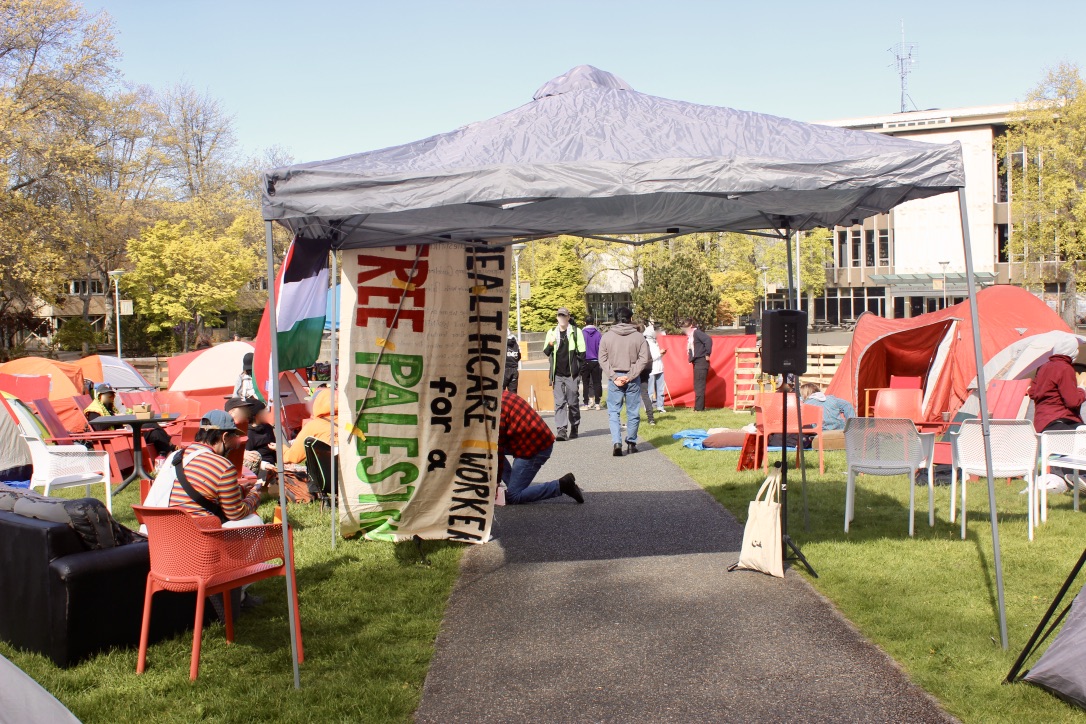
Photo by Sydney Lobe.
In late July, independent Canadian news outlet the Breach published a major investigation — the result of more than a year’s work by two reporters — revealing that over the summer of 2024, more than 30 Canadian universities operated communication channels with one another, sharing actions taken in response to the many pro-Palestine encampments that had been pitched on university campuses.
According to the Breach’s reporting, two networks with overlapping membership — one national network, hosted by the University of Toronto, and one in Alberta, hosted by Edmonton’s MacEwen University — were established, coordinating and sharing resources related to the pro-Palestine encampments that were pitched at universities across the country in the summer of 2024, among other subjects.
According to files obtained by the Breach via a freedom-of-information (FOI) request, the national “post-secondary emergency manager network” included a Microsoft SharePoint site containing, among other things, a discussion board, resource library, compiled list of contact information, and spreadsheet listing “actions taken,” created by the Business Continuity and Emergency Management manager at Toronto’s Humber College, Kathy Branton.
Ten postsecondary institutions of the 30 universities which were invited to the U of T-hosted national network contributed to the “actions taken” spreadsheet, detailing their response to encampments on university grounds.
The Breach reported UVic was the 18th university to be onboarded by U of T into the network, which records reveal was created in November 2023 — after the October 7 attacks, but long before encampments were pitched.
In a statement to the Martlet, UVic confirmed that two of the university’s emergency management personnel were invited to the network, but the university said that their participation was “scant,” and that UVic did not actively post materials or contribute to the site.
UVic does not appear in the screenshot of the spreadsheet detailing “actions taken.”
“Some member institutions shared emergency plans via the SharePoint site, which acts as a repository for materials that could be of assistance to other institutions. E.g. emergency management plans and messaging for specific incident scenarios (i.e. active threat, earthquake),” UVic told the Martlet in a written statement.
UVic’s “People’s Park” encampment was pitched on May 1, 2024; the timeline assembled by the Breach indicates UVic also joined the network before the encampment was pitched, and before the University of Calgary’s emergency manager was invited to the network on April 18, 2024.
“The network hosted guest speakers on a variety of topics of interest to emergency managers who could call in to listen, then ask questions related to their work,” UVic’s statement continued.
In the course of their reporting, the Breach’s article says, the two reporters covering the story were met with delays, obstruction, and destruction of records as they filed more than a dozen FOI requests with many different institutions.
The Breach’s article alleges several universities followed a pattern of delaying the release of requested records, and “withholding documents that are known to exist.” UVic is not listed among them. At the time of publication, the Martlet has submitted FOI requests to the university for records associated with the network.
Many of the allegations surrounding the denial of records’ existence are against Albertan universities such as the University of Calgary, University of Alberta, and MacEwan University, which are reported to have worked much more closely through their provincial network with city police in Edmonton and Calgary, as well as Alberta Ministry of Advanced Education personnel, and included information from these groups in their network. This claim is not made about the national network.
In Alberta, student demonstrators at the University of Calgary and University of Alberta were forcibly removed by police shortly after the encampment began. In Calgary, nine of those demonstrators are now suing the city, university, and Calgary Police for $331 000 in damages, alleging violations of Charter rights and excessive use of force.
The Alberta network is also reported to have included instructions to keep an update provided to MacEwan’s emergency manager “absolutely secret.” But other institutions, including U of T and the University of New Brunswick, are alleged to have had difficulty finding records requested via FOI.
In response to a question about whether UVic met or communicated with B.C. government officials about the encampment, a spokesperson for the university said: “As a publicly funded institution, we work with government, as appropriate, on critical issues and initiatives impacting our community. During incidents of note, UVic’s decisions and actions take into account the unique context of our campus community.”
The Martlet reached out to the UVic People’s Park for comment but did not hear back by publication time.