
Two new studies of trans-Neptunian objects reveal surprising insight into how our solar system formed and evolved.
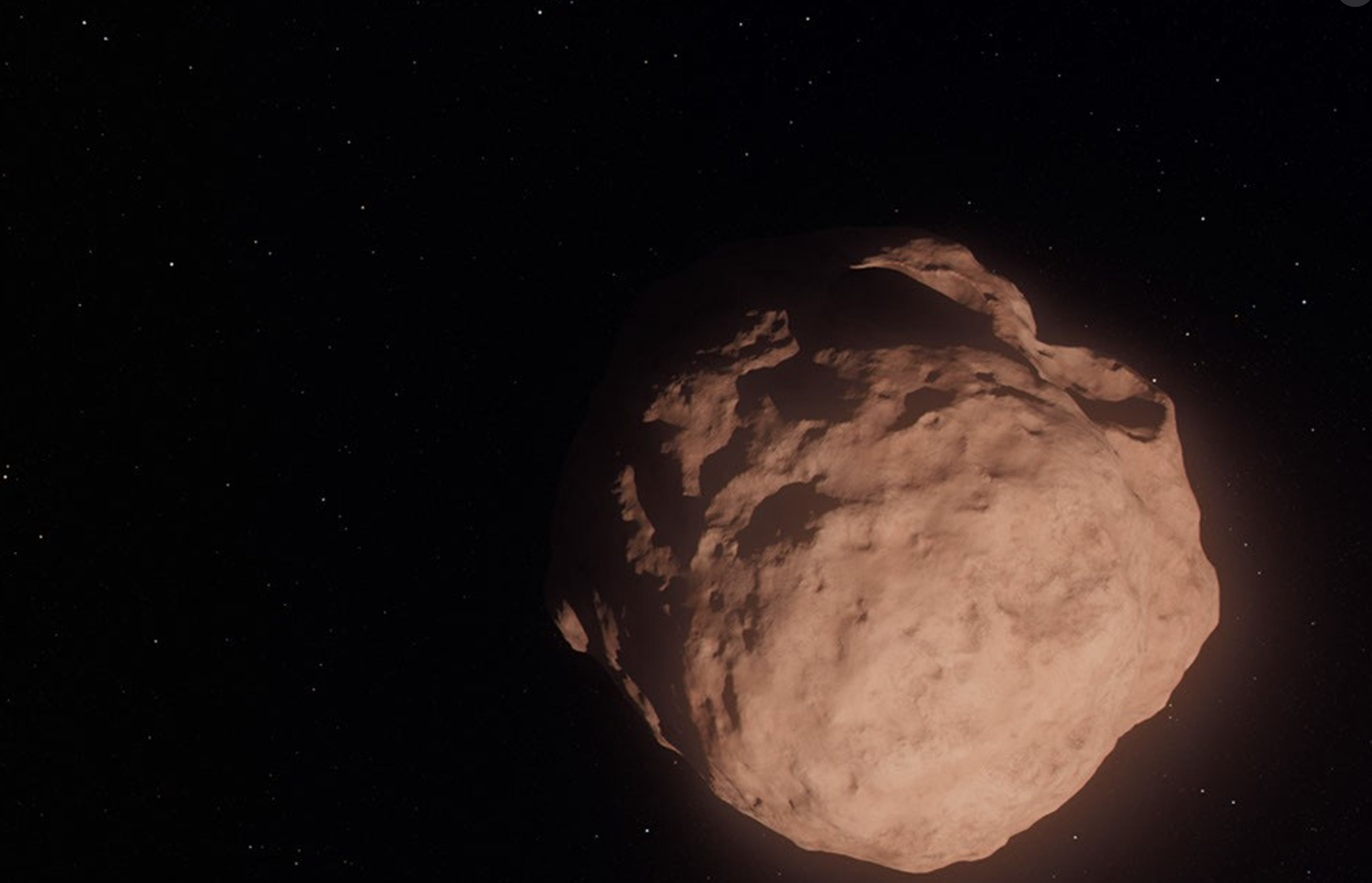
Rendering of Trans-Neptunian Object via NASA, ESA, Leah Hustak (STScI).
For billions of years, icy chunks of rock have been orbiting the far reaches of our solar system, largely undisturbed since they first formed.
New observations from the James Webb and Hubble space telescopes are giving astronomers an unprecedented look at these primordial objects, and the results are challenging their ideas about how planets form.
Trans-Neptunian objects (TNOs) are ancient, icy bodies that orbit the sun beyond Neptune. Because they have remained remarkably undisturbed, they provide a snapshot into what the solar system looked like in its early history while planets were still forming.
However, the small size and distant location of TNOs have made them difficult to detect and study. Until the launch of the James Webb Space Telescope (JWST) in 2021, astronomers were only able to see the biggest members of the population, leaving us in the dark about the smaller objects.
Two new papers published on Sept. 8, 2026, in The Astronomical Journal, by a large, international team of researchers including UVic PhD candidate Marielle Eduardo and Adjunct Associate Professor Dr. Wesley Fraser, used observations from both the JWST and Hubble Space Telescope to study TNOs as small as five kilometres in diameter that have never been seen before.
Researchers from around the world submit proposals for time on these space telescopes, which is highly competitive and involves an intense vetting process. Getting permission to use both the JWST and Hubble together is extremely rare, making Eduardo and Fraser’s new publications particularly exciting.
The researchers used observations from both space telescopes to answer two related questions: how big are TNOs, and what can their surface colours tell us about their histories? The JWST was used to detect and infer the size of incredibly faint TNOs through infrared light, while the Hubble provided visible-light observations to determine the colours of these objects.
The results were not quite what they expected.
TNOs can broadly be classified into two populations. Cold TNOs have fairly circular orbits and are thought to have formed in roughly the same location as they are today. Hot TNOs have more eccentric orbits and are thought to have formed closer to the sun and to have been violently pushed out to their current location during the solar system’s evolution.
The researchers anticipated that objects in the hot and cold populations would have different distributions of sizes.
“We expected this hot population to have more smaller members because they fragmented into tiny pieces, and the cold population … to just stay where they are,” Eduardo said.
But that is not what Eduardo and her collaborators found.
In Eduardo’s paper on TNO size, she and her fellow researchers found that both hot and cold TNOs showed remarkably similar distributions of small and large objects, despite their different histories. According to Eduardo, this suggests that whatever happened to hot TNOs during their outward transport was not intense or prolonged enough to fragment them.
Eduardo’s supervisor, Fraser, who has been studying TNOs for approximately 20 years, was surprised by this result.
“I expected we’d get a good measurement, and we’d provide new constraints and further refine our models. This is a much more exciting result because it kind of leaves us hanging a little bit,” he said.
In the second paper published by Eduardo, Fraser, and their collaborators, the researchers looked at the colours of TNOs to explore a related question: what can the surfaces of these ancient objects tell us about their pasts?
The colour of a TNO can provide information about the properties, composition, and history of its surface. This is particularly useful for studying collisions: if a larger object breaks apart, the newly exposed inner material generally has different properties than the surface that has been exposed to space for up to billions of years.
If collisions were responsible for producing most of the smaller TNOs, researchers expected the smaller objects would have different surface colours than their larger counterparts.
Instead, the colours of the smallest TNOs were remarkably similar to the larger objects.
“What we think is that these smaller TNOs, at least down to five kilometres, are not collisional fragments at all,” Eduardo said.
According to Fraser, these small TNOs have likely still experienced some collisions but have somehow been able to maintain their primordial surface chemistry, even though the ice on their surfaces is typically very sensitive to collisions.
Looking ahead, Fraser and Eduardo hope to use the JWST to search for even smaller TNOs, potentially detecting objects as small as one kilometre in diameter.
These studies offer a glimpse of what’s to come as more researchers gain access to data from the JWST to study the universe, as we enter what Fraser referred to as “the golden age of astronomy.”
“The politics of the world [are] pretty negative right now. A lot of people are feeling down, but if the stars are exciting to a person, then now is the time to be looking up,” Fraser said.
“I think the romance in the stars is real, and the highest they’ve ever been in humankind’s history.”