
The final Senate meeting of 2025 heard debate over numerous motions, with most discussion centered on new transnational education partnerships
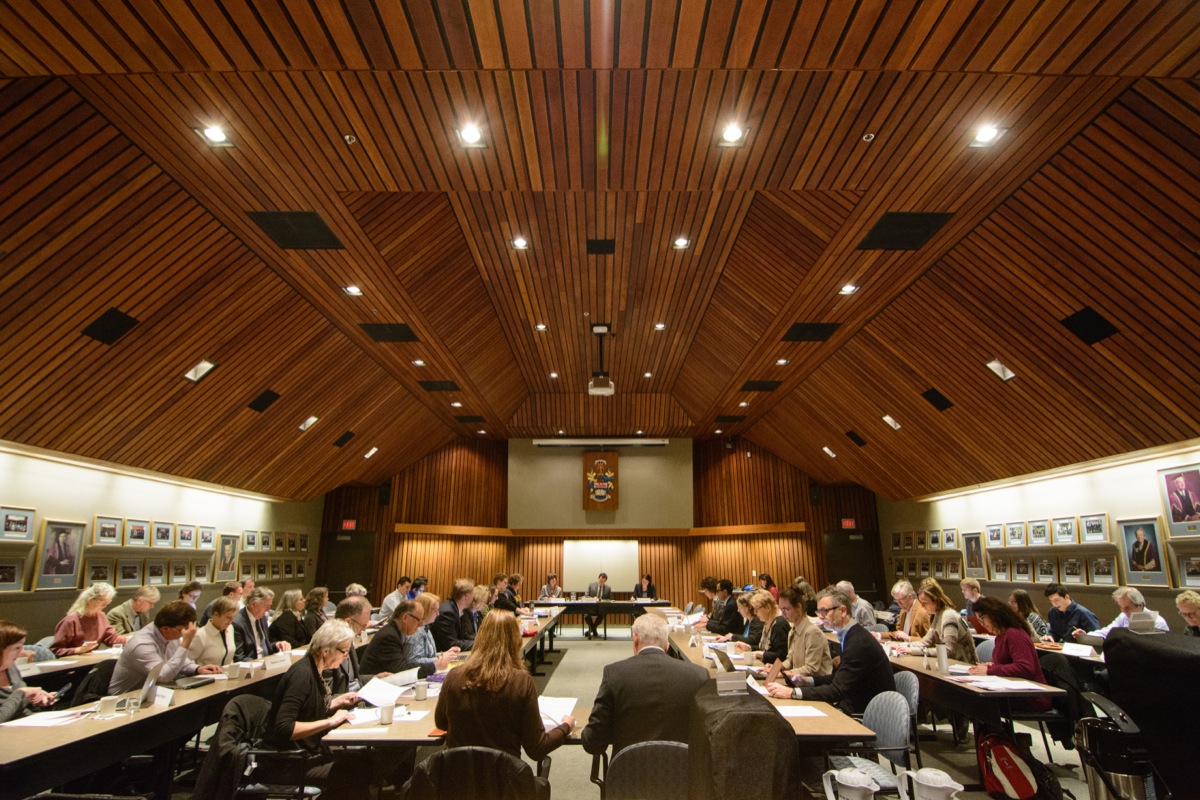
Photo by Hugo Wong.
The UVic Senate held its final meeting of the year on Dec. 5, navigating a dense agenda with approvals for major institutional restructuring and tense debate about the oversight of new transnational education (TNE) partnerships.
The meeting opened with discussions regarding the approval of the minutes from the Oct. 3 and Nov. 7 sessions. Concerns were immediately raised by a student senator regarding the accuracy of reporting on previous discussions concerning student accommodations and the Centre for Accessible Learning (CAL).
Further, senators noted that a proposed meeting with Associate Vice-President Student Affairs Jim Dunsdon to address student accommodation concerns following the October meeting did not occur, leading to a senator requesting to discuss these issues during the Dec. 5 session.
This was discussed further, with two senators raising concerns about student voices’ being heard, especially on an issue as serious as student accommodation, and requesting that it be included in today’s agenda.
Following discussion with numerous senators voicing concerns, a commitment was made to follow up next week with student senators to confirm a plan for holding discussions about academic accommodations.
Acting President and Vice-Chancellor Qwul’sih’yah’maht, Dr. Robina Thomas, provided remarks highlighting the four recent convocations, which conferred over 1 500 degrees, diplomas, and certificates. She also acknowledged the passing of Elder Snipton George and the B.C. government’s recently announced postsecondary system review.
Mike Wilson, director of campus planning and sustainability, provided a brief summary of the Campus Planning Committee’s report, confirming the National Centre for Indigenous Laws completed construction and received occupancy in September. He also noted that the Engineering and Computer Science Expansion remains on track for occupancy in September 2026, and that the provincial government provided $121 million to support the construction of 510 new student housing beds, with construction projected to begin in summer 2026.
The discussion also addressed climate goals, confirming that the electrification of the District Energy Plant (DEP), through the installation of two new electric boilers, aims to help the university reach a 50 per cent reduction in greenhouse gas (GHG) emission below 2010 levels by 2030. The report states the university has already reached a 30 per cent reduction as of 2023, a detail which prompted questions from one senator, given Wilson’s acknowledgment that the majority of campus emissions come from the DEP, which has yet to be electrified.
A discussion arose regarding the controversial new policy on workspace allocation guidelines, which passed quietly in September. A senator raised concerns over a provision mentioning the use of technological surveillance tools to monitor how often faculty members use their offices. The senator requested that the policy be temporarily suspended for Senate review, citing a potential violation of the B.C. Freedom of Information and Protection of Privacy Act (FIPPA), and that the university provides the Senate with their Privacy Impact Assessment (PIA).
Vice-President Academic and Provost Dr. Elizabeth Croft responded that the policy’s intent was transparency and efficient resource stewardship, not surveillance, but committed to consulting with the Vice President Finance and Operations and UVic’s privacy office, and returning with a report. Croft did not commit to suspending the policy until a Senate review.
Another senator asked how time spent in labs, classrooms, and other spaces would be factored into the report, to which Croft reiterated that the goal was not monitoring faculty members.
It was confirmed following a question from a senator that accommodations for faculty with disabilities would be accommodated in the policy.
The Senate Committee on Academic Standards presented its Grading Report for 2024/2025. Discussion focused on the observed increasing trend in “first class grades” (defined as those normally achieved by a “minority” of students). The committee spokesperson confirmed that the balance between strict grading and student success is determined within each faculty through its own grading policies, rather than by a single university-wide target percentage.
Subsequently, the Senate approved revisions to the Rules to Govern Elections to the Board of Governors and Senate. Key changes involved removing gendered pronouns and introducing guidelines about the ineligibility of employees and faculty on Long Term Disability (LTD) to vote or serve, as doing so may harm their LTD status.
The Senate Committee on Awards approved several new and revised awards, though conversation followed, addressed the ongoing issue of gendered language in award terms. Administration explained that changing language would be a slow and ongoing process, requiring working with the Development Office and donors to apply more inclusive language wherever possible.
The Senate Committee on Planning proposed new academic initiatives, including a revision to the Counselling Psychology Program, which was approved. Next, a proposal to approve, and recommend that the Board of Governors approve, establishing a non-credit Certificate in Gerontology was also approved.
The highlight of the proposals came in three related motions concerning the Department of Biochemistry and Microbiology.
Firstly, the Senate approved the proposal to change the name of the Department of Biochemistry and Microbiology to the School of Molecular Life Sciences. This move is intended to enhance departmental visibility, according to the proposal submitted to Senate, and align with modern interdisciplinary research in the field, integrating molecular, cellular, and microbial sciences.
Debate included sharp criticism that the proposed name was too broad and generic, and lacked sufficient external consultation supporting the name change. Advocates for the proposal confirmed that the designation “school” holds the same budgetary and governance standing as “department” at UVic, and said that extensive consultation occurred with the Faculty of Science, which they said offered “unanimous” support for the change.
One senator in favour of the proposal pointed to both the provincial and federal governments including “life sciences” in new funding commitments, and said this change keeps UVic “on the radar.”
Second, Senate voted to approve the proposal to establish a Bachelor of Science degree in Molecular Life Sciences. This new degree merges the formerly separate Biochemistry and Microbiology programs, creating a unified curriculum allowing for specific concentrations in Biochemistry or Microbiology.
Finally, Senate approved the discontinuation of the Bachelor of Science programs in Biochemistry and Microbiology. Proponents confirmed there was detailed transition plan in place for current students, ensuring they can complete their original degrees or transition to the MLSC program without losing credit.
Senate voted on two major transnational education (TNE) proposals that allow UVic to proceed with partnership negotiations in Asia. Both motions were subject to requests for secret ballots, requiring the support of 14 senators.
The agreement with the PSB Academy in Singapore to offer the Bachelor of Engineering in Biomedical Engineering and Management program was approved, though some senators shared concerns about Senate oversight of the final negotiated agreement and quality assurance mechanisms. Advocates explained that this vote would serve as the necessary “green light” to begin serious negotiations, and confirmed that periodic reports on program performance would be provided to Senate.
They elaborated that quality assurance will be conducted by UVic’s Provost’s office, and overseen by a faculty member who is an expert in the subject matter, ensuring UVic standards are maintained.
With significantly less discussion, the agreement with Siam University in Bangkok, Thailand, to offer the Master in Management program was approved.
Senate approved revisions to the Faculty of Graduate Studies Membership Policy. This change grants regular membership to all regular tenured and tenure-track faculty who wish to be involved in graduate supervision, acknowledging their equivalency with research stream faculty.
Finally, Senate approved the re-appointment of seven individuals as University Orators for a three-year term, and the final agenda item, a presentation on the Better Data Project, was deferred, though attendees were directed to the publicly available information online before the meeting was adjourned.