
The opening debate of 2026 reviewed new program proposals, student awards, and policy revisions
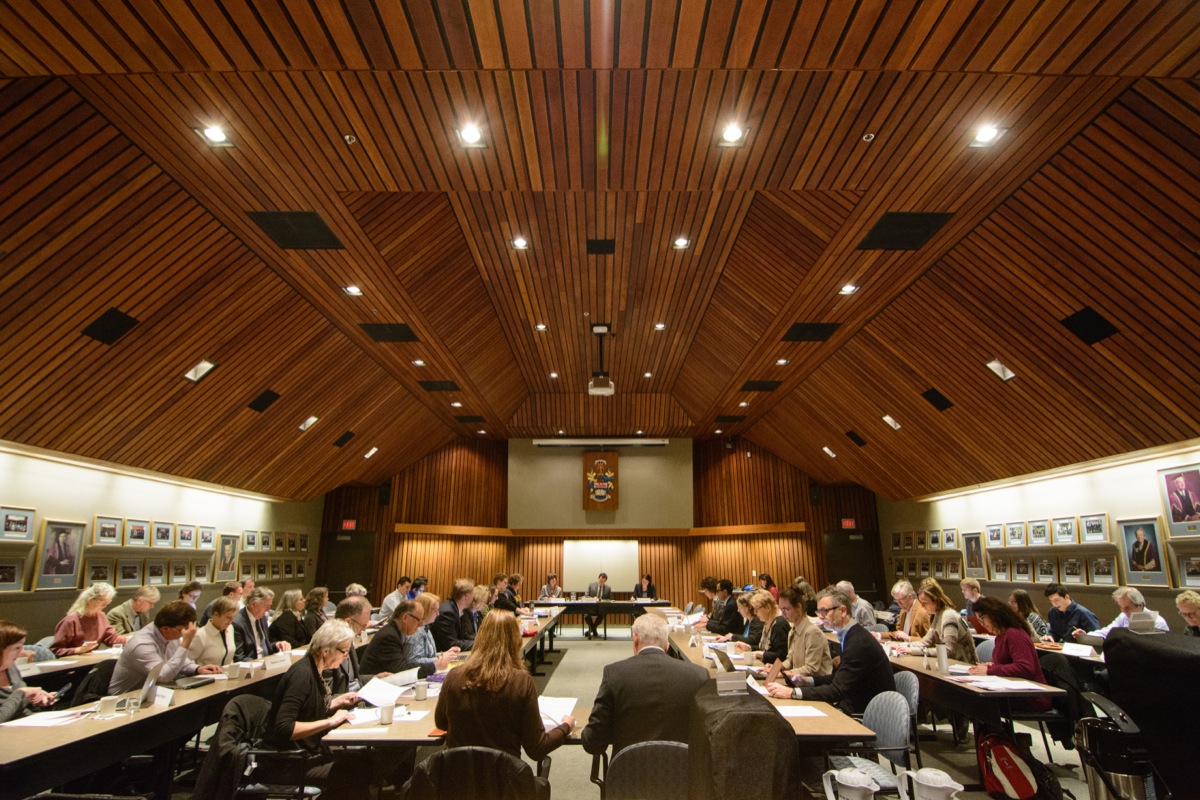
Photo by Hugo Wong.
At its first meeting of 2026, UVic’s Senate approved several new academic programs and discussed scholarship and award eligibility for students.
These academic programs include: a non-credit Certificate in Trade and Construction management, a Master of Community Planning program, and Minor, General, and Major programs in media studies.
The meeting began with the approval of minutes from previous Senate meetings on Oct. 3, Nov. 7, and Dec. 5.
Before the meeting moved on to proposals and reports from Senate committees, student senators asked whether the Office of the University Secretary and the Department of Vice President Academic & Provost (VPAC) would hold an additional engagement session regarding the implementation of Universal Extended Time (UET). UET is a strategy intended to reduce certain access barriers and –– the number of accommodations overseen by the university –– by universally expanding exam times for all students, regardless of whether or not they require accommodations. Their senator argued there is a contradiction between UET and the language of the university’s Indigenous Plan –– which commits the university to the “health, wellbeing, and equitable treatment” of all people within the structures of the university, and respecting “diverse ways of knowing and being” –– and asked whether the university is prioritizing either expanding UET or its Indigenous Plan.
Senate leaders responded that they could not commit to an additional meeting at the time of discussion, and that Universal Design for Learning (UDL) and UET are being considered by the Senate Committee on Learning and Teaching, and will be bringing further discussion about these measures to Senate in the future.. The student senators repeated their request for clarification, which was acknowledged but set aside to keep the meeting on schedule.
UVic’s acting president, Qwul’sih’yah’maht, Dr. Robina Thomas, welcomed the gathering of senators, ushering in the new year and acknowledging the semester ahead. Thomas thanked staff who responded to water damage in the Mearns Centre for Learning – McPherson Library, which has currently limited access to the third floor of the library and certain collections housed there.
There were no correspondence materials to discuss following the opening remarks from Dr. Thomas, and the meeting moved on to proposals and reports from Senate committees.
Dr. Erin Kelly provided comments on the annual report of the Senate Committee on Admissions, Re-Registration and Transfer Appeals (SCARDA). Kelly said this committee deals with “edge cases” involving students who have experiences “really out of the ordinary” and require re-admission or review. In the 2024–25 academic year, the committee met 17 times and received 90 appeals.
Kelly thanked staff from the University’s Office of the Registrar for collecting additional information on SCARDA review cases, noting the committee’s concern about emerging patterns in student experiences. An overview of SCARDA’s data, including charts, was provided to Senate and can be viewed in the meeting’s agenda notes.
Kelly also noted that the committee revised the university’s re-registration appeals forms, and documents. Kelly explained the committee referenced “extremely helpful student friendly documents” for academic concession requests in the process, which were revised by a previous Senate committee.
With no questions regarding the annual report, the meeting continued, addressing upcoming vacancies on multiple Senate committees, effective July 1, 2026. Committee members who are coming to the end of their term may apply for a second term, though prospective candidates do not have to be senators to serve on a Senate committee.
Senate Committee on Awards chairperson Dr. Maureen Ryan then presented a proposal on behalf of the committee, asking Senate to approve and recommend to the Board of Governors to approve a new and revised award set of almost 20 scholarships and awards. The full list is available in the agenda notes.
Continuing a trend from previous Senate meetings, a senator raised a question concerning the language in the awards materials relating to self-identified ethnic and gender identities, identifying a perceived inconsistency that had previously been flagged in prior senate meetings in discussion of “historical” awards. The senator asked if the university has a consistent policy toward donor awards or recommended language included in award guidelines to donors.
Another senator raised concerns about three revised awards linked to “entrepreneurship” provided to students in the Peter B. Gustavson School of Business, noting that a wording change may render certain students ineligible as program changes in the School are made. The senator recommended an immediate revision in wording to “Entrepreneurship or Entrepreneurship and Innovation Specializations” to remain inclusive of all prospective students within the Gustavson School of Business, and the committee spokesperson said the awards would be taken back into development and revised.
Following the remarks mentioned, the motion was put to a vote and carried without dispute.
Senate Committee on Planning Chairperson Dr. Elizabeth Adjin-Tettey introduced a motion that the Senate approve and recommend to the Board of Governors to approve the establishment of a non-credit Certificate in Trade and Construction, a Master of Community Planning program, as well as to establish Minor, General, and Major credentials in media studies. Under the proposal, each approval would be withdrawn if the program is not offered within five years of approval.
A senator asked whether Camonsun College was aware of the proposed trade and construction certificate, citing potential competition with the neighbouring post-secondary institution. A representative of the Senate Committee on Planning stated Camosun representatives are aware of the proposal and do not view it as a conflict, as UVic’s program will focus on management skills instead of physical construction skills. With no opposition, the motion was carried.
The proposal for a Master of Community Planning was met with no questions or opposition from senators, and the motion was carried. The proposal for the Minor, General, and Major programs in media studies was similarly met with no opposition or extensions, and the motion was carried.
With no proposals or reports from faculties or the vice-president academic and provost, the meeting continued to the final item, the “other business” forum.
A motion was proposed in this section for the Senate to approve and recommend to the Board of Governors that they approve revisions to the Policy for the Establishment, Review, and Closure of Research Centres (University policy RH8300).
Changes to the policy include updates to language, simplifying the framework for centres by gathering them under the term of “Multi-Faculty” and applying older language that provided a higher level of senate oversight.
Revisions as well clarified the conditions and process for the closure of centres. Seeing no discussion, the motion was carried.
A second motion proposed that the draft policy change the review and approval cycle from five to seven years so that current centres also receive an extension for their non-conditional Senate-approved status. This would allow faculty members and staff associated with the research centres to immediately benefit from the reduced administrative burdens of the revised timeline.
The blanket extension will take effect only if and when the Senate and the Board of Governors have also approved the draft policy previously mentioned. With no further discussion or abstensions, the motion was carried.
The presenting senator said that the second proposal aims to “capture the administrative efficiency of extending the cycle now instead of five years” from the time of approval.
The meeting was then adjourned by Dr. Thomas, concluding the public access portion of the meeting. The next Senate meeting will be on Feb. 6.