
ECS students, staff, and volunteers collaborate to host an emotional ceremony to honour the 14 women killed at École Polytechnique.
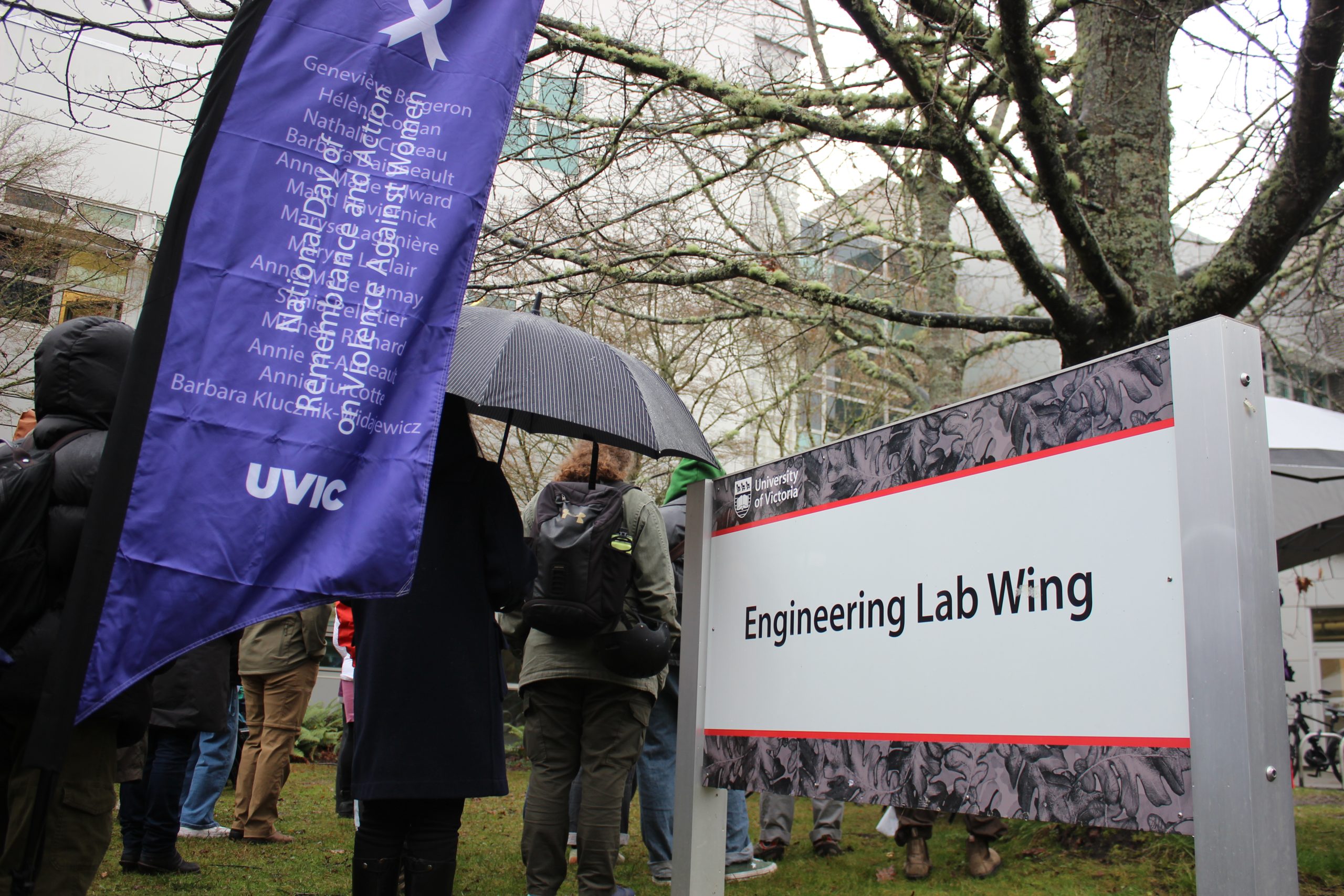
Photo by Sona Eidnani.
On Dec. 3, three days before the 36th anniversary of the École Polytechnique shooting, a small crowd congregated outside UVic’s Engineering Lab Wing (ELW) to commemorate the National Day of Remembrance and Action on Violence Against Women.
From 11:30 a.m. to 12:30 p.m., UVic’s Vice-President Academic and Provost, Dr. Elizabeth Croft, announced that classes would be cancelled for an event put on by the Department of Engineering and Computer Science (ECS) to honour the 14 women killed in an act of gender-based violence at École Polytechnique Montreal on Dec. 6, 1989.
Outside the ELW, students, staff, and supporters gathered for a series of speakers, followed by a silent walk around the university’s quad. Speakers included emcee Dr. Brad Buckham, Mechanical Engineering Chair; Elder Terri Barnhard, Dr. Elizabeth Croft, Dr. Mina Hoorfar, Dean of the Faculty of Engineering and Computer Science, Dr. Mary Sanseverino, a former Department of Computer Science faculty member, and Charli Harrold, a fourth-year computer science student.
Huddled outside the ELW in the rain, the speakers recalled memories of what they were doing on Dec. 6, 1989. They also spoke on the need to identify continued gender-based violence and oppression on campus, and the importance of supporting women in STEM.
After the first round of speakers, the audience followed organizer and Assistant Dean, Community and Culture, Jessica Vandenberghe, on a short, silent walk around the main area of campus, where volunteers stood holding signs with one of the victim’s names, as well as carrying a white rose. The white rose is used in ceremonies across Canada to commemorate the tragedy as a representation of the lost vitality and potential of the 14 women.
Vandenberghe sat down for a brief interview with the Martlet, sharing her reflections on the ceremony. “Today’s event was very moving; each of the speakers, they were moving to the point that I felt several times just like crying,” she said.
Following the walk and final speakers, Vandenberghe helped lead an optional sharing circle, where attendees could recall personal experiences of sexism and discrimination.
“To me, this day, when it comes to gender violence, is really important, because it does still exist” Vandenberghe said. “The truth is, today is also a day to commemorate action. It’s commitment and action, because we recognize that gender violence is still happening quite prominently around the world.”
Vandenberghe has been with UVic for almost three years, and has previously overseen similar community and culture initiatives during her time working at the University of Alberta. While she wasn’t able to remember exactly where she was on Dec. 6, 1989, she noted that the difference in news broadcasting almost four decades ago made information about the shooting less widely reached than the rapid spread of current events today might have.
Charli Harrold, the only student in the speaker line-up, spoke primarily on her experience being a female student in the field of computer science. In an interview with the Martlet, she described what it was like sharing the stage with older staff that afternoon, several of them who were around during the École Polytechnique shooting. “Seeing the emotion, I think, from a lot of the older women there … I saw how personal it was for so many of them, which I think was really impactful.”
In addition to finishing her honours degree in computer science and math, Harrold is the Vice President of UVic’s Women in Engineering and Computer Science club (WECS). Speaking with the Martlet, she shared a number of WECS initiatives, including workshops, community events, and skill development classes, that are available for students.
“It’s not all these crazy news headline things that happen, it’s a lot of day to day,” Harrold said, about sexism and gender-based oppression she had encountered during her time in clubs, classes, and the co-op program at UVic.
She recalled an experience of talking to a TA, and having another male student walk across the room to explain file opening to her. “I know how to do that, you know, things like that just [happen] all the time. That’s kind of why yesterday, I hoped to emphasize the less drastic forms of gender based violence.”
In addition to supporting more women in STEM, she hopes to see greater participation of men in solidarity of their female students and colleagues. “We need people to be willing to show up and to be a part of movements that are empowering women,” she said.
“Having a woman being the dean, having a lot of women in positions of power in the faculty, is really impactful. And I think that you can see yesterday, the women that were there — they’re cool, they [are] in charge of stuff,” she added.
Vandenberghe discussed several venues for reducing the prevalence of gender violence and oppression, including self awareness, empathy and support for others, and ensuring that individuals that perpetrate harmful behaviors are held accountable.
She mentioned that students at UVic can seek help from university staff — professors, department chairs, herself as the Assistant Dean, as well as a variety of outlets external to the Engineering and Computer Science Department, such as UVic’s Equity and Human Rights Office (EQHR).
“We can’t change other people’s behavior, but we can change our own so [we’re] conscious of our own biases, and making sure that we know when we are hurt, that we can seek out the care we need,” Vandenberghe said.
UVic has acknowledged commitment to the 30 by 30 initiative, a national endeavour to have 30 per cent of newly licensed engineers be women by 2030. As of 2022, according to UVic, women made up approximately 19 per cent of the UVic ECS student population.
While this figure shows improvement, female engineers still experience isolation and hostility in a male-dominated field. “It is kind of weird to walk into a room of 100 people, and there’s 10 women there,” Harrold said.
For Harrold, it’s more than just increasing the number of women in classes. It’s about ensuring the environment they enter into is safe, mentioning specifically the co-op program’s areas for improvement.
“Are co-op coordinators equipped to handle reports of discrimination or harassment … are women going to be disadvantaged if they report those things?” she asked. Whether it be equity training or having the proper resources and referrals on hand, she believes that there are specific, measurable steps that the university can engage in.
Despite the poor weather, staff, students, and volunteers from the ECS department worked tirelessly to put on an emotional, inspiring, and future-looking commemoration ceremony. “It takes a really large team of organizers plus volunteers to make an event like this happen. I do want to recognize that, even though the Faculty of Engineering and Computer Science [led] this, our volunteers and event planners are from many places around the university,” Vandenberghe said.
This is UVic’s second annual National Day of Remembrance and Action on Violence Against Women, and likely one of many more to come.
Vandenberghe’s biggest takeaway was her gratitude to the men and gender-diverse individuals that showed up in solidarity, stating that the support from men in these fields are integral to minimizing gender-based harms at UVic. “I do want to shout out to the men that come … little actions add up to a big impact.”
“We’re a collective, and we all need to go forward together. It’s not … women versus men