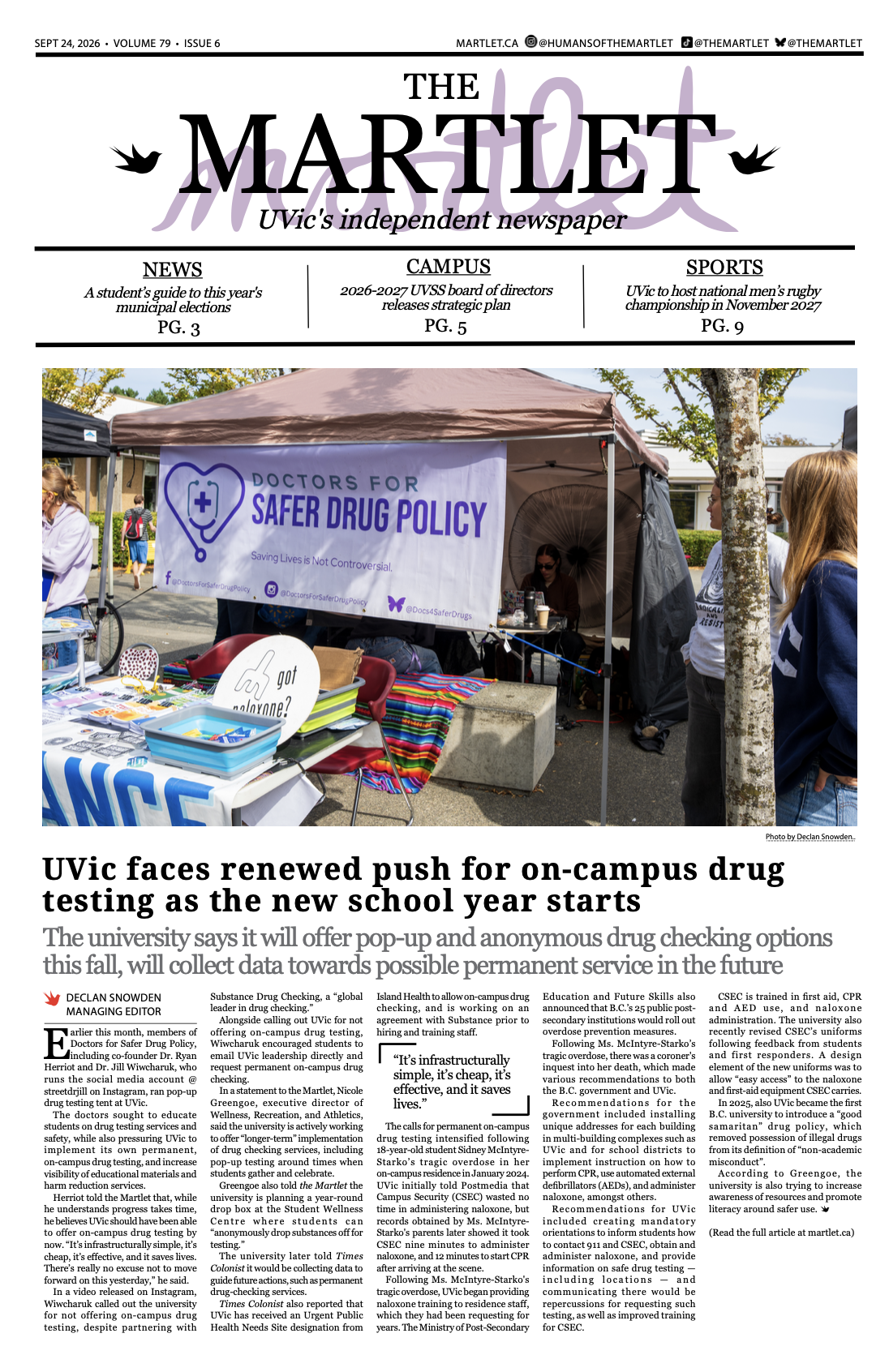

In the July 20 board meeting, directors passed a motion to expand hormone replacement therapy coverage under the UVSS Health Care Plan and delayed a motion to reestablish the University Relations Committee

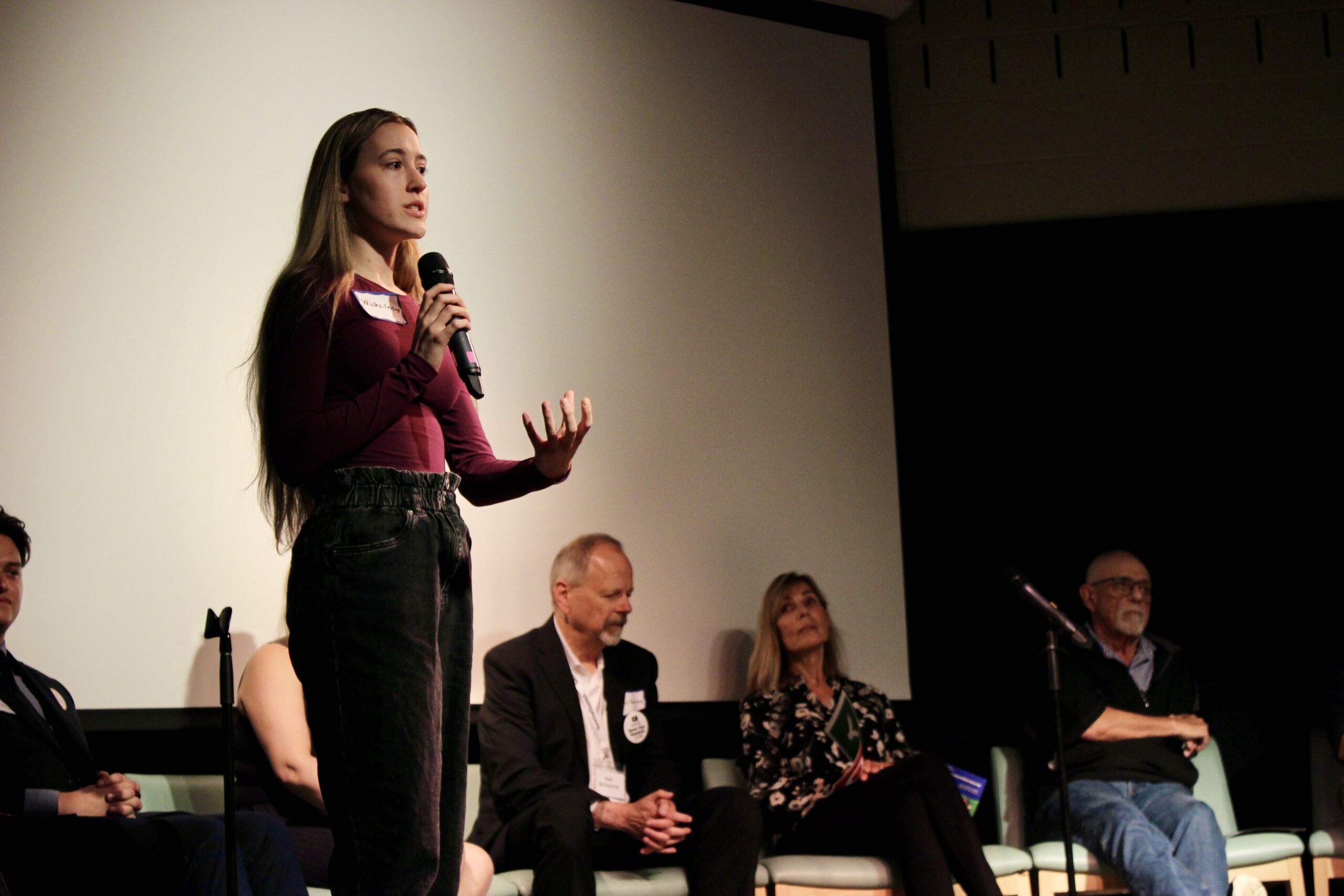
Photo by Belle White.
At its July 20 meeting, the UVSS Board of Directors spent much of the evening discussing motions to lobby for expanded hormone replacement therapy coverage under the UVSS Health Care Plan and include the issue in future advocacy efforts, re-establish the University Relations Committee, and use money from the Major Capital Fund to replace or purchase appliances for SUB businesses.
As always, the meeting started with a land acknowledgement. Matthew Allen Curtis, director of outreach and university relations, highlighted that his upbringing “was supported by a history that often sought to narrow the world to a single perspective,” and spoke on the value of having and listening to the diverse perspectives on the current UVSS board.
The meeting then turned to its first main motion, introduced by director at large Ame Sillars, to endorse injectable estradiol and testosterone pills, gels, and patches for hormone replacement therapy (HRT) to better support gender-affirming care for students. If passed, the motion would have the UVSS lobby for expanded HRT options under the UVSS Health and Dental Plan and include the issue in future advocacy efforts.
Sillars said an increasing number of transfeminine people are taking estrogen by injection as their preferred method of administration. Injectable estrogen can eliminate the need for both oral estrogen and anti-androgens (testosterone blockers), reducing strain on the liver.
However, Sillars said compounded hormone medications are generally not covered by Canadian pharmaceutical companies or the provincial Pharmacare program, with some exceptions. Because UVic is on a Pharmacare-shared health care plan, Sillars said, Pacific Blue Cross generally does not cover these medications.
For transmasculine people, only injectable testosterone is currently covered. However, Sillars said some struggle with needles, making alternative covered options beneficial for those who need them.
The proposed advocacy would include, but not be limited to, advocacy to the Pacific Blue Cross, GreenShield, pharmaceutical companies, and the B.C. government in support of expanded HRT coverage and production, as well as other student unions and student health-care plans to build coalition support.
One member of the meeting requested that voting for this motion go through a secret ballot with voting numbers being recorded, and the request was granted.
Several board members expressed their belief in the importance of this motion and the work that went into crafting it and consulting for it. UVSS advocacy groups, including the Gender Empowerment Centre, Pride Collective, the Native Student Union, the Society for Students with a Disability, and the Students of Colour Collective, all endorsed the motion.
The motion carried, with seven in favour, none against, and three abstaining.
The next motion, brought forward by Director of Events Mohan Selvarajan, proposed recreating the University Relations Committee. The committee has not been included in UVSS policy for several years, but supporters of the motion argue it is critical to ensuring undergraduate students have a unified voice across the committees and groups that represent them.
The motion proposed recreating the committee as outlined in this document, which states that its purpose is to develop lobbying strategies to represent and defend students’ interests to the university. Its duties include facilitating communication between the UVSS and student members of Senate, the Board of Governors, university departments, faculties, services, and committees, and providing resources to student representatives and board members so they can fully participate in their respective governing bodies and advance student interests.
Director at large Donovan Wood-Gaines raised the question of whether graduate students should be included on the committee by inviting a representative from the Graduate Student Society (GSS) to serve as a voting member.
Director at large Evan Maher responded to the suggestion, cautioning that graduate students have “voted in directions that are not in favour of the general student body,” citing the recent vote on the academic integrity policy as an example.
He also said some graduate student senators work for the university, and that he is concerned about letting these students into a committee that may discuss things that the university “might not appreciate.”
Maher suggested adding a clause requiring any graduate student voting member to be elected by the committee.
Board members then debated how graduate students could be involved in the committee, and whether it was appropriate to decide their participation based on assumptions about how they might vote.
Maher said there had been no consultation with student senators or Board of Governors representatives about the committee. He argued it was important to establish the committee first, and then discuss potential changes. Others argued that creating the committee without consultation would not set the committee up for success.
Curtis suggested that, rather than attempting to amend the policy during the meeting, the board either delay creating the committee and send the policy back to policy development, or approve the policy as written and revise it later.
Maher argued that delaying the committee’s creation would create problems. He said there are a number of issues the committee needs to be working on, including one affecting students with disabilities, which is expected to come before Senate in September.
“There’s actively a crisis with students with mental health and so the delay in creating the committee is actively harming students, and I think student senators recognize that,” he said.
The board ultimately voted to remove the motion from the agenda and bring it back as an e-motion after a policy development meeting on July 29.
The motion to defer passed with seven votes in favour, five opposed, and one abstention, delaying a decision on establishing the University Relations Committee. Logistics were discussed to allow student senators to attend the policy development meeting and provide comments online.
The meeting then moved to motions four through six, introduced by Mariah Luzon, director of finance & operations, to allocate up to $3 200 from the Major Capital Fund to replace the popcorn kettle at Munchie Bar, another $3 200 to replace the display cases at Munchie Bar, and $3 000 to purchase a new display fridge for SUBtext to expand its beverage offerings. All three motions had been recommended by the Finance Committee.
A board member asked what new beverages SUBtext planned to offer, and whether the display fridge would reduce space dedicated to student-made products. General Manager Dale Robertson said the new display would not take away from student art, and that additional space had been created after the magazine rack was removed due to poor sales.
Robertson said SUBtext has strong partnerships with Coca Cola, Red Bull, and Guayaki, which produces Yerba Mate, but would like to expand its beverage selection to include products such as bubble tea and kombucha.
Questions were also asked about the details of the Major Capital Fund, and Robertson said the fund is intended for revenue-generating projects. A document shared during the meeting showed the fund had a balance of $780 416 at the end of their fiscal year, April 30.
The board omnibused motions four through six and then approved them.
After the board completed its motions, more than an hour into the meeting, a recommendation was made to strike reports, given the time and that a meeting was held just last week. A motion to do so carried, and the board moved in camera.