
Select divisions of the Men’s and Women’s teams braved rain wind and sharp narrows for an annual Canada West gathering
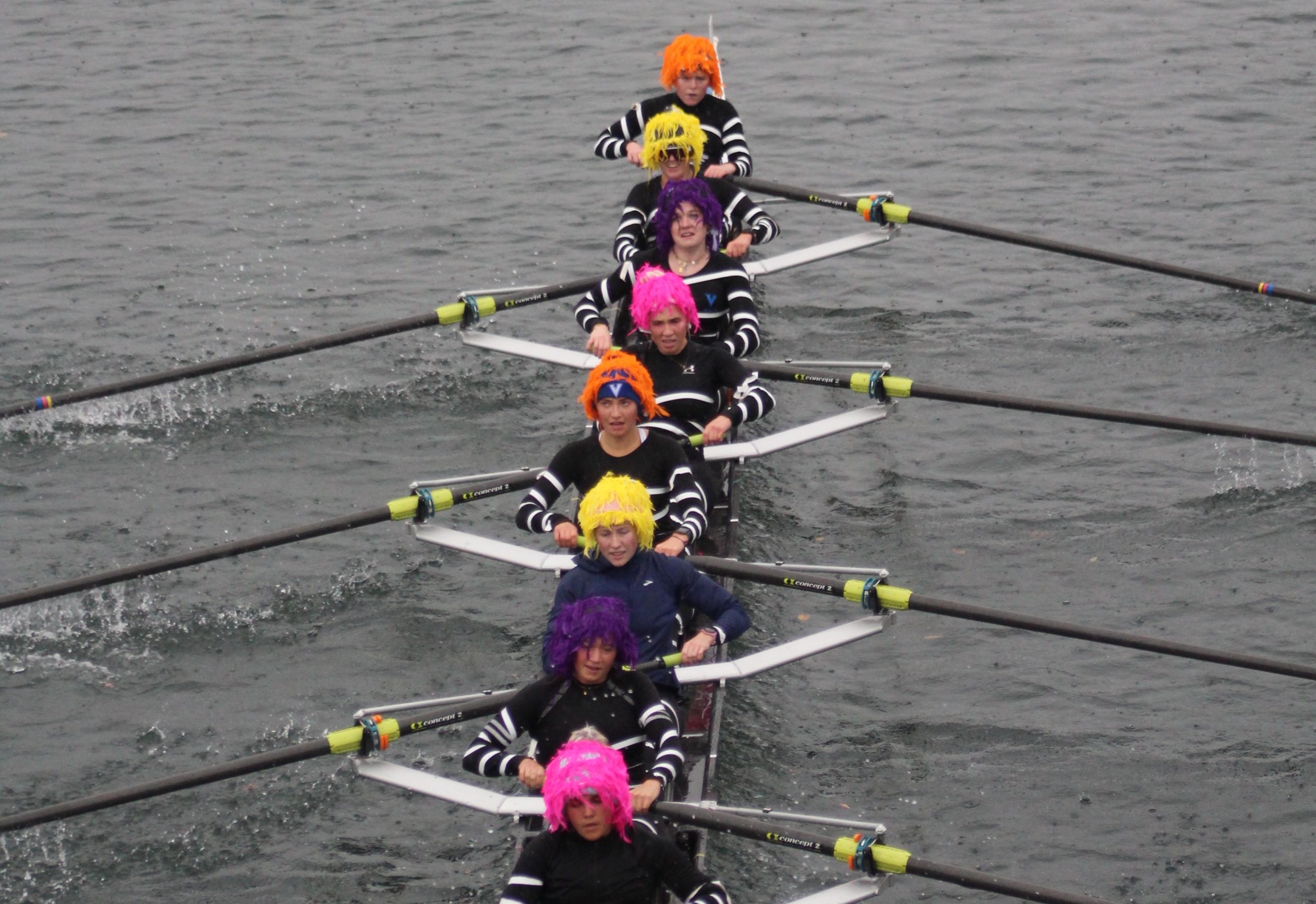
Photo courtesy of Paige Bateman.
The Vikes mens and womens rowing teams dressed in costume for a friendly competition on Oct. 18 as part of the Head and Tail of the Gorge Regattas.
The regatta began in 1978 and was hosted by UVic until 2022. The Gorge Narrows Rowing Club has hosted the event since. Saturday’s races launched as planned. However, events on Sunday, Oct. 19 were cancelled due to high winds and unsafe water conditions.
As the annual event occurs around Halloween, organizers hold a costume contest for all participants, and give out prizes between each race division. The Vikes won two divisions, the men’s open four coxed, dressed as the Incredibles featuring Edna Mode by their coxswain — the person who directs and steers the boat, and coordinates the power and rhythm of the rowers — as well as open women’s eight coxed, dressed as the Lorax and Truffula trees.
“The whole environment there is really fun,” said Olivia de Albuquerque, a second year coxswain with Vikes rowing; de Albuquerque was dressed as Cruella De Vil.
“It’s some people’s first race, so [they’re] always a little bit nervous, but it always makes it a little more exciting when you walk around and people are in crazy costumes … especially for spectators.”
The event draws participants from across B.C. and the Pacific Northwest. This year saw almost 300 entries across 21 clubs, including some from the United States, such as Corvallis Rowing Club from Oregon, and Sasquatch Scullers and Mill Town Rowing from Washington.
“The Head of the Gorge and Tail of the Gorge Regatta is recognized as one of the top 10 must-race events in North America, standing out as one of the most distinctive and anticipated competitions of the fall rowing season,” said Aalbert Van Schothorst, head coach of Vikes men’s rowing, in a written statement to the Martlet.
“For those who’ve never attended a regatta before, it’s a true spectacle with hundreds of athletes and shells gliding through the water in tight intervals, with crowds lining the shoreline to cheer as crews navigate the twists and turns of the Gorge Waterway from Johnson Street to Craigflower Park!”
Because of the unique features of the Gorge Waterway, the regattas are held as a head race, or a time-trial competition. Instead of racing side by side, crews raced against the clock, with the goal of having the fastest overall time with as few penalties as possible.
“The race winds through the Gorge Narrows, a tidal stretch of the channel known for its tight turns and shifting currents. Organizers must first shepherd the crews through the Tillicum Narrows against the incoming tide so they can turn around and race with it as it peaks. In the afternoon, the course reverses direction to match the outgoing tide, starting at Craigflower Park and finishing downtown at the Johnson Street Bridge,” said Van Schothorst.
Saturday of the weekend event is routinely a costume day, keeping the atmosphere and competition lighthearted. However, navigating the frigid waters of Gorge Inlet is less comfortable in costumes for some athletes, who would normally compete in leotards and toques.
“Our coxswain was the Lorax; she had the full orange suit and mustache and everything,” said Gracie Lorenson, a fifth-year rower with the junior varsity second team. “We all DIY’d our Truffula tree hair with bows and wrapped ourselves in tape. It was awesome.”
“You start the race where you launch, so you wet launch, which means you actually have to get in the water. You’re almost knee deep in the water that’s very cold this time of year. You’re not wearing many layers because you’ve got a costume on.”
“It’s cool to see how big the regatta has gotten,” said de Albuquerque. “Tillicum, where the boats were being stored, was so crowded. It’s insane how many people come out for this little regatta.”
Giancarlo DiPompeo, captain of the men’s rowing division, competed in the open men’s four coxed race. The crew won first place with an overall time of 11:52.35, beating the Vancouver Rowing Club by nearly two minutes.
“The narrows are a lot of fun because it’s like a slingshot,” said DiPompeo. “When the tide is flowing, it’s a lot of fun. It’s a weird feeling because you already feel like you’re completely out of control. It’s a defining feature of the race.”
Most years, the Vikes varsity teams do not enter the regatta, since it usually falls within a week of the Canadian University Rowing Championship. This year, however, there was roughly a two-week separation between the events, giving the Vikes men’s varsity a unique opportunity to join this community event.
“The energy for the varsity crew was to just go out and test what we’ve been working on in a race setting,” said DiPompeo. “It’s more of a friendly race, but it was still a lot of fun to keep things loose and have a bit of fun with the costumes.”
Other highlights of the day include UVic men’s finishing second and fourth in the open men’s eight coxed and first and second in the junior varsity men’s coxed division. They also placed second in the men’s masters eight coxed.
In the afternoon, the Vikes women’s team finished second and fourth in the open women’s eight coxed as well as first and third in the junior varsity open women’s eight. UVic also won first in the women’s open four coxless and second in the open women’s four featuring a coxswain.
“One of the things that I really enjoyed about this regatta is it’s the only one in our season that involves other age groups of Victoria’s rowing community,” said Sorenson. “It’s really awesome to be on the water with junior rowers, high school age rowers that could be future Vikes one day. On the flip side, we’ve also got masters rowers, some of whom are Vikes alumni. It’s cool to see all generations of rowers in our community come together.”
The event is traditionally a warm-up event for the Vikes before they go to the Canadian University Rowing Championships in November.
Both the men’s and the women’s team were able to secure three medals each at the Championships on Nov. 1 and 2, hosted by McGill University in Montreal, QC. Both teams finished third overall.
“It was a pretty tough weekend,” said DiPompeo. “Some good, some bad.”
In the women’s division, Kate Watson and Sai Sai Faubert won silver in the lightweight double scull. Watson, as well as Sophia Regosa, Zoe Scogna, Elena Masyte, and Sadie Green, secured bronze in the lightweight four sculls. Pepper Howe won bronze in the single sculls.
DiPompeo captured a gold medal in the lightweight men’s single race as well as bronze in the lightweight double scull with teammate Oliver Howard-Batek.
“I’m of course happy to be taking the lightweight single…. And in the double we had an extremely good race,” said DiPompeo. “It came down to the line in a good sprint, and so we left it out there.
“I think that was going to be anyone’s race. It was nice to finish off on the podium with Oliver. Him and I are both graduating athletes.
The men’s lightweight eight boat also secured a silver medal.
“[For the heavyweight] it’s the youngest boat we’ve had in a long time,” said Gabe Dyer, a member of the men’s lightweight eight boat. “That’s exciting to be part of that as a younger guy with three years left, building on the momentum.”
“When you have guys that are competitive for the next level that’s really important,” said DiPompeo. “It’s my last year and stepping away from the team knowing there’s a lot of young forward looking, ambitious guys is pretty cool.”
The Vikes will return to racing in spring 2026. Their main event is The Brown Cup, which takes place on April 5 in Victoria’s Gorge Waterway and features a head-to-head race against University of British Columbia.